Spec Home vs To-Be-Built: Which Works Better for JBSA Timelines and Report Dates?
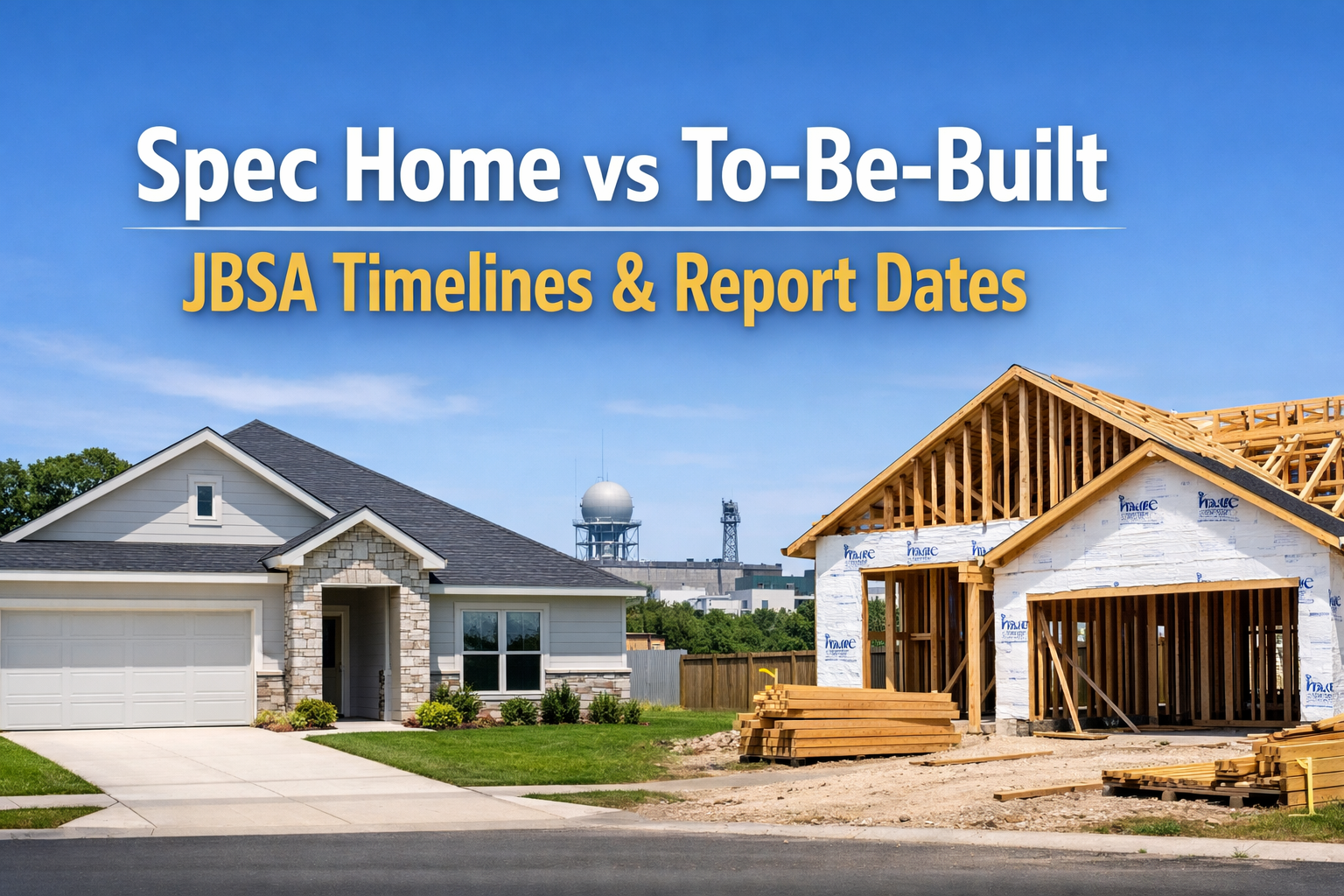
Military families relocating to San Antonio often face a unique challenge that civilian buyers rarely encounter. The purchase decision is not driven solely by price, features, or neighborhood preference. It is driven by orders, report dates, temporary lodging limits, and VA loan timing. For families PCSing to Joint Base San Antonio, choosing between a spec home and a to-be-built home can determine whether a move feels smooth or becomes stressful. Tami Price, REALTOR®, a San Antonio real estate agent and Air Force Veteran, works with military buyers navigating these decisions every day, and with nearly two decades of experience and firsthand knowledge of PCS moves, she helps buyers evaluate construction timelines realistically rather than optimistically.
This guide breaks down how spec homes and to-be-built homes compare for JBSA relocations, VA loan buyers, and families managing firm report dates.
This is also the perfect time to confirm your true outofpocket costs with the breakdown of the VA funding fee and cash needed for JBSA buyers in 2026.
What Are the Timeline Constraints for JBSA Relocations?
Joint Base San Antonio includes multiple installations with varying PCS flows, including Fort Sam Houston, Lackland Air Force Base, and Randolph Air Force Base. While each base serves a different mission, PCS timelines share common constraints that affect housing decisions significantly.
Orders often arrive with limited lead time between notification and report date. Report dates are fixed and non-negotiable without administrative burden that service members typically cannot afford. Temporary lodging allowances are capped at specific daily rates and duration limits. VA loans require specific appraisal and closing timelines that cannot be compressed to match construction schedules.
Because of these constraints, construction delays or misaligned expectations can create housing gaps that are costly and stressful. Understanding the difference between spec homes and to-be-built homes becomes critical before making purchase decisions that affect family stability during military transitions.
Q: How much notice do military families typically have between PCS orders and report dates?
A: Most PCS orders provide 30 to 90 days notice, though some situations allow less time. This compressed timeline makes spec homes with near-term closing dates more viable than to-be-built homes requiring 6 to 12 months of construction time that exceeds typical PCS notification periods.
When you hit the ‘get preapproved’ milestone, switch over to the stepbystep VA homebuying guide for JBSA families and follow it down the page.
What Defines a Spec Home in San Antonio's Market?
A spec home, short for speculative home, is a newly constructed house that a builder has already started or completed without a specific buyer under contract. These homes are built based on market demand and are typically located in established new construction communities throughout San Antonio including areas near JBSA installations.
Key characteristics of spec homes include construction that is complete or near completion requiring only final inspections and utility connections, floor plans, elevations, and finishes that are already selected by the builder, closing timelines that are shorter and more predictable typically ranging from 30 to 90 days, and builder incentives that are often stronger on inventory homes because builders want to move completed units before quarter end.
For military families with firm report dates and limited temporary lodging flexibility, these characteristics provide certainty that to-be-built options cannot match. Spec homes eliminate the primary risk factor that complicates military purchases: timeline unpredictability that creates housing gaps between arrival and move-in availability. Inventory homes near JBSA for faster closings
To keep your loan process aligned with your orders, use the 90–120day PCS to JBSA timeline as a planning checklist.
What Does To-Be-Built Mean for Military Buyers?
A to-be-built home is one that has not started construction or is in the early stages when the buyer contracts. The buyer selects the lot, floor plan, and many design elements before construction begins, offering customization opportunities that spec homes do not provide.
Key characteristics of to-be-built homes include construction that begins after contract execution creating longer overall timelines, buyers selecting finishes through design centers and sometimes making structural modifications, build timelines that range from six to twelve months or longer depending on complexity and market conditions, and delays that are common due to labor availability, material supply chain issues, weather, or inspection scheduling.
For PCS buyers with firm report dates, the timeline risk represents the most important factor to evaluate. Even when builders provide estimated completion dates, those estimates frequently extend beyond original projections, creating situations where military families arrive at their new duty station months before their home is ready for occupancy.
Q: Can builders guarantee completion dates for military buyers with PCS orders?
A: No. While builders provide estimated completion timeframes, these are projections rather than guarantees. Construction contracts typically include language protecting builders from liability for delays, meaning military buyers absorb the risk and cost of extended temporary housing if builds extend beyond report dates.
How Do Spec Home and To-Be-Built Timelines Compare?
Understanding realistic timelines for each construction option helps military buyers make informed decisions that align with PCS schedules and avoid expensive housing gaps.
Spec Home Timelines
Spec homes typically close within 30 to 90 days depending on construction status and lender readiness. For military buyers, this timeline aligns well with known report dates, temporary lodging expiration limits, school enrollment timing for families with children, and household goods delivery coordination that requires firm move-in dates.
Spec homes provide a clearer path from contract to keys, which reduces the risk of needing extended temporary housing or bridge solutions that deplete savings and create stress during already complex military transitions.
To-Be-Built Timelines
To-be-built homes are subject to construction schedules that can change due to factors outside buyer or builder control. Weather delays, inspection scheduling challenges, labor shortages, and supply chain issues can push completion dates weeks or months beyond original estimates provided at contract signing.
For buyers without flexibility in their report date, construction delays create gaps between arrival and move-in, additional out-of-pocket lodging costs that exceed temporary lodging allowance limits, storage and moving complications when household goods arrive before homes are ready, and family stress managing transitions without stable housing.
Real estate agents advise military clients to assume that build timelines may extend beyond initial projections by 30 to 60 days and to plan contingencies accordingly rather than relying on best-case completion scenarios.
If you’re eyeing new construction, review the spec vs tobebuilt timelines for JBSA military buyers before you sign a contract.
What VA Loan Considerations Differ Between Spec and To-Be-Built Homes?
VA loans are an excellent benefit for military buyers, but they come with specific requirements that interact differently with spec homes and to-be-built homes.
VA Loans and Spec Homes
Spec homes are generally easier for VA financing because the home is complete or near completion allowing immediate appraisal scheduling, appraisals can be ordered promptly without waiting for construction milestones, and closing dates are easier to coordinate within the 30 to 45 day window typical for VA loan processing. This makes spec homes a strong fit for VA buyers who need certainty and predictable closing timelines that align with PCS schedules.
VA Loans and To-Be-Built Homes
VA loans can be used for new construction, but the process is more complex and not all builders accept VA construction contracts due to additional requirements. Challenges include appraisal timing restrictions requiring substantial completion before VA appraisers can inspect, construction phase inspections that some builders resist, and lender requirements that vary by builder and may include additional documentation or approval steps.
These factors can extend timelines and increase complexity for PCS buyers who already face tight schedules and limited flexibility for addressing complications that arise during construction periods.
Q: Do all San Antonio builders accept VA loans for to-be-built homes?
A: No. Some builders prefer conventional or cash buyers for to-be-built homes due to VA appraisal timing requirements and construction phase inspection coordination. Military buyers should verify VA acceptance before falling in love with specific builders or communities to avoid disappointment after investing time in design selections.
How Do Builder Incentives Differ Between Spec and To-Be-Built Homes?
Pricing and incentive structures vary significantly between spec inventory and to-be-built contracts, affecting overall affordability and cash-to-close requirements for military buyers.
Spec Home Incentives
Builders often offer their strongest incentives on spec homes because they want to move completed inventory before incurring additional carrying costs. These incentives may include interest rate buydowns that reduce monthly payments significantly, closing cost assistance covering lender fees and prepaids, upgrade credits for appliances or other selections, and flexibility on close dates to accommodate military timelines.
For military families managing relocation expenses and establishing new households, these incentives can significantly reduce monthly payments or cash requirements at closing, making homeownership more accessible during expensive transition periods.
To-Be-Built Pricing
To-be-built homes often start at lower base prices in builder marketing, but upgrades add up quickly as buyers make selections through design centers. Final prices frequently exceed comparable spec homes once buyers add desired finishes, appliances, flooring, and structural modifications. Additionally, incentives on to-be-built homes are often smaller or structured differently than spec inventory promotions.
Buyers should calculate total cost including all selections before comparing to spec home pricing to understand true value rather than focusing only on advertised base prices that do not reflect move-in-ready costs.
Should Military Buyers Prioritize Customization or Certainty?
One of the biggest emotional differences between these options involves customization opportunities versus timeline certainty, each appealing to different buyer priorities and circumstances.
Customization Benefits of To-Be-Built
To-be-built homes offer personalized finishes selected through design centers, structural options such as extended patios, additional rooms, or layout modifications, and the emotional satisfaction of designing a new home from the ground up according to family preferences and needs.
Certainty Benefits of Spec Homes
Spec homes provide what-you-see-is-what-you-get clarity without surprises during selection processes, no unexpected upgrade costs that exceed initial budgets, predictable completion and closing timelines that align with military report dates, and immediate visualization of the actual home rather than relying on renderings or model homes.
For military families facing firm timelines and transition stress, certainty often outweighs customization benefits, especially when timelines are tight and housing gaps could create expensive complications or family instability during PCS moves.
Q: Can spec homes be customized at all, or are buyers locked into builder selections?
A: Spec homes are essentially complete with finishes already selected. Some builders allow minor modifications like paint colors or appliance upgrades if timing permits, but major customization is not possible. Buyers should view spec homes as move-in-ready inventory with fixed features rather than customizable projects.
When Do Spec Homes Make More Sense for JBSA Families?
Spec homes tend to work better when military families face specific timeline or logistical constraints that make construction risk untenable.
Spec homes provide advantages when report dates are within six months of beginning the home search, temporary lodging allowances are limited and extended stays would create financial burden, a spouse or family member is moving separately requiring coordinated housing availability, school enrollment timing matters for children's educational continuity, or families want to avoid managing construction oversight while settling into new duty stations.
In these scenarios, the reduced risk of delays and timeline predictability can prevent unnecessary stress, out-of-pocket costs, and complications that affect family stability during already complex military transitions to San Antonio.
If you’re eyeing new construction, review the spec vs tobebuilt timelines for JBSA military buyers before you sign a contract.
When Can To-Be-Built Homes Work for Military Buyers?
To-be-built homes may still be viable options when military families have specific circumstances that provide flexibility for longer construction timelines and associated risks.
To-be-built homes can work when orders arrive well in advance providing 9 to 12 months or more before report dates, the family has housing flexibility through extended lease options or base housing at current locations, the buyer is staying at the same duty station long-term rather than facing near-term PCS timing, or customization is a high priority that justifies accepting timeline uncertainty and potential delays.
Even in these cases, real estate agents encourage buyers to build contingency plans into their timelines including backup housing options if construction extends, financial reserves for temporary lodging beyond allowances, and flexibility in household goods delivery schedules that accommodate changing completion dates.
What San Antonio Locations Offer More Spec Home Inventory?
San Antonio offers a wide range of new construction communities near JBSA installations, with some areas featuring more spec inventory while others focus heavily on to-be-built options.
Areas with typically higher spec home availability include western Bexar County near Lackland Air Force Base, Schertz and Cibolo near Randolph Air Force Base, and expanding corridors along Loop 1604 and Highway 90 where multiple builders maintain inventory homes.
Understanding which communities offer move-in-ready homes versus longer build timelines is an important part of the decision-making process for military families with fixed report dates. This is where working with a local real estate agent who tracks builder inventory weekly makes a significant difference in identifying viable options quickly.
What Common Mistakes Should Military Buyers Avoid?
Military buyers often encounter challenges when they make assumptions about construction timelines or builder processes without verifying details that affect PCS coordination.
Common mistakes include assuming build timelines are guaranteed rather than estimates subject to delays, not confirming VA acceptance before contracting with builders or investing time in design selections, underestimating temporary housing costs that accumulate when construction extends beyond report dates, and over-customizing without understanding resale impact or budget implications that exceed initial affordability assessments.
Real estate agents help buyers avoid these pitfalls by walking through realistic timelines and cost scenarios before decisions are made, ensuring families understand risks and contingencies rather than proceeding based on optimistic assumptions that may not materialize.
Expert Insight from Tami Price, REALTOR®
Tami Price, REALTOR®, is a San Antonio-based real estate professional and Air Force Veteran with nearly two decades of experience representing military families through new construction purchases. With approximately 1,000 closed transactions and recognition as a RealTrends Verified Top Agent and 15-time Five Star Professional Award winner, she specializes in helping JBSA families navigate spec home versus to-be-built decisions.
"The number one mistake I see military buyers make is falling in love with customization possibilities without honestly evaluating whether their PCS timeline can absorb construction delays," Tami explains. "Builders provide estimated completion dates, but those are best-case scenarios. Reality often involves weather delays, inspection scheduling challenges, or supply chain issues that push completion weeks or months beyond original projections."
Tami emphasizes that spec homes provide critical certainty for most military buyers. "When families have firm report dates and limited temporary lodging budgets, spec homes eliminate the primary risk that creates housing gaps and unexpected costs. Yes, you give up some customization, but you gain predictability that matters enormously when you're coordinating PCS logistics, household goods delivery, and family transitions. For most military buyers, that trade-off strongly favors spec homes unless their situation genuinely allows 12-plus months of flexibility."
Three Key Takeaways
1. Spec Homes Provide Timeline Certainty That Aligns With Fixed Military Report Dates
Spec homes with 30 to 90 day closing timelines match typical PCS notification periods and temporary lodging allowance durations, eliminating the primary risk factor that complicates military purchases: construction delays creating housing gaps between arrival and move-in availability. Military families benefit from predictable timelines that allow coordinated household goods delivery, school enrollment, and family transitions without extended temporary housing costs that exceed allowances. While spec homes sacrifice customization opportunities, the timeline certainty they provide matters significantly more for families facing non-negotiable report dates and limited flexibility for managing construction delays.
2. To-Be-Built Homes Require 9 to 12 Months Timeline Flexibility That Most PCS Moves Cannot Accommodate
Construction timelines of six to twelve months for to-be-built homes exceed typical PCS notification periods, and delays extending completion 30 to 60 days beyond estimates occur frequently due to weather, inspections, labor, and supply chain factors outside buyer or builder control. Military buyers choosing to-be-built options must plan contingencies including backup temporary housing, financial reserves beyond temporary lodging allowances, and flexible household goods delivery that accommodates changing completion dates. Customization benefits of designing from the ground up appeal emotionally but create practical challenges for families with firm duty station report dates and limited tolerance for housing uncertainty during military transitions.
3. Builder Incentives on Spec Homes Often Provide Better Total Value Than Lower Base Prices on To-Be-Built Options
Spec home incentives including rate buydowns, closing cost assistance, and upgrade credits frequently provide better total value than to-be-built base prices that appear lower but accumulate significant costs through design center selections and structural modifications. Military buyers should calculate total cost to completion including all selections, upgrades, and finishes before comparing options, as final to-be-built prices commonly exceed comparable spec homes once buyers add desired features. Strong spec home incentives also reduce cash-to-close requirements and monthly payments during expensive relocation periods when military families are establishing households and managing transition costs at new duty stations.
Frequently Asked Questions
Q. How long does it take to close on a spec home versus starting a to-be-built home?
A. Spec homes typically close within 30 to 90 days from contract depending on completion status and lender processing. To-be-built homes require 6 to 12 months or more from contract to closing, with construction beginning after buyer selections are finalized through design centers.
Q. Can military buyers negotiate better prices on spec homes that have been sitting as inventory?
A. Yes. Spec homes that have been completed for extended periods may offer negotiation opportunities, particularly approaching quarter-end when builders want to move inventory. Military buyers with flexible closing dates can leverage this timing for better pricing or incentives.
Q. What happens if a to-be-built home is not ready by a military buyer's report date?
A. Buyers must extend temporary lodging at their own expense beyond temporary lodging allowance limits, arrange storage for household goods if they arrive before home completion, and coordinate delayed move-in while managing duty station responsibilities. These complications create financial burden and family stress during transitions.
Q. Do spec homes qualify for the same VA loan benefits as to-be-built homes?
A. Yes. VA loan benefits including zero down payment and no PMI apply equally to both spec homes and to-be-built homes. The difference lies in process complexity and timeline predictability rather than loan benefits or qualification requirements.
Q. Can military buyers back out of to-be-built contracts if they receive unexpected PCS orders?
A. Contract terms vary by builder. Most new construction contracts include buyer deposit at risk if terminating without qualifying contingency. Military clause provisions exist in some contracts but are not universal. Buyers should review contract language carefully before signing to understand termination rights and deposit refund conditions.
Q. Are spec homes more expensive than to-be-built homes?
A. Not necessarily. While to-be-built homes advertise lower base prices, final costs after design center selections often exceed spec homes. Spec homes also typically include stronger builder incentives that reduce net cost and monthly payments compared to to-be-built final pricing.
Q. What San Antonio areas near JBSA have the most spec home inventory?
A. Western Bexar County near Lackland, Schertz and Cibolo near Randolph, and corridors along Loop 1604 and Highway 90 typically maintain higher spec inventory. However, availability fluctuates, making local real estate agent guidance valuable for identifying current options that match military timelines.
Q. Should military buyers only consider spec homes, or can to-be-built ever make sense?
A. Spec homes work better for most military buyers with firm PCS timelines. To-be-built homes can make sense for families with 12-plus months before report dates, extended flexibility, or long-term assignment stability that justifies accepting construction timeline risks for customization benefits they genuinely value.
The Bottom Line
For most JBSA military families with firm report dates, spec homes offer greater certainty, smoother VA loan coordination, and fewer timeline risks that create housing gaps and unexpected costs during PCS transitions. To-be-built homes can work in specific situations where families have genuine timeline flexibility exceeding nine to twelve months, but they require contingency planning, financial reserves for potential delays, and careful builder selection.
The right choice depends on PCS orders, timeline flexibility, financial reserves for managing construction uncertainty, and whether customization benefits justify accepting timeline risks that could complicate military transitions. Working with an experienced local real estate agent who understands military relocation ensures that the decision supports both the mission and the move rather than creating avoidable stress during already complex duty station changes.

Contact Tami Price, REALTOR® | San Antonio, TX
Whether you're PCSing to Joint Base San Antonio, evaluating spec homes versus to-be-built options, or coordinating new construction with military timelines, Tami Price provides experienced representation focused on military buyer needs and PCS coordination.
📞 210 620 6681
Tami Price's Specialties
- Buyer and Seller Representation
- Military Relocations and PCS Moves
- VA Loan Guidance and Assumptions
- New Construction
- First-Time Home Buyers
- Move-Up Buyers
- Downsizing and Rightsizing
- Strategic Pricing and Market Analysis
- San Antonio, Schertz, Cibolo, Helotes, Converse, and Boerne
Disclaimer
This blog is for informational purposes only and does not constitute legal, financial, or real estate advice. Market conditions change, and individual circumstances vary. Readers should consult qualified professionals before making real estate decisions. Tami Price, REALTOR®, is licensed in Texas and affiliated with Real Broker, LLC. Fair Housing principles apply to all content.
Categories
- All Blogs (642)
- Home Buying (21)
- Neighborhood Guides (41)
- 10 Incentive and Rate Buydown Questions (1)
- 10 Military Neighborhood (1)
- 10 Mistakes Sellers Make (1)
- 10 Strategies to Coordinate a Same Day Close (1)
- 12 Lifestyle Questions to Move In (1)
- 12 PCS What Ifs (1)
- 12 Photos and Marketing Assets (1)
- 13 PCS Hunting Trip Tips (1)
- 14 Design Center Decisions (1)
- 15 Red Flags Touring Home in San Antonio (1)
- 2026 Market (1)
- 30 days after closing your home (1)
- 7 Offer Terms Beyond Price (1)
- 7 VA Specific Questions (1)
- 78015 Ranked One (1)
- 8 Bridge (1)
- 8 Myths Buyers Believe about Down Payments (1)
- 8 Reasons VA Buyers Love New Construction (1)
- 9 Mistakes Move Up Buyers Make (1)
- 9 Questions to Decide If You Keep Your PCS Home (1)
- 9 Timeline Questions Every Buyer Need to Ask (1)
- 9 Warranty Questions to Ask (1)
- 9 Ways to Attract VA & Military Buyers (1)
- 90 days before your move (1)
- About Tami Price (6)
- Active Adult Homes (1)
- Affordable Communities (2)
- Affordable Homes (1)
- Affordable Housing & Community Development (3)
- Agent Qualifications and Credentials (1)
- Agent Qualifications and Experience (1)
- Agent Recognition (3)
- Agent Selection (1)
- AI and Real Estate Tools (1)
- Alamo Heights (4)
- Alamo Heights ISD (1)
- Alamo Ranch (2)
- Amenities in Helotes, Texas (3)
- Appraisals (1)
- Arts and Culture (1)
- Awards and Recognition (7)
- Balcones Creek (1)
- Best Neighborhoods to Live in Cibolo, TX (3)
- Best Neighborhoods to Live in San Antonio (15)
- Best Places to Live in Northeast Inner Loop: A Neighborhood Guide (1)
- Bexar County Property Tax (1)
- Bexar County Real Estate (3)
- Blue Tape Walkthrough (1)
- Boerne Home Sellers (1)
- Boerne Texas (4)
- Builder Contracts & Warranties (3)
- Builder Incentives (1)
- Builder Warranties (1)
- Buyer (64)
- Buyer Activity San Antonio (1)
- Buyer and Seller Guidance (3)
- Buyer Due Diligence (1)
- Buyer Education (45)
- Buyer Guide (9)
- Buyer Guides (7)
- Buyer Protection Strategies (1)
- Buyer Representation (1)
- Buyer Representation Expertise (1)
- Buyer Resources (91)
- Buyer Strategy (2)
- Buyers (13)
- Buyers Agent (1)
- Buying a Foreclosed Home in San Antonio (10)
- Buying a Home (4)
- Buying a Home in San Antonio (6)
- Buying Near JBSA (1)
- Buying Timeline (1)
- Buying vs Renting (1)
- Castroville, TX (8)
- Central Texas Growth (1)
- Choosing a Real Estate Agent (1)
- Choosing an Agent (1)
- Cibolo Communities (1)
- Cibolo Home Sellers (1)
- Cibolo TX (12)
- Client Reviews and Testimonials (1)
- Client Satisfaction (1)
- Client Stories (1)
- Client Testimonial (4)
- Clients review (4)
- Closing (1)
- Cobblestone (1)
- Comal County (1)
- Commercial & Retail Development (2)
- Commercial Development (1)
- Community (1)
- Community Development (2)
- Community Development and Real Estate (1)
- Community Guides (1)
- Community Investment Impact (1)
- Community Spotlights (1)
- Commuter Neighborhoods (1)
- Cons of Living in Helotes, TX (4)
- Conservation Communities (1)
- Contingency Questions (1)
- Converse Home Sellers (1)
- Converse Homes For Sale (3)
- Converse Real Estate (1)
- Converse TX (10)
- Cost of Living Guides (1)
- Cost of Living in San Antonio TX (23)
- Custom Homes (5)
- Davis Ranch (1)
- Days on Market (1)
- Down Payment Assistance (1)
- Downtown Revitalization (1)
- Downtown San Antonio (2)
- Dual Military (1)
- East Side Living (1)
- Economic Development (1)
- Education, Texas Hill Country (1)
- Emerald Pointe (1)
- Employment (1)
- Employment Corridors (1)
- Encino Forest (1)
- Equity and Pricing Strategy (2)
- Equity Q&A (1)
- Established Communities (3)
- Events in San Antonio (34)
- Expert Advice from Tami Price, Realtor® (7)
- Fair Oak Ranch (1)
- Family Homes (3)
- FAQ (1)
- Far Northwest San Antonio (1)
- Far West San Antonio (1)
- Farmer Markets in San Antonio (1)
- Fastest Growing Zip Codes in America (1)
- Featured Homes for Sale (2)
- Featured Properties (1)
- Final Walkthrough (1)
- Financial Planning (11)
- Financing Strategy (1)
- First Time Buyers (23)
- First Time Sellers (1)
- First-Time Buyers (6)
- First-Time Homebuyer Resources (4)
- First-Time Homebuyer Tips (2)
- First-Time Homebuyers (6)
- First-Time Investors (1)
- Fort Sam Houston (3)
- Fort Sam Houston Real Estate (1)
- Fort Sam Houston, TX (2)
- Fox Grove (1)
- FSBO vs Agent Representation (1)
- Future Rental (1)
- Gated Communities (5)
- Golf Communities (1)
- Great Northwest (1)
- Greater San Antonio Housing Trends (2)
- Greater San Antonio Real Estate (5)
- Growth and Development (11)
- HELOC (1)
- Helotes Home Sellers (1)
- Hill Country (1)
- Hill Country Communities (2)
- Hill Country Development (1)
- Hill Country Homes for Sale (1)
- Hill Country Real Estate (2)
- Hill Country Retreat (1)
- Historic Districts (5)
- Historic Neighborhoods (4)
- Holiday Guide (1)
- Home Buying (7)
- Home Buying Education (3)
- Home Buying Guide (7)
- Home Buying Process (8)
- Home Buying Strategy (2)
- Home Buying Tips (5)
- Home Energy Efficiency San Antonio (5)
- Home Financing (3)
- Home Improvement ROI (1)
- Home Inspections (3)
- Home Maintenance (1)
- Home Preparation (2)
- Home Pricing Strategy (14)
- Home Renovation for Resale (1)
- Home Selling (12)
- Home Selling Guide (12)
- Home Selling Strategies (3)
- Home Selling Strategy (3)
- Home Selling Tips (23)
- Home Staging and Updates (2)
- Home Values (2)
- Homebuyer Education (15)
- Homebuyer Resources (1)
- Homebuying Guide (1)
- Homebuying Tips (3)
- Homeowner (32)
- Homeowner Tax Benefits (1)
- Homeownership Costs (1)
- Homes for Sale (2)
- Homes for sale near Lackland AFB (2)
- Homestead amenities (1)
- Horizon Pointe (1)
- House Hunting Guide (1)
- Housing Development (1)
- Housing Market Updates (3)
- How to Buy a House in San Antonio TX (43)
- Hunters Ranch (1)
- Hybrid (1)
- In Person (1)
- Incorporated Cities (6)
- Industry News (2)
- Industry Recognition (1)
- Infrastructure & Growth Projects (2)
- Interest Rates (2)
- Invest in San Antonio (32)
- Investment Opportunities (1)
- Investment Property San Antonio (3)
- JBSA (8)
- JBSA Housing (11)
- JBSA Real Estate (2)
- JBSA Resources (7)
- Joint Base San Antonio (4)
- Joint Base San Antonio Housing (1)
- Judson ISD (2)
- Lackland AFB (5)
- Lackland AFB Housing (1)
- Land Use Planning (1)
- Lera MLS (15)
- Lifestyle & Community Growth (2)
- Lifestyle & Local Growth (1)
- Lifestyle Communities (1)
- Listing Preparation (1)
- Listing Strategy (1)
- Live Oak (1)
- Living in San Antonio, TX (44)
- Living Near Randolph AFB (5)
- Loan Programs (1)
- Local Development News (2)
- Local Market Insights (4)
- Local News Around San Antonio (1)
- Luxury Communities (3)
- Luxury Homes (4)
- Luxury Real Estate (2)
- MacArthur Park (1)
- Making Offers on Homes (1)
- Market Analysis (24)
- Market Conditions (47)
- Market Expertise (1)
- Market Insights (5)
- Market Strategy (2)
- Market Timing (2)
- Market Trends (6)
- Market Trends & Insights (2)
- Market Update (17)
- Market Update 2026 (1)
- Market Updates (16)
- Master Planned Communities (12)
- Medical Center Area Real Estate (1)
- Medina Valley ISD (2)
- Midtown Living (1)
- Military & Economic Impact (3)
- Military Buyers (3)
- Military Communities (1)
- Military Families (1)
- Military Family Resources (1)
- Military Homebuying (3)
- Military Homeownership (1)
- Military Housing (2)
- Military Housing Market in Texas (14)
- Military Life in San Antonio (2)
- Military Neighborhoods (1)
- Military PCS Relocations (3)
- Military Real Estate (2)
- Military Relocation (99)
- Military Relocation & VA Loans (10)
- Military Relocation San Antonio (4)
- Military Relocation Services (3)
- Military Relocation to San Antonio (46)
- Military Relocations (18)
- Military Relocations & VA Home Loans (5)
- MLS Accuracy & Data Transparency (1)
- Mortgage Programs (1)
- Mothers Day in San Antonio (1)
- Move to Boerne TX (15)
- Move to Castroville TX (9)
- Move to Converse TX (14)
- Move to New Braunfels (1)
- Move to North San Antonio (16)
- Move to San Antonio TX (64)
- Move to Selma TX (17)
- Move to Shertz TX (10)
- Move to Texas (45)
- Move Up Buyer Resources (1)
- Move Up Buyers (24)
- Move-In Ready Homes (2)
- Move-In Ready Homes San Antonio (2)
- Move-Up Buyers (2)
- Moving to Helotes, TX (14)
- Moving to San Antonio (61)
- MUD Taxes (1)
- Natalia Homes For Sale (1)
- Near East Side Living (1)
- Negotiation Strategy (2)
- Neighborhood Amenities (1)
- Neighborhood Guides (7)
- Neighborhood Spotlights (3)
- Neighborhoods near Randolph AFB (9)
- New Braunfels (4)
- New Braunfels Homes For Sale (1)
- New Braunfels News (2)
- New Braunfels Real Estate (2)
- New Construction (62)
- New Construction Communities (1)
- New Construction Homes (12)
- New Construction Homes San Antonio (5)
- New Construction vs Resale (2)
- New Construction Without Customization (1)
- New Construction Without the Wait (1)
- New Contruction Cost (1)
- New Listing (12)
- News (21)
- News & updates (23)
- No City Tax (1)
- No HOA Homes (1)
- North Central San Antonio (5)
- North East ISD (4)
- North San Antonio (7)
- North Side Neighborhoods (1)
- North Side San Antonio Development (1)
- Northeast Inner Loop (1)
- Northeast Inner Loop Neighborhoods (1)
- Northeast San Antonio (1)
- Northside ISD (5)
- Northwest San Antonio (6)
- Northwest San Antonio Real Estate (2)
- Northwood (1)
- Olympia Hills (1)
- One-Story Homes (1)
- Outdoor Living (1)
- PCS and JBSA (2)
- PCS checklist (1)
- PCS Guide (4)
- PCS Moves (12)
- PCS Moves to Joint Base San Antonio (4)
- PCS Planning (16)
- PCS Randolph AFB (15)
- PCS Relocation (1)
- PCS Resources (6)
- PCS San Antonio (42)
- PCS to San Antonio (38)
- PID Assessments (1)
- Pinon Creek (1)
- Pipe Creek (1)
- Places to Eat Near Randolph AFB (1)
- Pool Homes (1)
- Pre Approval (1)
- Pre-Listing Preparation (2)
- Pre-Listing Process (1)
- Prescott Oaks (1)
- Preserve at Medina (1)
- Pricing and Marketing Strategy (3)
- Professional Awards and Achievements (2)
- Professional Real Estate Representation (1)
- Property Tax Exemptions Texas (1)
- pros and cons living in Converse TX (3)
- Pros and Cons Living in Selma TX (6)
- Pros and Cons of Living in Castroville, TX (4)
- Pros and Cons of Living in San Antonio (30)
- PT500 List (1)
- Purchase Negotiation (1)
- Quick Close Real Estate (1)
- Randolph AFB Neighborhoods (2)
- Real Estate (1)
- Real Estate Advice (1)
- Real Estate Agent Recognition (6)
- Real Estate Agent Selection (2)
- Real Estate Agent Value (1)
- Real Estate Consultation (1)
- Real Estate Finance (1)
- Real Estate Financing (1)
- Real Estate Impact (1)
- Real Estate Investment San Antonio (1)
- Real Estate Market Trends (3)
- Real Estate Professional Designations (1)
- Real Estate Strategy (1)
- Real Estate Technology & Trends (1)
- Real Estate Tips (1)
- Real Estate Tips and Guides (2)
- Real Estate Trends (2)
- RealTrends Verified (1)
- Relocating to San Antonio (2)
- Relocation (4)
- Relocation Resources (2)
- Relocation to San Antonio (49)
- Remote Homebuying (1)
- Rental Housing (1)
- Rental Property (1)
- Rental Strategy (1)
- Resale Properties (1)
- Retail Development (1)
- Retire in Boerne TX (10)
- Retire in San Antonio (31)
- Retirement Communities (1)
- Reviews and Recognition (1)
- Rockwall Ranch (1)
- Rural Living (2)
- SABOR (27)
- San Antonio Buyer Resources (2)
- San Antonio Communities (3)
- San Antonio Community Events (1)
- San Antonio Growth (1)
- San Antonio Home Buying and Selling (2)
- San Antonio Home Buying Guide (5)
- San Antonio Home Improvement (1)
- San antonio home prices (3)
- San Antonio Home Sellers (3)
- San Antonio Homeowner Guide (1)
- San Antonio Homes for Sale (12)
- San Antonio Housing Market (2)
- San Antonio Housing Market & Mortgage Financing (1)
- San Antonio Housing Market Analysis (1)
- San Antonio Housing Trends & Market Analysis (3)
- San Antonio Lifestyle Amenities (1)
- San Antonio Listing (1)
- San Antonio Living (1)
- San Antonio Market (3)
- San Antonio Market Updates (7)
- San Antonio Military Relocation (3)
- San Antonio Neighborhoods (48)
- San Antonio New Construction & Master-Planned Communities (2)
- San Antonio New Home Communities (1)
- San Antonio News (22)
- San Antonio Property Taxes (2)
- San Antonio Real Estate (163)
- San Antonio Real Estate Agents (6)
- San Antonio Real Estate Excellence (1)
- San Antonio Real Estate Guide (6)
- San Antonio Real Estate Market (32)
- San Antonio Real Estate Market Analysis (2)
- San Antonio REALTOR Awards (1)
- San Antonio Seller Resources (2)
- San Antonio Sellers (1)
- San Antonio Spec Homes (1)
- San Antonio Spurs Community Programs (1)
- San Antonio Urban Living (1)
- Scenic Loop (1)
- Schertz Home Sellers (1)
- Schertz Real Estate (1)
- Schertz, TX (11)
- School Information (1)
- SCUCISD Schools (1)
- Secured Quick Offer (1)
- Sell Home In San Antonio TX (50)
- Seller (50)
- Seller Education (24)
- Seller Guide (4)
- Seller Guides (1)
- Seller Representation Expertise (1)
- Seller Resources (69)
- Seller Should Understand (1)
- Seller Strategy (3)
- Seller Tips (2)
- Sellers (10)
- Selling A Home in San Antonio (49)
- Selling Your San Antonio Home (3)
- Selma TX (9)
- Single-Story Homes (4)
- Smart Homes (1)
- Solar Homes (3)
- Southtown (1)
- Spec Homes and Inventory Homes (2)
- Stone Oak (2)
- Suburban Housing Growth (2)
- Suburban Living (2)
- Talise De Culebra (1)
- Terrell Hills (2)
- Texas Acreage Properties (4)
- Texas Homestead Exemption (1)
- Things to do in San Antonio TX (16)
- Things to do Near Randolph AFB (3)
- Time Planning (1)
- Time-Sensitive Home Buying (1)
- Timing Strategy (1)
- Tips for Buying New Construction (9)
- Top Real Estate Agent in San Antonio (3)
- Transaction Coordination (1)
- Transportation Infrastructure (1)
- Two-Story Homes (2)
- Universal City (1)
- Updated Homes (2)
- Upscale Communities (1)
- Urban Communities (2)
- Urban Living (1)
- Urban Neighborhoods (4)
- VA Buyers (1)
- VA Home Loan Benefits (3)
- VA Loan Assumptions (3)
- VA loan benefits (27)
- VA Loan Guidance (1)
- VA Loan Home Buying Assistance (2)
- VA Loans (71)
- VA Loans and Military Benefits (3)
- VA Loans and Military Home Buying (3)
- VA Loans San Antonio (41)
- VET Benefits Living in San Antonio (3)
- Veterans Resources (3)
- Village Northwest (1)
- Virtual Buyers (1)
- Von Ormy Homes For Sale (1)
- week in sales (40)
- Weekly Sales Report (41)
- West San Antonio (2)
- West San Antonio Real Estate (1)
- Windcrest Homes for Sale (1)
Recent Posts