PCS to JBSA Timeline (90–120 Days Out): The Week-by-Week Plan That Protects Your Report Date
 Military moves are not typical real estate transactions. A Permanent Change of Station comes with fixed orders, non-negotiable report dates, funding timelines, household goods coordination, and lender rules that do not flex just because the market does. For families relocating to San Antonio and Joint Base San Antonio, timing is the single biggest risk factor that can determine whether a PCS feels smooth or becomes chaotic. This guide outlines a week-by-week PCS plan starting 90 to 120 days before report date, written specifically for service members and families moving to Fort Sam Houston, Lackland Air Force Base, and Randolph Air Force Base.
The goal is simple: protect the report date while reducing financial and logistical stress.
Why Do PCS Timelines Break Down in San Antonio?
San Antonio remains one of the largest military hubs in the country with Joint Base San Antonio supporting tens of thousands of service members. That creates opportunity for buyers, but also competition for housing, builder scheduling congestion, appraisal bottlenecks during peak season, and seasonal spikes in inventory that affect availability and pricing.
Most PCS delays are not caused by one catastrophic mistake. They are caused by small timing missteps that accumulate and create cascading problems. Common breakdown points include waiting too long to engage a VA-experienced real estate agent, starting lender conversations after house hunting begins rather than before, assuming new construction timelines are guaranteed without understanding builder risk, underestimating appraisal and inspection coordination timelines, and listing a departure home too late to support the next VA purchase timing.
This timeline is designed to prevent those issues before they create complications that jeopardize report dates or create unnecessary financial stress.
If you want the full picture beyond the loan itself, pair this article with the complete PCS guide for relocating to San Antonio with military orders.
Q: Is 90 days enough time to complete a VA home purchase before PCS report date?
A: Yes, if buyers start with completed pre-approval, focus on move-in-ready homes or spec inventory rather than to-be-built options, and work with real estate agents experienced in military timelines. However, 120 days provides better margin for unexpected delays and allows more housing options including some new construction scenarios.
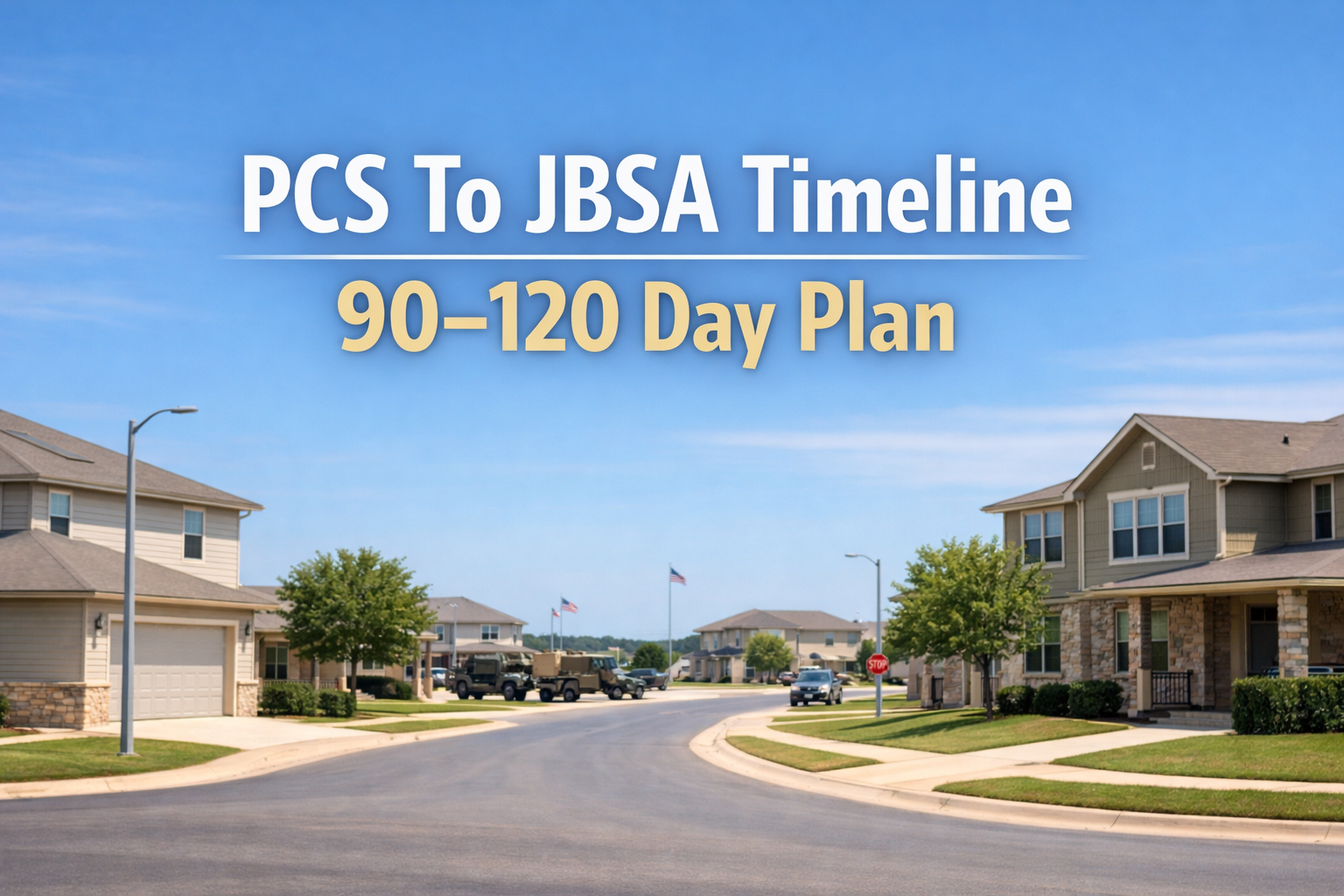
To keep your loan process aligned with your orders, use the 90–120day PCS to JBSA timeline as a planning checklist.
What Should Military Families Do 120 to 105 Days Before Report Date?
This phase focuses on information gathering and strategic planning rather than house hunting. Rushing into property searches before establishing proper foundation creates avoidable complications later in the timeline.
If you’re inside that 90–120 day window before your report date, follow this weekbyweek PCS to JBSA timeline so nothing slips through the cracks.
Confirm Orders and Flexibility
Once orders are received, military families should confirm report date specifics, any flexibility window or reporting instructions allowing early arrival, TDY or training overlap that could affect housing timelines, leave availability for house hunting trips, and household goods scheduling constraints from the transportation office.
Knowing whether even a one-week buffer exists changes the entire purchase strategy and risk tolerance for construction timelines or appraisal delays. This information guides decisions about whether to pursue new construction, how aggressively to negotiate, and what backup plans to establish.
Interview San Antonio-Based PCS Specialists
Military buyers benefit most from working with real estate agents who understand JBSA commuting patterns to all three installations, builder VA policies and which builders work smoothly with military timelines, appraisal trends by San Antonio submarket, PCS contract timing and contingency structuring, and remote buying safeguards for buyers coordinating from current duty stations.
This is where working with an Air Force Veteran and longtime San Antonio real estate agent matters. Tami Price, REALTOR®, structures PCS purchases around report dates first, not listing marketing hype or builder sales pressure that ignores military timeline realities.
Initial VA Lender Review
At this stage 120 to 105 days out, buyers should confirm VA eligibility and entitlement status, discuss funding fee exemptions if applicable based on disability ratings, review debt-to-income thresholds and residual income requirements, understand pre-approval documentation needed, and identify any credit cleanup needed before formal application.
This is not a pre-approval yet. This is a risk assessment conversation that identifies potential obstacles before time pressure creates urgency that prevents addressing issues properly.
Q: Should military buyers get pre-approved before receiving PCS orders?
A: Pre-approval before orders is premature since lenders need confirmed income including BAH from the new duty station. However, preliminary lender consultation before orders helps identify credit issues, documentation needs, or debt concerns that can be addressed proactively once orders arrive.
What Happens 105 to 90 Days Before Report Date?
This is the point where PCS success or failure trajectories start to diverge based on preparation quality and timeline discipline.
VA Pre-Approval Completed
By 90 days out, buyers should have full VA pre-approval with verified income documentation not just preliminary estimates, reviewed asset sourcing and reserves, rate strategy discussion considering rate locks and timing, and clear understanding of monthly payment capacity including taxes and insurance.
Waiting past this point increases the risk of missed deadlines because pre-approval typically requires 7 to 14 days even with responsive borrowers, and issues discovered during underwriting review can take additional weeks to resolve.
Location and Commute Mapping
San Antonio is geographically large, and commute time to specific JBSA installations matters significantly for quality of life. A proper PCS search defines acceptable commute ranges to Fort Sam Houston, Lackland Air Force Base, or Randolph Air Force Base, neighborhood options that match lifestyle priorities, new construction versus resale tradeoffs based on timeline and budget, HOA rules and fees that vary dramatically across communities, and property tax expectations by county and school district.
This is also where budget realism is set based on total monthly obligation including principal, interest, taxes, insurance, and HOA fees rather than just purchase price or listing price that ignores carrying costs.
New Construction Viability Check
If considering new construction, this 105 to 90 day window is critical for confirming true build completion timelines with written documentation, reviewing builder VA addenda and policies specific to military buyers, understanding incentive structures and whether they require preferred lenders, and identifying inventory homes versus to-be-built options that require 6 to 12 months.
Not all builders are PCS-friendly in their contract language or timeline flexibility. Understanding these differences before emotional attachment to specific communities prevents disappointment when builders cannot accommodate military deadlines.
What Should Military Buyers Do 90 to 75 Days Out?
This phase is execution-heavy, requiring active property evaluation and decision-making that leads to contract execution.
Resale Home Buyers
Buyers purchasing resale should tour homes in person or virtually using detailed video walkthroughs, review disclosure patterns common to San Antonio including foundation and drainage issues, track days-on-market trends indicating how quickly properly priced homes are selling, and prepare offer strategies aligned with VA guidelines and competitive positioning.
Homes that look ideal online may fail VA appraisal or inspection standards. Filtering for condition early protects time and prevents emotional attachment to properties unlikely to close successfully.
New Construction Buyers
Buyers selecting new construction should lock a completion date with written acknowledgment from the builder, confirm appraisal timing relative to drywall installation and substantial completion, review penalty clauses or extension provisions for delays, and understand earnest money risk if construction extends beyond acceptable timelines.
A build that finishes two weeks late can derail a PCS if temporary lodging allowances run out or household goods delivery creates storage complications. Contract language protecting buyers matters more than optimistic completion estimates from sales representatives.
Q: Can military buyers tour San Antonio homes remotely before arriving at JBSA?
A: Yes. Most real estate agents provide detailed video tours, FaceTime walkthroughs, and comprehensive photography for out-of-state military buyers. However, in-person visits before contracting are ideal when possible, particularly for resale homes where condition assessment matters more than new construction.
What Needs to Happen 75 to 60 Days Before Report Date?
At this point, timing precision becomes critical as contract deadlines and lender timelines create less flexibility for delays or indecision.
Contract Accepted
Once under contract, option period clocks start running immediately, inspection scheduling begins within days, and appraisal ordering follows lender timelines that typically cannot be accelerated significantly. Military buyers should avoid shortened option periods unless risk has been fully evaluated through pre-listing inspections or new construction warranties.
Inspection Strategy
Inspections should focus on safety and structural concerns that affect livability, VA Minimum Property Requirements that lenders require for loan approval, major systems with remaining useful life including HVAC and roof, and deferred maintenance that could trigger appraisal conditions requiring repair before closing.
Code changes after a home was built are not retroactive requirements for sellers, but safety issues affecting habitability must be addressed regardless of when the home was constructed or code adoption timing.
Repair Negotiation Discipline
Repair requests should be reasonable and focused on genuine safety or function concerns, VA-focused on items appraisers will identify as conditions, and time-conscious to avoid delays from extensive repair lists that extend negotiations unnecessarily. Over-negotiating repairs is a common cause of PCS delays when sellers reject unreasonable demands and buyers must decide whether to proceed or walk away after investing weeks in the transaction.
What Happens 60 to 45 Days Out During Appraisal Phase?
This is the most fragile phase of a VA PCS purchase where appraisal results can require quick pivots and backup planning.
VA Appraisal Process
VA appraisals can take longer during peak PCS season from May through August when JBSA sees maximum transfer activity. Buyers should be prepared for Tidewater value discussions if appraisers believe contract price exceeds supported market value, repair requirements flagged through Minimum Property Requirements review, and appraisal completion delays when appraiser scheduling backlogs extend beyond typical timelines.
A strong local real estate agent manages this proactively with comparable sales data, repair cost estimates, and timeline communication rather than emotional reactions that create additional stress without improving outcomes.
Backup Plans Established
This 60 to 45 day window is when contingency planning matters most because enough time remains to pivot if issues arise. Backup plans may include short-term rental options if closing delays threaten report date, extended lodging reservations beyond temporary lodging allowance periods, possession-after-closing arrangements if selling a departure home creates timing conflicts, and builder completion contingency language protecting buyers from construction delays.
PCS success depends on planning for what might go wrong rather than assuming everything will proceed perfectly according to initial timelines and estimates.
Q: What happens if VA appraisal comes in below contract price?
A: Buyers can request sellers reduce price to appraised value, contribute cash to cover the gap if they have reserves available, or terminate under VA appraisal contingency. Negotiation success depends on market conditions and how far below contract price the appraisal falls. Real estate agents help navigate these situations based on local market dynamics.
What Should Occur 45 to 30 Days Before Report Date?
This phase focuses on final loan approval and coordinating the physical move to align with home availability.
Loan Clear to Close
By 45 to 30 days out, buyers should be condition-free or close to it with only routine verifications remaining, clear on final closing costs without surprises, and aligned on funding timelines coordinated with closing date. Any new documentation requests should be escalated immediately to lenders and addressed within 24 to 48 hours to prevent delays.
Household Goods Scheduling
Military families must coordinate pack-out dates from current residence, delivery windows at San Antonio destination, and storage arrangements if closing and delivery dates don't align perfectly. Closing dates should align with household goods delivery timelines rather than fight against transportation office scheduling that may not accommodate last-minute changes.
What Needs Attention 30 to 14 Days Out Before Report Date?
The final two weeks require attention to closing execution details and final verification that everything meets expectations.
Final Walk-Through
Military buyers should confirm repairs are completed as negotiated and documented, utilities are active and functional, no new damage has occurred since inspections, and new construction completion standards are met including certificate of occupancy issuance.
Closing Execution
VA closings require precision where funds, documents, and timing must align across lender, title company, seller or builder, and military schedule that may include reporting immediately after closing. This is not the time for last-minute changes to loan programs, down payment sources, or closing date adjustments that could derail carefully coordinated logistics.
What Special Considerations Affect PCS Sellers?
Many PCS moves involve selling a home at the departure location while purchasing in San Antonio. Proper sequencing prevents financial complications and timeline conflicts.
Key considerations include bridge financing options if purchasing before selling, VA entitlement restoration timing if using VA loans for both transactions, sale contingency risk when offers depend on selling the current home, and power of attorney execution for closing remotely on either or both properties.
Selling too late creates rush pressure that forces pricing concessions, while selling too early creates carrying costs or forces temporary housing that depletes savings. Coordinating both transactions requires experienced guidance and realistic timeline planning.
Expert Insight from Tami Price, REALTOR®
Tami Price, REALTOR®, is a San Antonio-based real estate professional and Air Force Veteran with nearly two decades of experience representing military families through PCS relocations. With approximately 1,000 closed transactions and recognition as a RealTrends Verified Top Agent and 15-time Five Star Professional Award winner, she specializes in helping JBSA families execute timeline-critical purchases.
"The PCS moves that go smoothly are the ones where families start planning at 120 days out, not 30 days," Tami explains. "By the time buyers are 30 days from report date without a contract or clear path to closing, the stress level becomes enormous and options become limited. Starting at 120 days allows proper lender selection, realistic property evaluation, and contingency planning that makes the difference between confidence and chaos."
Tami emphasizes that military timelines require different thinking than civilian purchases. "Civilian buyers have flexibility to extend closings, wait for better inventory, or adjust timelines when issues arise. Military buyers don't have that luxury. Report dates are fixed, temporary lodging has limits, and household goods coordination doesn't accommodate real estate delays gracefully. The week-by-week discipline matters because small timing mistakes in week one create major problems by week ten when there's no runway left to fix them."
Three Key Takeaways
1. Starting 120 Days Out Provides Critical Margin for Delays That Commonly Occur in PCS Purchases
Military families who begin planning 120 days before report dates gain advantages including completed VA pre-approval identifying issues before timeline pressure increases, adequate time for property searches without settling for suboptimal options, buffer periods absorbing appraisal delays or inspection complications, and proper coordination between home purchase and household goods delivery. Starting at 90 days provides minimum viable timeline for straightforward transactions, while 120 days allows margin for complications that frequently arise including new construction delays, appraisal rework, repair negotiations, or lender documentation delays that consume weeks without careful management.
2. Week-by-Week Discipline Prevents Cascading Timeline Failures That Jeopardize Report Dates
Small delays in early phases accumulate and create major problems in final weeks when fixing issues becomes impossible within remaining timeframes. Completing pre-approval by day 90 rather than day 60 provides two-week buffer if documentation issues arise. Contracting by day 75 rather than day 45 allows adequate inspection, appraisal, and repair coordination. These buffers matter enormously when unexpected complications arise, as they frequently do in real estate transactions even with excellent planning and experienced representation.
3. Backup Planning During Appraisal Phase Protects Report Dates When Primary Plans Hit Complications
The 60 to 45 day window represents highest risk period when appraisal results, repair requirements, or financing issues can derail transactions. Military families who establish backup plans during this window including short-term rental options, extended lodging reservations, and storage arrangements maintain flexibility when complications arise. Buyers who assume everything will work perfectly without contingency planning face crisis situations when appraisals come in low, sellers refuse necessary repairs, or construction completion delays exceed estimates, leaving insufficient time to pivot without jeopardizing report dates or creating expensive housing gaps.
Frequently Asked Questions
Q. What if military buyers receive orders with less than 90 days before report date?
A. Buyers with compressed timelines should focus exclusively on move-in-ready homes or spec inventory rather than to-be-built construction, accept less negotiation leverage on repairs to maintain timeline, consider temporary housing if purchasing cannot complete before report date, and work with real estate agents experienced in compressed military timelines who can accelerate coordination.
Q. Can military families start house hunting before receiving official orders?
A. Preliminary research and neighborhood evaluation can occur before orders, but lenders require confirmed income including BAH from the new duty station for pre-approval. Contract execution before orders creates risk if assignments change, though this is rare once informal notification occurs.
Q. What happens if closing cannot occur before report date?
A. Buyers must arrange temporary lodging through on-base housing, short-term rentals, or extended stay facilities, coordinate household goods storage if delivery cannot occur immediately, and potentially pay out-of-pocket beyond temporary lodging allowance limits until closing completes and home access is available.
Q. Should military buyers only consider homes that can close within their timeline?
A. Yes. Pursuing homes with closing timelines extending beyond report dates creates guaranteed complications. Buyers should filter property searches based on realistic closing windows that align with military schedules rather than hoping timelines will work out despite obvious conflicts.
Q. How do military buyers coordinate if they cannot be present for closing?
A. Power of attorney allows trusted individuals to sign closing documents on the buyer's behalf, remote online notarization is available in Texas for certain closing documents, and digital document review occurs before closing day to identify issues requiring resolution before funds transfer and recording.
Q. What if new construction is not complete by the agreed date?
A. Contract language determines remedies, which vary by builder. Some contracts include compensation for delays while others simply extend closing with buyers absorbing additional temporary housing costs. This is why reviewing contract language before signing and establishing backup plans matters for military buyers.
Q. Can military buyers use VA loans if they're selling a home with an existing VA loan?
A. Yes, if sufficient remaining entitlement exists for the new purchase amount. Otherwise, buyers must wait for the first loan to close and entitlement to restore, use conventional financing for the new purchase, or pursue VA loan assumption on the first property to restore entitlement faster.
Q. What makes a San Antonio real estate agent qualified to help with PCS moves?
A. Look for military experience or extensive JBSA transaction history, understanding of VA loan requirements and timeline constraints, established builder relationships and knowledge of military-friendly policies, systems for remote buyer coordination, and track record of successful PCS purchases meeting report dates without complications.
The Bottom Line
A PCS move to JBSA is not just a home purchase. It is a mission with fixed deadlines and real consequences for families and careers. Starting 90 to 120 days out with a clear, disciplined timeline protects report dates, reduces stress, and creates better financial outcomes through proper planning rather than rushed decisions made under timeline pressure.
Military families moving to Joint Base San Antonio need planning and discipline, not pressure and hope. Working with a San Antonio real estate agent who understands VA loans, builder timelines, and military life makes the difference between a smooth PCS and a costly scramble where timeline failures create housing gaps, unexpected expenses, and unnecessary stress during an already demanding transition.

Contact Tami Price, REALTOR® | San Antonio, TX
Whether you're PCSing to Joint Base San Antonio, need a week-by-week PCS timeline plan, or want guidance on VA home buying coordination, Tami Price provides experienced representation focused on protecting military report dates and PCS success.
📞 210 620 6681
Tami Price's Specialties
- Buyer and Seller Representation
- Military Relocations and PCS Moves
- VA Loan Guidance and Assumptions
- New Construction
- First-Time Home Buyers
- Move-Up Buyers
- Downsizing and Rightsizing
- Strategic Pricing and Market Analysis
- San Antonio, Schertz, Cibolo, Helotes, Converse, and Boerne
Disclaimer
This blog is for informational purposes only and does not constitute legal, financial, or real estate advice. Market conditions change, and individual circumstances vary. Readers should consult qualified professionals before making real estate decisions. Tami Price, REALTOR®, is licensed in Texas and affiliated with Real Broker, LLC. Fair Housing principles apply to all content.
Categories
- All Blogs (943)
- Home Buying (20)
- Neighborhood Guides (45)
- 10 Incentive and Rate Buydown Questions (1)
- 10 Military Neighborhood (1)
- 10 Mistakes Sellers Make (1)
- 10 Strategies to Coordinate a Same Day Close (1)
- 12 Lifestyle Questions to Move In (1)
- 12 PCS What Ifs (1)
- 12 Photos and Marketing Assets (1)
- 13 PCS Hunting Trip Tips (1)
- 14 Design Center Decisions (1)
- 15 Red Flags Touring Home in San Antonio (1)
- 2026 Market (1)
- 30 days after closing your home (1)
- 7 Offer Terms Beyond Price (1)
- 7 VA Specific Questions (1)
- 78015 Ranked One (1)
- 8 Bridge (1)
- 8 Myths Buyers Believe about Down Payments (1)
- 8 Reasons VA Buyers Love New Construction (1)
- 9 Mistakes Move Up Buyers Make (1)
- 9 Questions to Decide If You Keep Your PCS Home (1)
- 9 Timeline Questions Every Buyer Need to Ask (1)
- 9 Warranty Questions to Ask (1)
- 9 Ways to Attract VA & Military Buyers (1)
- 90 days before your move (1)
- About Tami Price (6)
- Active Adult Homes (1)
- Affordable Communities (2)
- Affordable Housing & Community Development (5)
- Agent Qualifications and Credentials (1)
- Agent Qualifications and Experience (1)
- Agent Recognition (3)
- Agent Selection (1)
- AI and Real Estate Tools (1)
- Alamo Heights (5)
- Alamo Heights ISD (1)
- Alamo Heights Real Estate (1)
- Alamo Ranch (3)
- Amenities in Helotes, Texas (3)
- Apartment Market (1)
- Appraisals (1)
- Arts and Culture (1)
- Awards and Recognition (7)
- Balcones Creek (1)
- Best Neighborhoods to Live in Cibolo, TX (3)
- Best Neighborhoods to Live in San Antonio (16)
- Best Places to Live in Leon Valley: A Neighborhood Guide (1)
- Best Places to Live in Northeast Inner Loop: A Neighborhood Guide (1)
- Bexar County Property Tax (1)
- Bexar County Real Estate (3)
- Blue Tape Walkthrough (1)
- Boerne Home Sellers (1)
- Boerne Neighborhoods (2)
- Boerne Texas (9)
- Broadway Corridor Development (1)
- Build-to-Rent Communities (1)
- Builder Contracts & Warranties (3)
- Builder Incentives (1)
- Builder Warranties (1)
- Buyer (97)
- Buyer Activity San Antonio (1)
- Buyer and Seller Guidance (4)
- Buyer Due Diligence (1)
- Buyer Education (46)
- Buyer Guide (9)
- Buyer Guides (7)
- Buyer Protection Strategies (1)
- Buyer Representation (1)
- Buyer Representation Expertise (1)
- Buyer Resources (90)
- Buyer Strategy (2)
- Buyers (13)
- Buyers Agent (1)
- Buying a Foreclosed Home in San Antonio (10)
- Buying a Home (3)
- Buying a Home in San Antonio (6)
- Buying Near JBSA (1)
- Buying Timeline (1)
- Buying vs Renting (1)
- Castroville, TX (8)
- Central San Antonio (1)
- Central San Antonio Development (2)
- Central Texas Growth (1)
- Choosing a Real Estate Agent (1)
- Choosing an Agent (1)
- Cibolo Communities (1)
- Cibolo Home Sellers (1)
- Cibolo TX (15)
- Client Reviews and Testimonials (1)
- Client Satisfaction (1)
- Client Stories (1)
- Client Testimonial (4)
- Clients review (4)
- Closing (1)
- Cobblestone (1)
- Comal County (1)
- Commercial & Retail Development (27)
- Commercial Development (13)
- Commercial Development Impact on Home Values (1)
- Commercial Real Estate (1)
- Community (1)
- Community Amenities (2)
- Community Development (23)
- Community Development and Real Estate (3)
- Community Events & Development (1)
- Community Guides (1)
- Community Infrastructure (1)
- Community Investment Impact (2)
- Community Landmarks (1)
- Community News (4)
- Community Planning (2)
- Community Revitalization (1)
- Community Spotlights (1)
- Commuter Neighborhoods (1)
- Cons of Living in Helotes, TX (4)
- Conservation Communities (1)
- Contingency Questions (1)
- Converse Home Sellers (1)
- Converse Homes For Sale (3)
- Converse Real Estate (1)
- Converse TX (10)
- Converse TX Real Estate (1)
- Cost of Living Guides (1)
- Cost of Living in San Antonio TX (25)
- CPS Energy Programs (1)
- Custom Homes (5)
- Davis Ranch (1)
- Days on Market (1)
- Deco District San Antonio (1)
- Denver Heights (1)
- Down Payment Assistance (1)
- Downtown Boerne (1)
- Downtown Development (3)
- Downtown Living (1)
- Downtown Revitalization (14)
- Downtown San Antonio (2)
- Downtown San Antonio Real Estate (5)
- Downtown San Antonio Revitalization (1)
- Dual Military (1)
- East Side Living (1)
- East Side Neighborhoods (1)
- East Side San Antonio (4)
- Economic Development (3)
- Economic Growth & Industry (1)
- Education, Texas Hill Country (1)
- Emerald Pointe (1)
- Employment (1)
- Employment Corridors (1)
- Encino Forest (1)
- Entertainment Economy (1)
- Equity and Pricing Strategy (2)
- Equity Q&A (1)
- Established Communities (3)
- Events in San Antonio (207)
- Expert Advice from Tami Price, Realtor® (10)
- Fair Oak Ranch (1)
- Family Activities (2)
- Family Homes (3)
- Family Living in San Antonio (1)
- FAQ (1)
- Far Northwest San Antonio (1)
- Far West San Antonio (1)
- Far Westside Real Estate (4)
- Farmer Markets in San Antonio (1)
- Fastest Growing Zip Codes in America (1)
- Featured Homes for Sale (2)
- Featured Properties (1)
- Final Walkthrough (1)
- Financial Planning (11)
- Financing Strategy (1)
- First Time Buyers (23)
- First Time Sellers (1)
- First-Time Buyers (6)
- First-Time Homebuyer Resources (4)
- First-Time Homebuyer Tips (2)
- First-Time Homebuyers (6)
- First-Time Investors (1)
- Fort Sam Houston (3)
- Fort Sam Houston Real Estate (1)
- Fort Sam Houston, TX (2)
- Fox Grove (1)
- FSBO vs Agent Representation (1)
- Future Rental (1)
- Gated Communities (5)
- Golf Communities (1)
- Great Northwest (1)
- Greater San Antonio Housing Trends (2)
- Greater San Antonio Real Estate (5)
- Green Home Upgrades (1)
- Growth and Development (11)
- Healthcare (1)
- HELOC (1)
- Helotes Home Sellers (1)
- Highway 151 Corridor Growth (1)
- Hill Country Business (1)
- Hill Country Communities (2)
- Hill Country Development (3)
- Hill Country Homes for Sale (1)
- Hill Country Living (3)
- Hill Country Market Updates (1)
- Hill Country Real Estate (4)
- Hill Country Retreat (1)
- Historic Districts (5)
- Historic Neighborhoods (4)
- Historic Preservation (2)
- Holiday Attractions (1)
- Holiday Guide (1)
- Home Buying (7)
- Home Buying Education (3)
- Home Buying Guide (7)
- Home Buying Process (8)
- Home Buying Strategy (2)
- Home Buying Tips (6)
- Home Energy Efficiency San Antonio (5)
- Home Financing (2)
- Home Improvement ROI (1)
- Home Inspections (3)
- Home Maintenance (1)
- Home Preparation (2)
- Home Pricing Strategy (14)
- Home Renovation for Resale (1)
- Home Selling (12)
- Home Selling Guide (11)
- Home Selling Strategies (3)
- Home Selling Strategy (3)
- Home Selling Tips (22)
- Home Staging and Updates (2)
- Home Values (2)
- Homebuyer Education (15)
- Homebuyer Resources (1)
- Homebuying Guide (1)
- Homebuying Tips (3)
- Homeowner (38)
- Homeowner Tax Benefits (1)
- Homeownership Costs (1)
- Homes for Sale (2)
- Homes for sale near Lackland AFB (4)
- Homes Near Military Bases (1)
- Homestead amenities (1)
- Horizon Pointe (1)
- House Hunting Guide (1)
- Housing (1)
- Housing Community Development (1)
- Housing Development (2)
- Housing Market Updates (3)
- How to Buy a House in San Antonio TX (48)
- Huebner Oaks shopping center (1)
- Hunters Ranch (1)
- Hybrid (1)
- I-10 Corridor (1)
- I-35 Corridor (1)
- In Person (1)
- Incorporated Cities (6)
- Industrial Investment Impact (1)
- Industry News (2)
- Industry Recognition (1)
- Infrastructure & Growth Projects (26)
- Infrastructure and Sustainability (1)
- Infrastructure Development (1)
- Infrastructure Investment (1)
- Infrastructure Updates (2)
- Interest Rates (2)
- Invest in San Antonio (46)
- Investment Opportunities (3)
- Investment Property San Antonio (4)
- JBSA (9)
- JBSA Housing (11)
- JBSA Real Estate (4)
- JBSA Resources (7)
- Joint Base San Antonio (5)
- Joint Base San Antonio Housing (1)
- Judson ISD (2)
- Kendall County (1)
- La Cantera Retail Development (1)
- Lackland AFB (7)
- Lackland AFB Housing (1)
- Land Conservation (1)
- Land Use Planning (1)
- Lera MLS (15)
- Lifestyle & Community Growth (18)
- Lifestyle & Local Growth (12)
- Lifestyle Amenities (1)
- Lifestyle Communities (1)
- Listing Preparation (1)
- Listing Strategy (1)
- Live Oak (1)
- Living in San Antonio, TX (52)
- Living Near Randolph AFB (7)
- Loan Programs (1)
- Local Attractions (3)
- Local Business (1)
- Local Business & Development (9)
- Local Business & Economy (3)
- Local Business Spotlight (20)
- Local Business Support (5)
- Local Development (4)
- Local Development News (9)
- Local Market Insights (5)
- Local News (2)
- Local News Around San Antonio (2)
- Local Policy Changes (1)
- Local Real Estate News (1)
- Loop 1604 Corridor Growth (2)
- Loop 410 Corridor Development (1)
- Luxury Communities (3)
- Luxury Homes (2)
- Luxury Real Estate (1)
- Luxury Retail San Antonio (1)
- MacArthur Park (1)
- Major Developments (2)
- Making Offers on Homes (1)
- Market Analysis (26)
- Market Conditions (47)
- Market Expertise (1)
- Market Insights (5)
- Market Strategy (1)
- Market Timing (2)
- Market Trends (10)
- Market Trends & Insights (2)
- Market Update (18)
- Market Update 2026 (1)
- Market Updates (22)
- Master Planned Communities (12)
- Medical Center Area Real Estate (1)
- Medina Valley ISD (2)
- Midtown Living (1)
- Military & Economic Impact (3)
- Military Buyers (3)
- Military Communities (1)
- Military Families (1)
- Military Family Resources (1)
- Military Heritage (1)
- Military Homebuying (3)
- Military Homeownership (1)
- Military Housing (3)
- Military Housing Market in Texas (16)
- Military Life in San Antonio (2)
- Military Neighborhoods (1)
- Military PCS Relocations (3)
- Military Real Estate (2)
- Military Relocation (100)
- Military Relocation & VA Loans (10)
- Military Relocation San Antonio (4)
- Military Relocation Services (3)
- Military Relocation to San Antonio (50)
- Military Relocations (20)
- Military Relocations & VA Home Loans (5)
- Mixed-Income Housing (1)
- MLS Accuracy & Data Transparency (1)
- Mortgage Programs (1)
- Mothers Day in San Antonio (1)
- Move to Boerne TX (18)
- Move to Castroville TX (11)
- Move to Converse TX (16)
- Move to New Braunfels (1)
- Move to North San Antonio (19)
- Move to San Antonio TX (73)
- Move to Selma TX (19)
- Move to Shertz TX (13)
- Move to Texas (53)
- Move Up Buyer Resources (1)
- Move Up Buyers (23)
- Move-In Ready Homes (3)
- Move-In Ready Homes San Antonio (2)
- Move-Up Buyers (2)
- Moving to Helotes, TX (17)
- Moving to San Antonio (69)
- MUD Taxes (1)
- Natalia Homes For Sale (1)
- Near East Side Living (1)
- Negotiation Strategy (2)
- Neighborhood Amenities (1)
- Neighborhood Development (1)
- Neighborhood Guides (7)
- Neighborhood Investment (1)
- Neighborhood News (2)
- Neighborhood Revitalization (2)
- Neighborhood Spotlights (12)
- Neighborhood Updates (1)
- Neighborhoods near Randolph AFB (12)
- New Braunfels (6)
- New Braunfels Homes For Sale (1)
- New Braunfels News (3)
- New Braunfels Real Estate (3)
- New Businesses (2)
- New Construction (63)
- New Construction Communities (1)
- New Construction Homes (13)
- New Construction Homes San Antonio (5)
- New Construction vs Resale (2)
- New Construction Without Customization (1)
- New Construction Without the Wait (1)
- New Contruction Cost (1)
- New Development (3)
- New Listing (19)
- New Restaurants (3)
- News (211)
- News & updates (213)
- No HOA Homes (1)
- North Central San Antonio (5)
- North East ISD (4)
- North San Antonio (9)
- North San Antonio Real Estate (3)
- North Side Neighborhoods (1)
- North Side San Antonio Development (2)
- Northeast Inner Loop (1)
- Northeast Inner Loop Neighborhoods (1)
- Northeast San Antonio (3)
- Northside ISD (5)
- Northwest San Antonio (9)
- Northwest San Antonio Development (1)
- Northwest San Antonio Growth (1)
- Northwest San Antonio Real Estate (3)
- Northwood (1)
- Olympia Hills (1)
- One-Story Homes (1)
- Outdoor Living (1)
- Parks and Recreation (2)
- PCS and JBSA (2)
- PCS checklist (1)
- PCS Guide (4)
- PCS Moves (12)
- PCS Moves to Joint Base San Antonio (4)
- PCS Planning (16)
- PCS Randolph AFB (17)
- PCS Relocation (1)
- PCS Resources (6)
- PCS San Antonio (46)
- PCS to San Antonio (42)
- Pearl District Area Real Estate (2)
- PID Assessments (1)
- Pinon Creek (1)
- Pipe Creek (1)
- Places to Eat Near Randolph AFB (1)
- Pool Homes (1)
- Pre Approval (1)
- Pre-Listing Preparation (2)
- Pre-Listing Process (1)
- Prescott Oaks (1)
- Pricing and Marketing Strategy (3)
- Professional Awards and Achievements (2)
- Professional Real Estate Representation (1)
- Property Tax Exemptions Texas (1)
- Property Value Enhancement (1)
- pros and cons living in Converse TX (3)
- Pros and Cons Living in Selma TX (6)
- Pros and Cons of Living in Castroville, TX (4)
- Pros and Cons of Living in San Antonio (33)
- PT500 List (1)
- Purchase Negotiation (1)
- Quality of Life (1)
- Quick Close Real Estate (1)
- Randolph AFB Neighborhoods (2)
- Real Estate (1)
- Real Estate Advice (1)
- Real Estate Agent Recognition (6)
- Real Estate Agent Selection (2)
- Real Estate Agent Value (1)
- Real Estate Consultation (1)
- Real Estate Finance (1)
- Real Estate Financing (1)
- Real Estate Impact (1)
- Real Estate Investment San Antonio (2)
- Real Estate Legal Issues (1)
- Real Estate Market Insights (2)
- Real Estate Market Trends (5)
- Real Estate Professional Designations (1)
- Real Estate Strategy (1)
- Real Estate Technology & Trends (2)
- Real Estate Tips (1)
- Real Estate Tips and Guides (2)
- Real Estate Trends (4)
- RealTrends Verified (1)
- Regional Development (1)
- Regional Real Estate (2)
- Relocating to San Antonio (2)
- Relocation (4)
- Relocation Resources (2)
- Relocation to San Antonio (55)
- Remote Homebuying (1)
- Rental Housing (1)
- Rental Property (1)
- Rental Strategy (1)
- Resale Properties (1)
- Retail Development (2)
- Retire in Boerne TX (11)
- Retire in San Antonio (37)
- Retirement Communities (1)
- Reviews and Recognition (1)
- Rockwall Ranch (1)
- Rural Living (2)
- SABOR (28)
- San Antonio Area Listings (1)
- San Antonio Business Growth (1)
- San Antonio Buyer Resources (2)
- San Antonio Communities (3)
- San Antonio Community Events (1)
- San Antonio Community News (1)
- San Antonio Data Center Development (1)
- San Antonio Development (5)
- San Antonio Development & East Side Real Estate (1)
- San Antonio Dining and Lifestyle (3)
- San Antonio East Side Development (1)
- San Antonio Employment Growth (1)
- San Antonio Food & Community Development (2)
- San Antonio Growth (8)
- San Antonio Home Buying and Selling (2)
- San Antonio Home Buying Guide (5)
- San Antonio Home Improvement (2)
- San antonio home prices (3)
- San Antonio Home Sellers (3)
- San Antonio Homeowner Guide (1)
- San Antonio Homeowner Resources (1)
- San Antonio Homes for Sale (12)
- San Antonio Housing Market (2)
- San Antonio Housing Market & Mortgage Financing (2)
- San Antonio Housing Market Analysis (2)
- San Antonio Housing Trends & Market Analysis (4)
- San Antonio Industrial Development (1)
- San Antonio Industrial Policy (1)
- San Antonio Investment Properties (2)
- San Antonio Job Market (1)
- San Antonio Lifestyle Amenities (2)
- San Antonio Listing (1)
- San Antonio Living (1)
- San Antonio Market (3)
- San Antonio Market Updates (18)
- San Antonio Military Relocation (3)
- San Antonio Neighborhoods (67)
- San Antonio New Construction & Master-Planned Communities (4)
- San Antonio New Home Communities (1)
- San Antonio News (229)
- San Antonio North Side Development (1)
- San Antonio Parks (1)
- San Antonio Property Investment (1)
- San Antonio Property Taxes (2)
- San Antonio Real Estate (164)
- San Antonio Real Estate Agents (6)
- San Antonio Real Estate Excellence (1)
- San Antonio Real Estate Guide (6)
- San Antonio Real Estate Market (41)
- San Antonio Real Estate Market Analysis (6)
- San Antonio Real Estate News (2)
- San Antonio REALTOR Awards (1)
- San Antonio Restaurant News (2)
- San Antonio Restaurant Openings (1)
- San Antonio Seller Resources (2)
- San Antonio Sellers (1)
- San Antonio Spec Homes (1)
- San Antonio Spurs Community Programs (1)
- San Antonio Suburbs (1)
- San Antonio Transportation (2)
- San Antonio University Area Housing (1)
- San Antonio Urban Living (7)
- San Antonio West Side Development (2)
- San Antonio Zoning Policy (1)
- Scenic Loop (1)
- Schertz Home Sellers (1)
- Schertz Real Estate (1)
- Schertz, TX (13)
- School Districts (1)
- School Information (1)
- SCUCISD Schools (1)
- Secured Quick Offer (1)
- Sell Home In San Antonio TX (64)
- Seller (83)
- Seller Education (24)
- Seller Guide (4)
- Seller Guides (1)
- Seller Representation Expertise (1)
- Seller Resources (68)
- Seller Should Understand (1)
- Seller Strategy (3)
- Seller Tips (2)
- Sellers (10)
- Selling A Home in San Antonio (62)
- Selling Your San Antonio Home (3)
- Selma TX (9)
- Single-Story Homes (4)
- Smart Homes (1)
- Solar Homes (3)
- South San Antonio Real Estate (1)
- South Side Economic Growth (1)
- South Side San Antonio (1)
- Southtown (2)
- Southwest San Antonio Real Estate (1)
- Spec Homes and Inventory Homes (2)
- Spurs Arena Project Marvel (1)
- Stone Oak (2)
- Stone Oak Community News (5)
- Suburban Housing Growth (12)
- Suburban Living (2)
- Talise De Culebra (1)
- Technology Growth (3)
- Technology Sector Growth (1)
- Terrell Hills (3)
- Texas Acreage Properties (3)
- Texas Homestead Exemption (1)
- The Dominion Real Estate (1)
- The Rim Area Real Estate (1)
- Things to do in San Antonio TX (22)
- Things to do Near Randolph AFB (4)
- Time Planning (1)
- Time-Sensitive Home Buying (1)
- Timing Strategy (1)
- Tips for Buying New Construction (9)
- Tobin Hill Neighborhoods (2)
- Top Real Estate Agent in San Antonio (3)
- Tourism and Economic Development (1)
- Traders's Joe San Antonio (1)
- Transaction Coordination (1)
- Transportation Infrastructure (1)
- Two-Story Homes (2)
- Universal City (1)
- Updated Homes (2)
- Upscale Communities (1)
- Urban Communities (2)
- Urban Corridor Real Estate (1)
- Urban Development (5)
- Urban Living (3)
- Urban Neighborhoods (4)
- Urban Real Estate (1)
- Urban Renewal Projects (1)
- Urban Revitalization San Antonio (1)
- Utility Cost Reduction (1)
- UTSA Campus Development (1)
- VA Buyers (1)
- VA Home Loan Benefits (3)
- VA Loan Assumptions (3)
- VA loan benefits (27)
- VA Loan Guidance (1)
- VA Loan Home Buying Assistance (2)
- VA Loans (71)
- VA Loans and Military Benefits (3)
- VA Loans and Military Home Buying (3)
- VA Loans San Antonio (43)
- VET Benefits Living in San Antonio (3)
- Veterans Resources (3)
- Village Northwest (1)
- Virtual Buyers (1)
- Walkable Communities (1)
- week in sales (41)
- Weekly Sales Report (42)
- West San Antonio (2)
- West San Antonio Development (1)
- West San Antonio Real Estate (3)
- West San Antonio Real Estate Market (2)
- West Side Infrastructure Planning (1)
- West Side Real Estate (1)
- West Side San Antonio (2)
- Windcrest Homes for Sale (1)
Recent Posts