San Antonio Housing Market Update June 1-7, 2025: Tami Price on What Rising Prices Mean for Buyers and Sellers
The San Antonio real estate market delivered a notable and instructive data set during the week of June 1 through June 7, 2025. According to LERA MLS® data for the city of San Antonio, both average and median sales prices increased substantially compared to the prior week, even as the number of closed transactions declined. Reading this data correctly requires understanding what weekly price movement actually reflects, and what it does not.
Tami Price, REALTOR®, notes that weekly fluctuations in average and median price are most often driven by the composition of what closed during that specific reporting window, not by uniform changes in home values across the market. A week with more higher-priced homes closing will show elevated averages and medians even if no individual home appreciated in value. Understanding that distinction is one of the most important tools buyers and sellers can apply when evaluating market data in real time.
This report covers LERA MLS® data for San Antonio for the week of June 1 through June 7, 2025, with comparison to the prior week ending May 31, 2025.
What Did the LERA MLS® Data Show for the Week of June 1 Through June 7, 2025?
The reported figures for the two comparison periods show a sharp contrast in both volume and price across just one week.
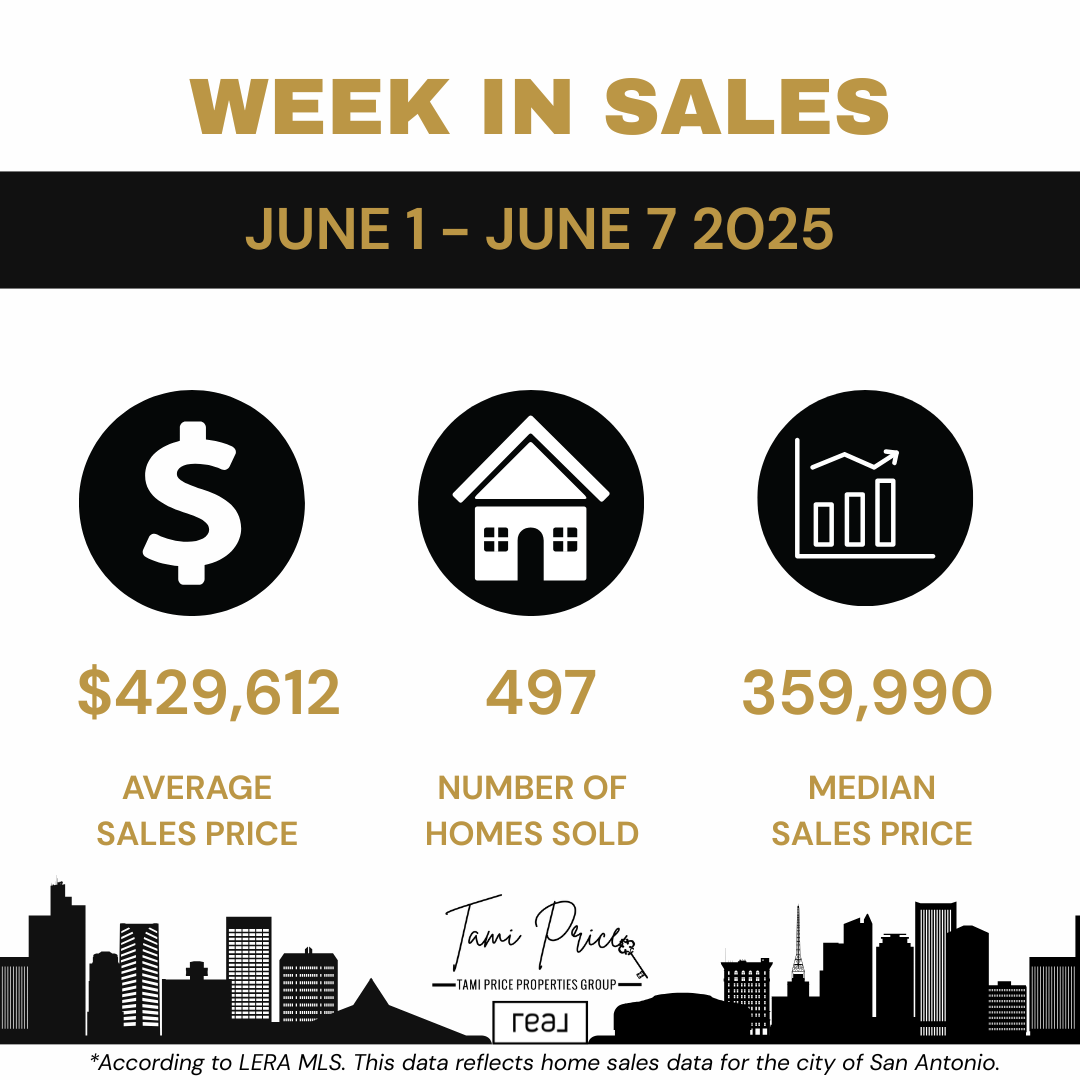
Week of June 1 Through June 7, 2025:
- Average Sales Price: $429,612
- Median Sales Price: $359,990
- Homes Sold: 497
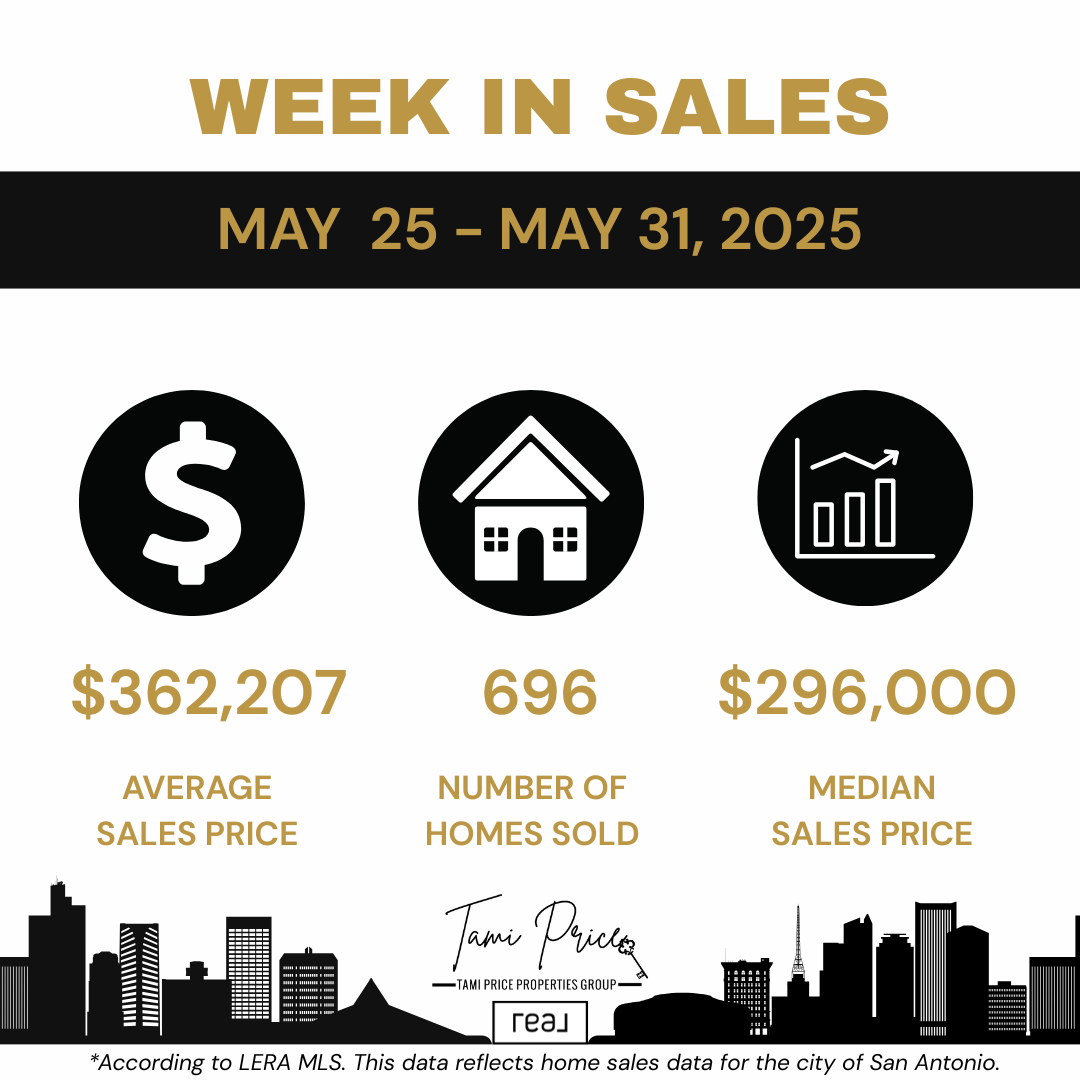
Prior Week of May 25 Through May 31, 2025:
- Average Sales Price: $362,207
- Median Sales Price: $296,000
- Homes Sold: 696
The week-over-week changes are significant on their face: average sales price increased by more than 18 percent, median sales price increased by more than 21 percent, and the number of closed transactions declined by approximately 29 percent. Each of those figures deserves careful interpretation before drawing conclusions about what they mean for buyers or sellers evaluating the San Antonio market.
Q: What is the difference between average sales price and median sales price in a weekly market report?
A: Average sales price is calculated by adding all sales prices and dividing by the number of transactions, making it sensitive to outlier sales at the high end of the market. Median sales price represents the midpoint, where half of homes sold for more and half sold for less, which makes it more resistant to distortion from a small number of very high-priced closings. Both figures are useful for tracking trends over time, but both can fluctuate meaningfully week to week based on which specific homes closed during the reporting period.
Why Did Home Prices Rise While Fewer Homes Closed in San Antonio That Week?
The relationship between falling transaction volume and rising prices in this report is best explained by inventory composition, not by a sudden shift in market-wide demand or value. When fewer homes close in a given week, the specific mix of those closings has a disproportionate effect on both the average and median figures. A week in which a larger share of higher-priced homes happen to close, perhaps due to timing of contract execution, builder deliveries, or seasonal patterns, will reflect elevated price figures even if no individual home increased in value.
This is a consistent dynamic in weekly MLS® reporting and is important context for anyone interpreting the June 1-7 data. The 18 percent jump in average price and the 21 percent increase in median price do not indicate that San Antonio home values rose by those amounts across the board in a single week. They indicate that the 497 homes that closed during that reporting window skewed toward higher price points compared to the 696 homes that closed the prior week.
Weekly data is most useful when observed as part of a longer trend pattern rather than as a standalone data point. Single-week fluctuations are expected, and both buyers and sellers benefit most from evaluating data across multiple weeks and comparing it to the same periods in prior years.
Why weekly composition shifts affect LERA MLS® price figures in San Antonio:
- Builder deliveries of upper-tier spec homes often cluster at specific points in the month, affecting weekly averages
- Higher-priced resale closings may concentrate mid-month as contract timelines align
- Fewer total closings amplify the statistical impact of individual high-value transactions on both average and median figures
- Holiday-adjacent weeks and end-of-month patterns affect which contracts close when, creating natural fluctuation across weeks
- Price figures in any single reporting period should be read alongside volume and Days on Market data for a more complete picture
For context on how San Antonio's market has been trending over longer periods, the Is the San Antonio Housing Market Becoming More Balanced? overview and the San Antonio Housing Market Update for December 2025 through January 2026 provide useful trend comparison.
What Does Weekly Price Movement Actually Reveal About San Antonio Home Values?
Q: Does a week-over-week price increase mean San Antonio home values are rising uniformly across all neighborhoods?
A: No. Weekly price figures from LERA MLS® data reflect the composition of what closed during that specific period, not uniform appreciation across all San Antonio homes. A meaningful week-over-week change in average or median price almost always reflects a shift in which segment of the market closed during that reporting window, not a blanket change in what any specific home is worth. Buyers and sellers should avoid drawing conclusions about their specific home's value from weekly averages without comparing to recent comparable sales in their specific neighborhood and price range.
The June 1-7 data remains informative for several reasons, regardless of the composition explanation. The fact that 497 transactions closed during that week confirms that buyers are active in the San Antonio market and completing purchases across a range of price points. The elevated average and median figures confirm that the upper end of the market remains functional, with buyers willing to transact at higher price points when they find the right property and terms. And the contrast with the prior week provides a useful data point for understanding how volume and composition interact in LERA MLS® reporting.
What the weekly data does and does not tell buyers and sellers:
- It confirms that transactions are closing and buyer activity remains present in the San Antonio market
- It provides a reference point for the mix of closings during that specific reporting window
- It does not indicate uniform price appreciation or depreciation across all San Antonio neighborhoods
- It should not be used in isolation to make pricing or offer decisions without neighborhood-level comparable sales data
- It is most useful as part of a multi-week trend analysis that identifies directional movement over time
What Does This Market Data Mean for Buyers in San Antonio?
For buyers actively searching in San Antonio, the June 1-7 data reinforces several practical realities about how the market is functioning. Active buyer demand at the higher end of the price spectrum confirms that well-priced homes across multiple segments are still attracting purchase decisions. Buyers who are pre-approved, prepared, and clear on their total monthly payment parameters are in the strongest position to act when the right property becomes available.
The volume decline from 696 closings the prior week to 497 closings during June 1-7 also reflects the normal fluctuation of a market that has more inventory and more deliberate buyer behavior than it did during the compressed-timeline peak years. That deliberation is a feature, not a flaw. Buyers have more choices and more time to evaluate total ownership cost, including property taxes, insurance, HOA dues, and any applicable MUD or PID assessments, before committing to a specific property.
Q: Should buyers wait for prices to drop further or act when they find the right home in San Antonio?
A: The most reliable answer depends on the buyer's specific financial profile, timeline, and neighborhood priorities, not on weekly headline price figures. Buyers who find a well-located home priced correctly relative to current comparable sales, with a total monthly cost that fits comfortably within their budget, are generally better served by acting than by waiting for macro-level market shifts that may or may not materialize in the specific segments they are targeting. Working with an experienced local real estate agent who can interpret neighborhood-level data is more valuable than reacting to week-over-week averages.
What prepared buyers should focus on when evaluating market data:
- Total monthly payment, not just purchase price, factoring in effective tax rates and all applicable fees
- Comparable recent sales in the specific neighborhood and price range under consideration
- Days on Market trends in the target area, which indicate how quickly or slowly inventory is moving
- Builder incentive availability if new construction is being evaluated alongside resale options
- Long-term resale potential in the community based on historical absorption and appreciation patterns
For buyers at the beginning of the process, Deciding to Buy a Home in San Antonio and The Home Buying Process in San Antonio provide a practical framework. The Making an Offer and Negotiation guide covers current strategy for buyers ready to move from search to offer.
What Does This Market Data Mean for Sellers in San Antonio?
The June 1-7 data confirms what experienced sellers already know: buyers are transacting in San Antonio, and homes at the right price point with the right presentation are continuing to close. The elevated average and median figures for that week reflect buyer willingness to purchase at higher price points when they perceive appropriate value. That buyer selectivity is the key phrase.
The market rewards sellers who enter correctly rather than those who test a high price and reduce later. Homes that performed best during this period share consistent characteristics that have defined successful San Antonio listings throughout 2025: competitive pricing grounded in current comparable sales, move-in-ready condition, professional marketing, and realistic seller expectations about negotiations, timelines, and buyer concessions.
Q: How should a seller interpret a week with strong median price movement in San Antonio?
A: A strong median price figure confirms that buyers in the mid-to-upper tier are transacting, but it does not mean a seller should increase an asking price or hold out for a higher offer than comparable sales support. The appropriate takeaway is that the market is functional and buyers are closing, which reinforces the value of entering the market priced correctly. Sellers who are tempted to overprice based on strong weekly headlines often find that buyer activity does not materialize at unsupported price points, regardless of what the weekly average shows.
What San Antonio sellers should focus on in the current environment:
- Accurate pricing established through a current comparative market analysis, not through prior-peak expectations
- Professional photography, staging preparation, and strong online exposure across buyer platforms
- Realistic expectations about inspection requests, appraisal outcomes, and buyer concession patterns
- Positioning against active competition, including both resale and builder inventory in the same price range
- Timing entry to market thoughtfully, since the first weeks of a listing establish the buyer perception that shapes the entire transaction
For a full seller strategy framework, How to Price Your San Antonio Home to Sell and the What Buyers Are Looking for Right Now in San Antonio post provide current, actionable context. The Pricing Your San Antonio Home page and Is Now a Good Time to Sell My Home in San Antonio? are also worth reviewing before a listing conversation.
How Does San Antonio's Market Vary by Neighborhood and Price Point?
One of the most important cautions in reading any metro-wide weekly data is that San Antonio is a large, highly fragmented real estate market where conditions in one area bear little relationship to conditions a few ZIP codes away. The LERA MLS® data for the week of June 1-7, 2025 covers the city of San Antonio as a whole, which encompasses a wide range of neighborhoods, price segments, and market dynamics that a single average or median figure cannot capture.
Some neighborhoods during this period were experiencing extended Days on Market and more buyer negotiation. Others were still seeing relatively competitive conditions for well-priced, well-presented properties. Military relocation corridors near JBSA, neighborhoods adjacent to significant employment centers, and communities with strong school district ratings tend to behave differently than outer-growth communities with larger amounts of new construction competition. For military buyers and PCS families, the Military Relocation resource at TamiPrice.com covers the JBSA-specific considerations that intersect with general market conditions.
The San Antonio Neighborhoods and Communities guide provides a useful overview of how different parts of the metro compare for buyers evaluating specific areas. The How New Business Announcements Affect San Antonio Real Estate post adds useful context on how employment and development activity shapes neighborhood-level market behavior.
What Should Buyers and Sellers Watch as San Antonio's Summer Selling Season Develops?
Weekly fluctuations in transaction volume and price figures are an expected feature of the summer selling season in San Antonio, not a signal of market instability. What matters most for both buyers and sellers is identifying the direction of broader trends over time rather than reacting to any single week's data in isolation.
Trends worth watching as the summer market develops in San Antonio:
- Whether Days on Market in specific neighborhoods and price ranges are trending longer or shorter over consecutive weeks
- How builder incentive activity in suburban corridors affects resale seller competition in the same price segments
- Whether the ratio of list price to close price is tightening or widening in the areas of most interest
- How quickly new listings in the target price range receive offers versus sitting without activity
- Whether overall monthly volume trends indicate a seasonal pickup or continued deliberate buyer pace
Buyers and sellers can track current listing activity across San Antonio and surrounding communities to monitor real-time inventory levels alongside reported data. For a longer-view perspective on how the market has evolved, the San Antonio Real Estate Market Update for Early February 2026 provides comparable historical data context.
Expert Insight from Tami Price
Tami Price, REALTOR®, has spent nearly two decades tracking and interpreting San Antonio market data on behalf of buyers and sellers across the metro, with approximately 1,000 closed transactions and more than 650 five-star reviews across Google, Zillow, Realtor.com, and Real Satisfied. She publishes regular market updates drawn from LERA MLS® data to help buyers and sellers understand current conditions with the context needed to make informed decisions, not just the headline figures.
Interpreting weekly data accurately is a skill that separates informed buyers and sellers from those who react to surface-level numbers.
"What I always tell clients when they see a week with a big jump in average or median price is to look at how many homes closed," Tami says. "When you go from nearly 700 closings to just under 500, and the mix of those 500 closings is weighted toward higher price points, the average is going to move up significantly. That does not mean your neighbor's house appreciated by 18 percent in a week. It means the reporting window captured a different segment of the market. The value of following these reports over time is identifying direction and momentum, not reacting to any single week."
Her approach to market data reflects the same principle she applies to every client conversation: accurate interpretation of available information is the foundation of a confident real estate decision. Buyers who understand what weekly data does and does not say are better equipped to evaluate asking prices, make offers, and negotiate effectively. Sellers who understand how market data moves are better equipped to price correctly from the start rather than chasing reductions based on misread signals.
Buyers and sellers who want to discuss how current San Antonio market conditions apply to their specific situation can schedule a consultation at TamiPrice.com. The About Tami Price page provides additional background on her experience and approach to market analysis.
Three Key Takeaways
- The sharp week-over-week increase in San Antonio's average and median sales prices during June 1-7, 2025 reflects a shift in inventory composition, not uniform appreciation across all homes in the market. When fewer transactions close in a given reporting window and those closings skew toward higher price points, the average and median figures will rise even if no individual home changed in value. This is a consistent feature of weekly LERA MLS® data and is critical context for buyers and sellers trying to read market direction accurately. Single-week figures should always be evaluated alongside multi-week trends and neighborhood-specific comparable sales data.
- The 497 closed transactions reported for the week of June 1-7 confirm that buyers are actively completing purchases in the San Antonio market, and that homes at higher price points are finding buyers when priced and presented correctly. The decline from 696 closings the prior week reflects normal seasonal and calendar-related fluctuation rather than a demand collapse. Buyers who are pre-approved and prepared to act when the right property becomes available are in a stronger position than those who wait for definitive signals from weekly data that is inherently variable.
- San Antonio's market behaves very differently across neighborhoods, price ranges, and property types, and metro-wide averages do not substitute for neighborhood-level analysis when making individual buying or selling decisions. Sellers pricing based on a strong weekly average rather than current comparable sales in their specific area risk entering the market above where buyers are transacting. Buyers evaluating offers based on metro-level data rather than ZIP-code-level comparable sales risk either overpaying or missing on well-priced properties that reflect local, not citywide, market conditions.
Frequently Asked Questions
Q. What data does the LERA MLS® weekly report cover for San Antonio?
A. The LERA MLS® weekly report covers closed residential sales transactions recorded within the city of San Antonio during the specified reporting period. The figures include total homes sold, average sales price, and median sales price for that specific week, compared to the prior reporting window. The data reflects transactions that closed during the reporting period, not new listings or homes that went under contract.
Q. Why did San Antonio average home prices increase by more than 18 percent in a single week in June 2025?
A. The 18 percent increase in average sales price from the prior week to June 1-7 is most likely explained by a shift in inventory composition, meaning a higher proportion of upper-price-range homes closed during that specific week. When transaction volume falls from 696 to 497 closings and the mix shifts toward higher-priced properties, the average will reflect those closings disproportionately. This is a normal feature of weekly reporting and does not indicate that all San Antonio home values increased by that amount.
Q. Does a drop in weekly closings mean the San Antonio market is slowing down?
A. Not necessarily. Weekly transaction volume fluctuates based on contract timing, calendar factors, seasonal patterns, and builder delivery schedules. A single week with fewer closings does not indicate a sustained slowdown. The more meaningful indicator is the multi-week trend in volume, Days on Market, and the ratio of list price to close price across the segments a buyer or seller is most interested in.
Q. What is the difference between average and median sales price in a San Antonio market report?
A. Average sales price is calculated by dividing the total dollar volume of all closings by the number of transactions, making it sensitive to a small number of very high-priced sales. Median sales price is the midpoint at which half of homes sold for more and half for less, making it more stable when outlier sales are present. Both figures are useful, and significant divergence between them in a given week often signals that high-end closings are influencing the average more than the median reflects.
Q. How should San Antonio buyers use weekly market data when searching for a home?
A. Weekly data provides useful context on market activity and direction, but it should not replace neighborhood-level comparable sales analysis when evaluating a specific property. Buyers benefit most from understanding Days on Market trends in their target area, the ratio of recent list prices to close prices, and how builder incentives in nearby communities are affecting resale competition in the same price range. An experienced local real estate agent can translate weekly data into actionable guidance for a specific buyer situation.
Q. What does the June 1-7, 2025 data suggest about seller strategy in San Antonio?
A. The data confirms that buyers are transacting at higher price points when they find appropriate value, which reinforces the importance of accurate, market-supported pricing from the first day a home is listed. Sellers who enter at a price supported by current comparable sales and present their homes in move-in-ready condition are best positioned to capture buyer attention from active buyers in the market. Sellers who price above comparable support based on strong weekly averages often find that buyer activity does not materialize at unsupported price points.
Q. How does San Antonio's market vary across different neighborhoods and price points?
A. Significantly. San Antonio is a large, diverse market where conditions in one corridor can differ substantially from conditions just a few miles away. Neighborhoods near JBSA, major employment centers, and established school districts tend to maintain different absorption rates and price dynamics than outer-growth communities with more new construction competition. Metro-wide weekly averages provide directional context but do not describe conditions in any specific neighborhood accurately without neighborhood-level data to accompany them.
Q. How can buyers and sellers get a more accurate picture of San Antonio market conditions beyond weekly data?
A. The most reliable picture combines multi-week trend data from LERA MLS® reports with neighborhood-specific comparable sales, current Days on Market in the target area, and active listing inventory counts in the relevant price range. A pre-listing consultation for sellers and a buyer consultation before the active search begins are both effective ways to get a market assessment grounded in current local conditions rather than metro-level headline figures alone.
The Bottom Line
The week of June 1 through June 7, 2025 delivered a strong upward movement in both average and median sales prices in San Antonio's LERA MLS® data, alongside a meaningful decline in total closings from the prior week. Reading those numbers in context, the most accurate interpretation is that a smaller number of closings skewed toward higher price points, producing elevated averages that reflect inventory composition rather than uniform appreciation. Buyer activity confirmed by 497 closed transactions indicates that demand remains present across San Antonio's market, particularly for well-priced homes in the right condition.
For buyers, the takeaway is that the market is functional and active buyers are transacting. Preparation, pre-approval, and a clear understanding of total monthly cost remain the strongest assets in any week. For sellers, the message reinforces what every effective listing strategy requires: accurate pricing grounded in current comparable sales, strong presentation, and realistic expectations about today's buyer behavior.
Tami Price tracks LERA MLS® data weekly to keep buyers and sellers informed about San Antonio market conditions as they evolve. To discuss what current data means for a specific buying or selling situation, buyers and sellers can schedule a consultation, search current listings, or reach out directly through TamiPrice.com.

Contact Tami Price, REALTOR® | San Antonio, TX
Tami Price, REALTOR®, serves buyers, sellers, and military families across San Antonio and surrounding communities. For market analysis, pricing strategy, or to start a home search, reach out directly.
📞 210-620-6681
Tami Price's Specialties
- Buyer and Seller Representation
- Military Relocations and PCS Moves
- VA Loan Guidance
- New Construction
- First-Time Home Buyers
- Move-Up Buyers
- Downsizing and Rightsizing
- Strategic Pricing and Market Analysis
- San Antonio, Schertz, Cibolo, Helotes, Converse, and Boerne
Disclaimer
This blog is for informational purposes only and does not constitute legal, financial, or real estate advice. Market data referenced reflects LERA MLS® reported figures for the city of San Antonio for the specified reporting periods and is subject to revision. Weekly data reflects closed transactions during the reporting window and should be interpreted alongside multi-week trend data and neighborhood-specific comparable sales. Tami Price, REALTOR®, is licensed in Texas and affiliated with Real Broker, LLC. Fair Housing principles apply to all content.
Categories
- All Blogs (643)
- Home Buying (21)
- Neighborhood Guides (41)
- 10 Incentive and Rate Buydown Questions (1)
- 10 Military Neighborhood (1)
- 10 Mistakes Sellers Make (1)
- 10 Strategies to Coordinate a Same Day Close (1)
- 12 Lifestyle Questions to Move In (1)
- 12 PCS What Ifs (1)
- 12 Photos and Marketing Assets (1)
- 13 PCS Hunting Trip Tips (1)
- 14 Design Center Decisions (1)
- 15 Red Flags Touring Home in San Antonio (1)
- 2026 Market (1)
- 30 days after closing your home (1)
- 7 Offer Terms Beyond Price (1)
- 7 VA Specific Questions (1)
- 78015 Ranked One (1)
- 8 Bridge (1)
- 8 Myths Buyers Believe about Down Payments (1)
- 8 Reasons VA Buyers Love New Construction (1)
- 9 Mistakes Move Up Buyers Make (1)
- 9 Questions to Decide If You Keep Your PCS Home (1)
- 9 Timeline Questions Every Buyer Need to Ask (1)
- 9 Warranty Questions to Ask (1)
- 9 Ways to Attract VA & Military Buyers (1)
- 90 days before your move (1)
- About Tami Price (6)
- Active Adult Homes (1)
- Affordable Communities (2)
- Affordable Homes (1)
- Affordable Housing & Community Development (3)
- Agent Qualifications and Credentials (1)
- Agent Qualifications and Experience (1)
- Agent Recognition (3)
- Agent Selection (1)
- AI and Real Estate Tools (1)
- Alamo Heights (4)
- Alamo Heights ISD (1)
- Alamo Ranch (2)
- Amenities in Helotes, Texas (3)
- Appraisals (1)
- Arts and Culture (1)
- Awards and Recognition (7)
- Balcones Creek (1)
- Best Neighborhoods to Live in Cibolo, TX (3)
- Best Neighborhoods to Live in San Antonio (15)
- Best Places to Live in Northeast Inner Loop: A Neighborhood Guide (1)
- Bexar County Property Tax (1)
- Bexar County Real Estate (3)
- Blue Tape Walkthrough (1)
- Boerne Home Sellers (1)
- Boerne Texas (4)
- Builder Contracts & Warranties (3)
- Builder Incentives (1)
- Builder Warranties (1)
- Buyer (64)
- Buyer Activity San Antonio (1)
- Buyer and Seller Guidance (3)
- Buyer Due Diligence (1)
- Buyer Education (45)
- Buyer Guide (9)
- Buyer Guides (7)
- Buyer Protection Strategies (1)
- Buyer Representation (1)
- Buyer Representation Expertise (1)
- Buyer Resources (91)
- Buyer Strategy (2)
- Buyers (13)
- Buyers Agent (1)
- Buying a Foreclosed Home in San Antonio (10)
- Buying a Home (4)
- Buying a Home in San Antonio (6)
- Buying Near JBSA (1)
- Buying Timeline (1)
- Buying vs Renting (1)
- Castroville, TX (8)
- Central Texas Growth (1)
- Choosing a Real Estate Agent (1)
- Choosing an Agent (1)
- Cibolo Communities (1)
- Cibolo Home Sellers (1)
- Cibolo TX (12)
- Client Reviews and Testimonials (1)
- Client Satisfaction (1)
- Client Stories (1)
- Client Testimonial (4)
- Clients review (4)
- Closing (1)
- Cobblestone (1)
- Comal County (1)
- Commercial & Retail Development (2)
- Commercial Development (1)
- Community (1)
- Community Development (2)
- Community Development and Real Estate (1)
- Community Guides (1)
- Community Investment Impact (1)
- Community Spotlights (1)
- Commuter Neighborhoods (1)
- Cons of Living in Helotes, TX (4)
- Conservation Communities (1)
- Contingency Questions (1)
- Converse Home Sellers (1)
- Converse Homes For Sale (3)
- Converse Real Estate (1)
- Converse TX (10)
- Cost of Living Guides (1)
- Cost of Living in San Antonio TX (23)
- Custom Homes (5)
- Davis Ranch (1)
- Days on Market (1)
- Down Payment Assistance (1)
- Downtown Revitalization (1)
- Downtown San Antonio (2)
- Dual Military (1)
- East Side Living (1)
- Economic Development (1)
- Education, Texas Hill Country (1)
- Emerald Pointe (1)
- Employment (1)
- Employment Corridors (1)
- Encino Forest (1)
- Equity and Pricing Strategy (2)
- Equity Q&A (1)
- Established Communities (3)
- Events in San Antonio (34)
- Expert Advice from Tami Price, Realtor® (7)
- Fair Oak Ranch (1)
- Family Homes (3)
- FAQ (1)
- Far Northwest San Antonio (1)
- Far West San Antonio (1)
- Farmer Markets in San Antonio (1)
- Fastest Growing Zip Codes in America (1)
- Featured Homes for Sale (2)
- Featured Properties (1)
- Final Walkthrough (1)
- Financial Planning (11)
- Financing Strategy (1)
- First Time Buyers (23)
- First Time Sellers (1)
- First-Time Buyers (6)
- First-Time Homebuyer Resources (4)
- First-Time Homebuyer Tips (2)
- First-Time Homebuyers (6)
- First-Time Investors (1)
- Fort Sam Houston (3)
- Fort Sam Houston Real Estate (1)
- Fort Sam Houston, TX (2)
- Fox Grove (1)
- FSBO vs Agent Representation (1)
- Future Rental (1)
- Gated Communities (5)
- Golf Communities (1)
- Great Northwest (1)
- Greater San Antonio Housing Trends (2)
- Greater San Antonio Real Estate (5)
- Growth and Development (11)
- HELOC (1)
- Helotes Home Sellers (1)
- Hill Country (1)
- Hill Country Communities (2)
- Hill Country Development (1)
- Hill Country Homes for Sale (1)
- Hill Country Real Estate (2)
- Hill Country Retreat (1)
- Historic Districts (5)
- Historic Neighborhoods (4)
- Holiday Guide (1)
- Home Buying (7)
- Home Buying Education (3)
- Home Buying Guide (7)
- Home Buying Process (8)
- Home Buying Strategy (2)
- Home Buying Tips (5)
- Home Energy Efficiency San Antonio (5)
- Home Financing (3)
- Home Improvement ROI (1)
- Home Inspections (3)
- Home Maintenance (1)
- Home Preparation (2)
- Home Pricing Strategy (14)
- Home Renovation for Resale (1)
- Home Selling (12)
- Home Selling Guide (12)
- Home Selling Strategies (3)
- Home Selling Strategy (3)
- Home Selling Tips (23)
- Home Staging and Updates (2)
- Home Values (2)
- Homebuyer Education (15)
- Homebuyer Resources (1)
- Homebuying Guide (1)
- Homebuying Tips (3)
- Homeowner (32)
- Homeowner Tax Benefits (1)
- Homeownership Costs (1)
- Homes for Sale (2)
- Homes for sale near Lackland AFB (2)
- Homestead amenities (1)
- Horizon Pointe (1)
- House Hunting Guide (1)
- Housing Development (1)
- Housing Market Updates (3)
- How to Buy a House in San Antonio TX (43)
- Hunters Ranch (1)
- Hybrid (1)
- In Person (1)
- Incorporated Cities (6)
- Industry News (2)
- Industry Recognition (1)
- Infrastructure & Growth Projects (2)
- Interest Rates (2)
- Invest in San Antonio (32)
- Investment Opportunities (1)
- Investment Property San Antonio (3)
- JBSA (8)
- JBSA Housing (11)
- JBSA Real Estate (2)
- JBSA Resources (7)
- Joint Base San Antonio (4)
- Joint Base San Antonio Housing (1)
- Judson ISD (2)
- Lackland AFB (5)
- Lackland AFB Housing (1)
- Land Use Planning (1)
- Lera MLS (15)
- Lifestyle & Community Growth (2)
- Lifestyle & Local Growth (1)
- Lifestyle Communities (1)
- Listing Preparation (1)
- Listing Strategy (1)
- Live Oak (1)
- Living in San Antonio, TX (44)
- Living Near Randolph AFB (5)
- Loan Programs (1)
- Local Development News (2)
- Local Market Insights (4)
- Local News Around San Antonio (1)
- Luxury Communities (3)
- Luxury Homes (4)
- Luxury Real Estate (2)
- MacArthur Park (1)
- Making Offers on Homes (1)
- Market Analysis (24)
- Market Conditions (47)
- Market Expertise (1)
- Market Insights (5)
- Market Strategy (2)
- Market Timing (2)
- Market Trends (6)
- Market Trends & Insights (2)
- Market Update (17)
- Market Update 2026 (1)
- Market Updates (16)
- Master Planned Communities (12)
- Medical Center Area Real Estate (1)
- Medina Valley ISD (2)
- Midtown Living (1)
- Military & Economic Impact (3)
- Military Buyers (3)
- Military Communities (1)
- Military Families (1)
- Military Family Resources (1)
- Military Homebuying (3)
- Military Homeownership (1)
- Military Housing (2)
- Military Housing Market in Texas (14)
- Military Life in San Antonio (2)
- Military Neighborhoods (1)
- Military PCS Relocations (3)
- Military Real Estate (2)
- Military Relocation (99)
- Military Relocation & VA Loans (10)
- Military Relocation San Antonio (4)
- Military Relocation Services (3)
- Military Relocation to San Antonio (46)
- Military Relocations (18)
- Military Relocations & VA Home Loans (5)
- MLS Accuracy & Data Transparency (1)
- Mortgage Programs (1)
- Mothers Day in San Antonio (1)
- Move to Boerne TX (15)
- Move to Castroville TX (9)
- Move to Converse TX (14)
- Move to New Braunfels (1)
- Move to North San Antonio (16)
- Move to San Antonio TX (64)
- Move to Selma TX (17)
- Move to Shertz TX (10)
- Move to Texas (45)
- Move Up Buyer Resources (1)
- Move Up Buyers (24)
- Move-In Ready Homes (3)
- Move-In Ready Homes San Antonio (2)
- Move-Up Buyers (2)
- Moving to Helotes, TX (14)
- Moving to San Antonio (61)
- MUD Taxes (1)
- Natalia Homes For Sale (1)
- Near East Side Living (1)
- Negotiation Strategy (2)
- Neighborhood Amenities (1)
- Neighborhood Guides (7)
- Neighborhood Spotlights (3)
- Neighborhoods near Randolph AFB (9)
- New Braunfels (4)
- New Braunfels Homes For Sale (1)
- New Braunfels News (2)
- New Braunfels Real Estate (2)
- New Construction (62)
- New Construction Communities (1)
- New Construction Homes (12)
- New Construction Homes San Antonio (5)
- New Construction vs Resale (2)
- New Construction Without Customization (1)
- New Construction Without the Wait (1)
- New Contruction Cost (1)
- New Listing (13)
- News (21)
- News & updates (23)
- No City Tax (1)
- No HOA Homes (1)
- North Central San Antonio (5)
- North East ISD (4)
- North San Antonio (7)
- North Side Neighborhoods (1)
- North Side San Antonio Development (1)
- Northeast Inner Loop (1)
- Northeast Inner Loop Neighborhoods (1)
- Northeast San Antonio (1)
- Northside ISD (5)
- Northwest San Antonio (6)
- Northwest San Antonio Real Estate (2)
- Northwood (1)
- Olympia Hills (1)
- One-Story Homes (1)
- Outdoor Living (1)
- PCS and JBSA (2)
- PCS checklist (1)
- PCS Guide (4)
- PCS Moves (12)
- PCS Moves to Joint Base San Antonio (4)
- PCS Planning (16)
- PCS Randolph AFB (15)
- PCS Relocation (1)
- PCS Resources (6)
- PCS San Antonio (42)
- PCS to San Antonio (38)
- PID Assessments (1)
- Pinon Creek (1)
- Pipe Creek (1)
- Places to Eat Near Randolph AFB (1)
- Pool Homes (1)
- Pre Approval (1)
- Pre-Listing Preparation (2)
- Pre-Listing Process (1)
- Prescott Oaks (1)
- Preserve at Medina (1)
- Pricing and Marketing Strategy (3)
- Professional Awards and Achievements (2)
- Professional Real Estate Representation (1)
- Property Tax Exemptions Texas (1)
- pros and cons living in Converse TX (3)
- Pros and Cons Living in Selma TX (6)
- Pros and Cons of Living in Castroville, TX (4)
- Pros and Cons of Living in San Antonio (30)
- PT500 List (1)
- Purchase Negotiation (1)
- Quick Close Real Estate (1)
- Randolph AFB Neighborhoods (2)
- Real Estate (1)
- Real Estate Advice (1)
- Real Estate Agent Recognition (6)
- Real Estate Agent Selection (2)
- Real Estate Agent Value (1)
- Real Estate Consultation (1)
- Real Estate Finance (1)
- Real Estate Financing (1)
- Real Estate Impact (1)
- Real Estate Investment San Antonio (1)
- Real Estate Market Trends (3)
- Real Estate Professional Designations (1)
- Real Estate Strategy (1)
- Real Estate Technology & Trends (1)
- Real Estate Tips (1)
- Real Estate Tips and Guides (2)
- Real Estate Trends (2)
- RealTrends Verified (1)
- Relocating to San Antonio (2)
- Relocation (4)
- Relocation Resources (2)
- Relocation to San Antonio (49)
- Remote Homebuying (1)
- Rental Housing (1)
- Rental Property (1)
- Rental Strategy (1)
- Resale Properties (1)
- Retail Development (1)
- Retire in Boerne TX (10)
- Retire in San Antonio (31)
- Retirement Communities (1)
- Reviews and Recognition (1)
- Rockwall Ranch (1)
- Rural Living (2)
- Ryland Homes (1)
- SABOR (27)
- San Antonio Buyer Resources (2)
- San Antonio Communities (3)
- San Antonio Community Events (1)
- San Antonio Growth (1)
- San Antonio Home Buying and Selling (2)
- San Antonio Home Buying Guide (5)
- San Antonio Home Improvement (1)
- San antonio home prices (3)
- San Antonio Home Sellers (3)
- San Antonio Homeowner Guide (1)
- San Antonio Homes for Sale (13)
- San Antonio Housing Market (2)
- San Antonio Housing Market & Mortgage Financing (1)
- San Antonio Housing Market Analysis (1)
- San Antonio Housing Trends & Market Analysis (3)
- San Antonio Lifestyle Amenities (1)
- San Antonio Listing (1)
- San Antonio Living (1)
- San Antonio Market (3)
- San Antonio Market Updates (7)
- San Antonio Military Relocation (3)
- San Antonio Neighborhoods (48)
- San Antonio New Construction & Master-Planned Communities (2)
- San Antonio New Home Communities (1)
- San Antonio News (22)
- San Antonio Property Taxes (2)
- San Antonio Real Estate (163)
- San Antonio Real Estate Agents (6)
- San Antonio Real Estate Excellence (1)
- San Antonio Real Estate Guide (6)
- San Antonio Real Estate Market (32)
- San Antonio Real Estate Market Analysis (2)
- San Antonio REALTOR Awards (1)
- San Antonio Seller Resources (2)
- San Antonio Sellers (1)
- San Antonio Spec Homes (1)
- San Antonio Spurs Community Programs (1)
- San Antonio Urban Living (1)
- Scenic Loop (1)
- Schertz Home Sellers (1)
- Schertz Real Estate (1)
- Schertz, TX (11)
- School Information (1)
- SCUCISD Schools (1)
- Secured Quick Offer (1)
- Sell Home In San Antonio TX (50)
- Seller (50)
- Seller Education (24)
- Seller Guide (4)
- Seller Guides (1)
- Seller Representation Expertise (1)
- Seller Resources (69)
- Seller Should Understand (1)
- Seller Strategy (3)
- Seller Tips (2)
- Sellers (10)
- Selling A Home in San Antonio (49)
- Selling Your San Antonio Home (3)
- Selma TX (9)
- Single-Story Homes (4)
- Smart Homes (1)
- Solar Homes (3)
- Southtown (1)
- Spec Homes and Inventory Homes (2)
- Stone Oak (2)
- Suburban Housing Growth (2)
- Suburban Living (2)
- Talise De Culebra (1)
- Terrell Hills (2)
- Texas Acreage Properties (4)
- Texas Homestead Exemption (1)
- Things to do in San Antonio TX (16)
- Things to do Near Randolph AFB (3)
- Time Planning (1)
- Time-Sensitive Home Buying (1)
- Timing Strategy (1)
- Tips for Buying New Construction (9)
- Top Real Estate Agent in San Antonio (3)
- Transaction Coordination (1)
- Transportation Infrastructure (1)
- Two-Story Homes (2)
- Universal City (1)
- Updated Homes (2)
- Upscale Communities (1)
- Urban Communities (2)
- Urban Living (1)
- Urban Neighborhoods (4)
- VA Buyers (1)
- VA Home Loan Benefits (3)
- VA Loan Assumptions (3)
- VA loan benefits (27)
- VA Loan Guidance (1)
- VA Loan Home Buying Assistance (2)
- VA Loans (71)
- VA Loans and Military Benefits (3)
- VA Loans and Military Home Buying (3)
- VA Loans San Antonio (41)
- VET Benefits Living in San Antonio (3)
- Veterans Resources (3)
- Village Northwest (1)
- Virtual Buyers (1)
- Von Ormy Homes For Sale (1)
- week in sales (40)
- Weekly Sales Report (41)
- West San Antonio (2)
- West San Antonio Real Estate (1)
- Westover Hills Employment Corridor (1)
- Westover Valley (1)
- Windcrest Homes for Sale (1)
Recent Posts