Army Reduces PCS Moves in 2026: What It Means for JBSA Military Families Buying or Selling in San Antonio | Tami Price, REALTOR®
How does the Army's PCS reduction affect military homebuying and selling near JBSA in 2026?
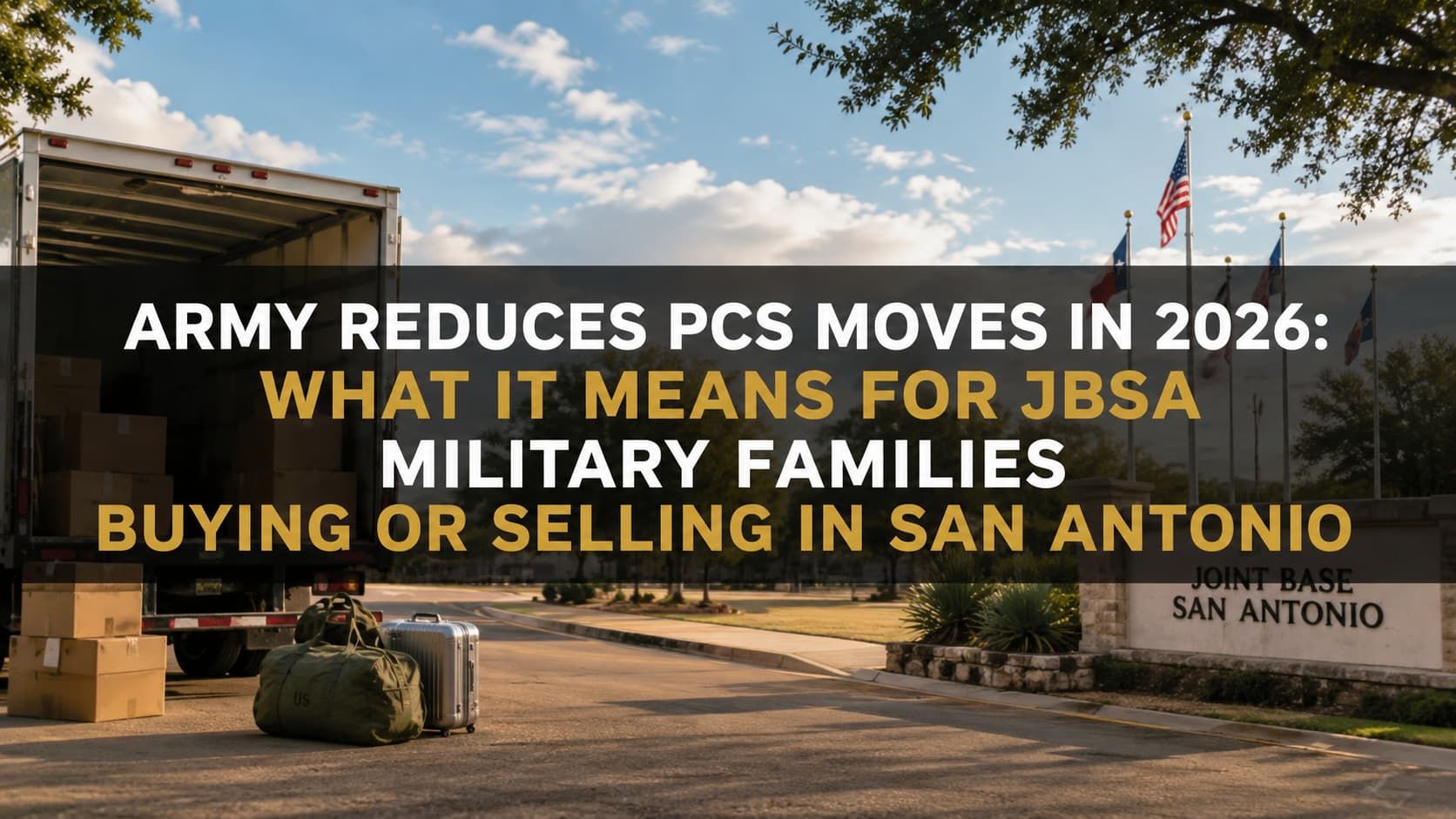
The Army is cutting more than 12,000 PCS moves in FY26 and over 13,600 in FY27, meaning thousands of military families will stay at their current duty stations longer. For families stationed at Joint Base San Antonio, this shift creates more time and stability to make informed housing decisions, including transitioning from renting to buying with a VA loan. For sellers near JBSA, fewer incoming PCS transfers could reduce the traditional cycle of military buyer demand that many neighborhoods depend on. Whether buying or selling, understanding how this policy change reshapes the local market is essential for making the right move in 2026.
The U.S. Army announced in June 2026 that it is significantly reducing Permanent Change of Station moves across the force, cutting more than 12,000 relocations in FY26 and over 13,600 in FY27. For military families stationed at Joint Base San Antonio, one of the largest military installations in the Department of Defense, this policy shift carries direct implications for housing decisions, neighborhood stability, and the local real estate market across San Antonio, Schertz, Cibolo, Converse, and surrounding communities.
Tami Price, REALTOR®, notes that PCS cycles have historically driven a significant share of buyer and seller activity in neighborhoods surrounding JBSA-Fort Sam Houston, JBSA-Lackland, and JBSA-Randolph, and any structural change to how often military families move reshapes both demand and timing in the local housing market. The sections below break down what the Army's announcement means for military families evaluating whether to buy, sell, or stay.
What Is the Army's PCS Reduction and Why Is It Happening?
The Army's Human Resource Continuous Transformation initiative is driving a broad reduction in scheduled PCS moves. According to the Army's June 2026 announcement, the goal is to keep warfighting formations intact longer, build more cohesive teams, boost readiness, and provide predictability for Soldiers and their families. This is not a temporary freeze or a budget-driven pause. It represents a structural shift in how the Army approaches personnel management.
- More than 12,000 PCS moves are being cut in FY26, with over 13,600 additional cuts planned for FY27
- The Stabilization Retention Option enabled approximately 6,200 Soldiers to remain at their duty station in FY25
- The High School Stabilization program benefited approximately 4,000 Soldiers by allowing families to stay through a child's senior year
- Over 5,000 school-related PCS moves were avoided in FY25 by expanding distance learning and temporary duty attendance models for Professional Military Education courses
- Pilot programs at installations including Fort Riley and Fort Bliss are offering retention bonuses to Soldiers who choose to stay at their current location
The combined effect is significant. Tens of thousands of military families who would have moved in 2026 and 2027 under the previous system will instead remain at their current installations, including the thousands of Soldiers and families assigned to JBSA.
Q: Does this PCS reduction apply to all branches or just the Army?
A: The June 2026 announcement specifically addresses Army PCS reductions under the HR Continuous Transformation initiative. Other branches may implement similar programs independently, but this policy applies to Army personnel. Families at JBSA assigned to Air Force or other branch components should verify their specific PCS guidance through their respective personnel channels.
How Does This Affect Military Families Considering Buying a Home Near JBSA?
For military families who are now staying at JBSA longer than originally anticipated, the housing calculus changes in meaningful ways. A family that expected a two-year assignment and planned to rent may now be looking at three, four, or even five years at the same duty station. That timeline shift often moves the financial math from favoring a rental to favoring a home purchase with a VA loan.
- Longer station time favors buying. The general guidance many financial advisors reference is that buying makes more financial sense when a family plans to stay in a home for at least three years. With stabilization extending tours beyond the traditional two to three year PCS cycle, more JBSA families now cross that threshold.
- BAH can build equity instead of paying rent. Military families using Basic Allowance for Housing toward a mortgage payment build equity each month rather than funding a landlord's investment. Over a four or five year stabilized tour, that equity accumulation becomes meaningful.
- VA loan benefits are especially strong in the current market. Zero down payment requirements, competitive interest rates, and no private mortgage insurance combine to make VA loan homebuying in San Antonio accessible even for families who have not accumulated a traditional down payment.
- More time means more choices. Families who previously felt rushed by a tight PCS timeline now have breathing room to evaluate neighborhoods and communities thoroughly before committing to a purchase.
Q: Should a military family buy a home if they still might PCS in two to three years?
A: The decision depends on the specific family's financial situation, BAH rate, local home prices, and risk tolerance. Even a two to three year ownership window can make financial sense in certain price ranges and market conditions. A conversation with a Military Relocation Professional and a VA-experienced lender can help clarify the numbers for each family's situation.
What Does the PCS Reduction Mean for Military Families Already Selling Near JBSA?
Sellers in neighborhoods that have traditionally depended on a steady flow of incoming military buyers need to understand that the PCS reduction could slow that pipeline. Fewer families receiving orders to JBSA means fewer buyers entering the market at the pace sellers may have come to expect.
- Incoming buyer volume may decrease in military-heavy neighborhoods. Communities near JBSA-Fort Sam Houston, JBSA-Lackland, and JBSA-Randolph that have historically attracted incoming PCS families could see fewer competing offers and longer days on market for listings.
- Pricing accuracy becomes even more important. In a market where the buyer pool may be smaller, pricing a home accurately from day one is critical. Overpriced listings in military corridors that previously sold quickly due to steady PCS demand may now sit longer.
- Sellers who are PCSing themselves face dual pressure. A family that receives PCS orders while trying to sell in a market with fewer incoming military buyers needs a clear PCS selling strategy that accounts for realistic timelines and pricing.
- VA loan assumptions may become more attractive. Sellers with existing VA loans at lower interest rates may find that VA loan assumptions attract buyers who would otherwise look elsewhere, particularly if the assumable rate is significantly below current market rates.
Q: Will home values near JBSA decline because of fewer PCS moves?
A: The PCS reduction alone is unlikely to cause significant price declines near JBSA. San Antonio's housing demand comes from multiple sources beyond military relocations, including civilian job growth, healthcare sector expansion, and general population migration. However, sellers in neighborhoods where military buyers historically represented a large share of demand should price and prepare their homes with a realistic understanding of the current buyer pool.
How Does This Policy Change Affect the Broader San Antonio Housing Market?
San Antonio is known as Military City USA for good reason. JBSA is one of the largest military installations in the country, and the military community represents a meaningful segment of local housing activity. Any policy that changes how frequently military families move through San Antonio affects inventory levels, rental markets, and buyer demand patterns across the metro.
- Fewer PCS moves means fewer homes listed for sale by departing military families, which could tighten inventory in certain neighborhoods even as overall San Antonio inventory has been rising
- The rental market near JBSA installations may see increased demand from families who previously would have purchased but are now staying for a shorter or less certain timeframe
- Neighborhoods farther from JBSA that compete for military buyers on quality of life factors may see less military buyer traffic as stabilized families have more time to evaluate but fewer are entering the market fresh
- Civilian buyers and sellers should understand that any shift in military housing patterns has ripple effects across the broader metro, particularly in family-oriented communities in Schertz, Cibolo, Converse, and the northeast corridor
The Army's announcement also comes at a time when San Antonio has already experienced broader market shifts, including rising inventory and longer days on market across Bexar and surrounding counties. The PCS reduction adds another variable to an already evolving market, making professional guidance on PCS-related housing decisions more valuable than ever.
Q: Does this policy affect Air Force families at JBSA-Lackland and JBSA-Randolph?
A: The June 2026 announcement specifically addresses Army personnel reductions. Air Force PCS policies are managed separately. However, the housing market effects in shared neighborhoods near JBSA are interconnected. A reduction in Army PCS activity affects the same neighborhoods where Air Force families buy and sell, so all military families should factor this context into their housing decisions.
What Should JBSA Families Who Are Staying Put Consider About Their Current Housing?
Families who learn they are stabilizing at JBSA rather than PCSing should take the opportunity to evaluate whether their current housing situation still serves their needs for the extended timeframe. A home or rental that worked for a planned two-year tour may not be the right fit for four or five years.
- Renters should run the buy-versus-rent math. With an extended tour now likely, families currently renting should evaluate whether purchasing a home with a VA loan would be more financially advantageous over the remaining time at station. The current inventory in San Antonio offers options across multiple price points and neighborhoods.
- Current homeowners should assess equity and condition. Families who purchased when they first arrived at JBSA may have built equity that opens options, including refinancing, making improvements, or evaluating whether a move-up purchase makes sense during the extended tour.
- Families with school-age children should consider school district alignment. The High School Stabilization program specifically allows families to stay through a child's senior year, which means school quality and proximity become long-term factors rather than temporary compromises. Exploring top neighborhoods for military families with strong school options is worth the time.
- New construction may now be a viable option. Families who previously dismissed new construction because the build timeline did not align with a short tour may now have the time to build and enjoy a new home. The spec home versus to-be-built comparison is especially relevant for stabilized families.
How Should Military Families Approach Real Estate Decisions Differently Under This New Policy?
The core shift is one of timeline and certainty. Under the traditional PCS cycle, military families made housing decisions under significant time pressure, often searching for homes during PTDY with a firm report date driving every deadline. The PCS reduction gives many families something they have rarely had: time to plan.
- Families should work with a REALTOR® who holds the Military Relocation Professional designation and understands how stabilization, PTDY, and VA loan timelines interact with the local market
- Buyers should get pre-approved before touring so they can move quickly when the right home appears, even though stabilization provides more flexibility
- Sellers who are still PCSing under orders should begin the listing timeline evaluation as early as possible to maximize market exposure before their departure date
- All military families should maintain awareness that policy changes can evolve. Building flexibility into housing decisions, including understanding VA loan assumption options and exit strategies, protects against future changes in assignment length or location
Q: Should stabilized families rush to buy before other stabilized families create more competition?
A: San Antonio's current housing market has elevated inventory across most price ranges, so competition pressure from stabilized families entering the market is unlikely to create urgency. Families should take advantage of the time stabilization provides to make thoughtful, well-researched decisions rather than reacting to perceived urgency.
Expert Insight from Tami Price
Tami Price, REALTOR®, a Broker Associate with Real Broker, LLC and USAF veteran, brings nearly two decades of experience and approximately 1,000 closed transactions serving military families and civilian buyers and sellers across San Antonio, Schertz, Cibolo, Helotes, Converse, and Boerne. As a RealTrends Verified Top Agent and Military Relocation Professional with more than 650 five-star reviews and recommendations, she understands the unique pressures military families face when making housing decisions around PCS orders, stabilization, and VA loan eligibility.
"This PCS reduction is one of the most significant personnel policy changes for military families in years, and it changes the housing conversation for thousands of families at JBSA," says Tami Price, REALTOR®. "For families who are staying longer, the opportunity to build equity through homeownership instead of paying rent is real, and the VA loan makes that accessible without a traditional down payment. For sellers in military-heavy neighborhoods, the shift means pricing and preparation matter more than ever because the steady pipeline of incoming PCS buyers that many sellers have relied on is smaller now. Every family's situation is different, and the right strategy depends on how long they are staying, what their BAH covers, and what their goals are beyond their current assignment. That is exactly the kind of conversation a Military Relocation Professional is trained to help with."
The intersection of military personnel policy and local real estate conditions is something many real estate agents are not equipped to navigate. Families stationed at JBSA benefit from working with representation that understands both sides of that equation.
Three Key Takeaways
1. The Army's PCS reduction gives stabilized JBSA families more time to make informed housing decisions, and many should evaluate buying over renting. With more than 25,000 PCS moves being cut across FY26 and FY27, thousands of families at JBSA will remain at station longer than originally planned. That extended timeline often shifts the financial math toward homeownership, especially with VA loan benefits that eliminate down payment requirements. Families should run the numbers with a VA-experienced lender and a local REALTOR® who understands military housing patterns.
2. Sellers near JBSA should recognize that the traditional cycle of incoming military buyer demand may slow, and pricing strategy must adjust accordingly. Fewer PCS orders to San Antonio means fewer families entering the market with immediate housing needs. Sellers in military corridor neighborhoods should price competitively from day one and invest in home preparation to attract both military and civilian buyers rather than relying on the volume of incoming transfers that characterized previous years.
3. This policy change adds another variable to an already shifting San Antonio housing market, and professional guidance is more important than ever. The PCS reduction is happening alongside broader market trends including rising inventory and longer days on market across the metro. Military families navigating buying, selling, or deciding whether to stay in their current home should work with a Military Relocation Professional who can connect the policy implications to the local market data and each family's specific circumstances.
Frequently Asked Questions
Q. How many PCS moves is the Army cutting in 2026 and 2027?
A. The Army is cutting more than 12,000 PCS moves in FY26 and over 13,600 in FY27. These reductions are part of the HR Continuous Transformation initiative designed to improve readiness and family stability across the force.
Q. Does the PCS reduction affect families already at JBSA?
A. Yes. Families who were expecting PCS orders may find their tours extended under stabilization programs. The Stabilization Retention Option and High School Stabilization program allow Soldiers to remain at their current duty station, which directly affects housing timelines and decisions for JBSA families.
Q. Should military families at JBSA buy a home if they are stabilized?
A. Stabilization often makes buying more financially favorable than renting, especially for families who will remain at station for three or more years. The VA loan's zero down payment and competitive rates make homeownership accessible. Each family should evaluate their specific BAH, price range, and long-term plans before deciding.
Q. Will fewer PCS moves lower home prices near JBSA?
A. The PCS reduction alone is unlikely to cause significant price declines. San Antonio's housing demand comes from multiple sources beyond military relocations. However, neighborhoods where military buyers represent a large share of demand may experience longer days on market and more buyer negotiating leverage.
Q. How does this affect military families who still receive PCS orders to San Antonio?
A. Families who do receive PCS orders to JBSA in 2026 and 2027 will enter a market with more inventory and less competition from other incoming military buyers. This creates favorable buying conditions, including more negotiating room and time to evaluate neighborhoods.
Q. Is new construction a good option for stabilized military families?
A. Stabilized families now have the time that new construction build cycles require, which was often a barrier under traditional two to three year PCS assignments. Builders in the San Antonio metro are offering incentives including rate buydowns and closing cost credits, making new construction worth evaluating for families with extended tours.
Q. What is the High School Stabilization program?
A. The Army's High School Stabilization program allows families to remain at their current duty station through a child's senior year of high school. Approximately 4,000 Soldiers benefited from this program in the past year. For housing purposes, this program provides the timeline certainty that supports a home purchase decision.
Q. Should sellers near JBSA wait to list until PCS season?
A. Traditional PCS season timing may be less reliable as a selling strategy given the reduction in moves. Sellers should base their listing timeline on current market conditions, personal circumstances, and competitive pricing rather than waiting for a seasonal wave of military buyers that may be smaller than in previous years.
The Bottom Line
The Army's decision to cut more than 25,000 PCS moves across FY26 and FY27 is a structural policy change, not a temporary adjustment, and it carries real consequences for the San Antonio housing market. Military families at JBSA who are stabilizing have an opportunity to approach homeownership with more time and information than the traditional PCS cycle has ever allowed. Sellers near military corridors need to adapt their pricing and preparation strategies to reflect a buyer pool that may look different from what they have experienced in previous years.
Every military family's housing situation is shaped by a combination of assignment length, BAH rate, family size, school needs, and long-term financial goals. A consultation with a Military Relocation Professional who understands both the policy landscape and the local market data is the most effective way to turn this announcement into a clear, personalized housing strategy.

Contact Tami Price, REALTOR® | San Antonio, TX
Tami Price, REALTOR®, provides expert guidance for military families, buyers, and sellers across the greater San Antonio metro and Joint Base San Antonio area.
📞 210-620-6681
Tami Price's Specialties
- Buyer and Seller Representation
- Military Relocations and PCS Moves
- VA Loan Guidance
- New Construction
- First-Time Home Buyers
- Move-Up Buyers
- Downsizing and Rightsizing
- Strategic Pricing and Market Analysis
- San Antonio, Schertz, Cibolo, Helotes, Converse, Boerne, and New Braunfels
Disclaimer
This blog is for informational purposes only and does not constitute legal, financial, or real estate advice. Military policy details referenced in this post are based on the U.S. Army's June 2026 announcement and may evolve. Service members should verify PCS and stabilization eligibility through their chain of command and servicing personnel office. Market conditions change, and individual circumstances vary. Readers should consult qualified professionals before making real estate decisions. Tami Price, REALTOR®, is licensed in Texas and affiliated with Real Broker, LLC. Fair Housing principles apply to all content.
Categories
- All Blogs (644)
- Home Buying (21)
- Neighborhood Guides (41)
- 10 Incentive and Rate Buydown Questions (1)
- 10 Military Neighborhood (1)
- 10 Mistakes Sellers Make (1)
- 10 Strategies to Coordinate a Same Day Close (1)
- 12 Lifestyle Questions to Move In (1)
- 12 PCS What Ifs (1)
- 12 Photos and Marketing Assets (1)
- 13 PCS Hunting Trip Tips (1)
- 14 Design Center Decisions (1)
- 15 Red Flags Touring Home in San Antonio (1)
- 2026 Market (1)
- 30 days after closing your home (1)
- 7 Offer Terms Beyond Price (1)
- 7 VA Specific Questions (1)
- 78015 Ranked One (1)
- 8 Bridge (1)
- 8 Myths Buyers Believe about Down Payments (1)
- 8 Reasons VA Buyers Love New Construction (1)
- 9 Mistakes Move Up Buyers Make (1)
- 9 Questions to Decide If You Keep Your PCS Home (1)
- 9 Timeline Questions Every Buyer Need to Ask (1)
- 9 Warranty Questions to Ask (1)
- 9 Ways to Attract VA & Military Buyers (1)
- 90 days before your move (1)
- About Tami Price (6)
- Active Adult Homes (1)
- Affordable Communities (2)
- Affordable Homes (1)
- Affordable Housing & Community Development (3)
- Agent Qualifications and Credentials (1)
- Agent Qualifications and Experience (1)
- Agent Recognition (3)
- Agent Selection (1)
- AI and Real Estate Tools (1)
- Alamo Heights (4)
- Alamo Heights ISD (1)
- Alamo Ranch (2)
- Amenities in Helotes, Texas (3)
- Appraisals (1)
- Arts and Culture (1)
- Awards and Recognition (7)
- Balcones Creek (1)
- Best Neighborhoods to Live in Cibolo, TX (3)
- Best Neighborhoods to Live in San Antonio (15)
- Best Places to Live in Northeast Inner Loop: A Neighborhood Guide (1)
- Bexar County Property Tax (1)
- Bexar County Real Estate (3)
- Blue Tape Walkthrough (1)
- Boerne Home Sellers (1)
- Boerne Texas (4)
- Builder Contracts & Warranties (3)
- Builder Incentives (1)
- Builder Warranties (1)
- Buyer (64)
- Buyer Activity San Antonio (1)
- Buyer and Seller Guidance (3)
- Buyer Due Diligence (1)
- Buyer Education (45)
- Buyer Guide (9)
- Buyer Guides (7)
- Buyer Protection Strategies (1)
- Buyer Representation (1)
- Buyer Representation Expertise (1)
- Buyer Resources (91)
- Buyer Strategy (2)
- Buyers (13)
- Buyers Agent (1)
- Buying a Foreclosed Home in San Antonio (10)
- Buying a Home (4)
- Buying a Home in San Antonio (6)
- Buying Near JBSA (1)
- Buying Timeline (1)
- Buying vs Renting (1)
- Castroville, TX (8)
- Central Texas Growth (1)
- Choosing a Real Estate Agent (1)
- Choosing an Agent (1)
- Cibolo Communities (1)
- Cibolo Home Sellers (1)
- Cibolo TX (12)
- Client Reviews and Testimonials (1)
- Client Satisfaction (1)
- Client Stories (1)
- Client Testimonial (4)
- Clients review (4)
- Closing (1)
- Cobblestone (1)
- Comal County (1)
- Commercial & Retail Development (2)
- Commercial Development (1)
- Community (1)
- Community Development (2)
- Community Development and Real Estate (1)
- Community Guides (1)
- Community Investment Impact (1)
- Community Spotlights (1)
- Commuter Neighborhoods (1)
- Cons of Living in Helotes, TX (4)
- Conservation Communities (1)
- Contingency Questions (1)
- Converse Home Sellers (1)
- Converse Homes For Sale (3)
- Converse Real Estate (1)
- Converse TX (10)
- Cost of Living Guides (1)
- Cost of Living in San Antonio TX (23)
- Custom Homes (5)
- Davis Ranch (1)
- Days on Market (1)
- Down Payment Assistance (1)
- Downtown Revitalization (1)
- Downtown San Antonio (2)
- Dual Military (1)
- East Side Living (1)
- Economic Development (1)
- Education, Texas Hill Country (1)
- Emerald Pointe (1)
- Employment (1)
- Employment Corridors (1)
- Encino Forest (1)
- Equity and Pricing Strategy (2)
- Equity Q&A (1)
- Established Communities (3)
- Events in San Antonio (34)
- Expert Advice from Tami Price, Realtor® (7)
- Fair Oak Ranch (1)
- Family Homes (3)
- FAQ (1)
- Far Northwest San Antonio (1)
- Far West San Antonio (1)
- Farmer Markets in San Antonio (1)
- Fastest Growing Zip Codes in America (1)
- Featured Homes for Sale (2)
- Featured Properties (1)
- Final Walkthrough (1)
- Financial Planning (11)
- Financing Strategy (1)
- First Time Buyers (23)
- First Time Sellers (1)
- First-Time Buyers (6)
- First-Time Homebuyer Resources (4)
- First-Time Homebuyer Tips (2)
- First-Time Homebuyers (6)
- First-Time Investors (1)
- Fort Sam Houston (3)
- Fort Sam Houston Real Estate (1)
- Fort Sam Houston, TX (2)
- Fox Grove (1)
- FSBO vs Agent Representation (1)
- Future Rental (1)
- Gated Communities (5)
- Golf Communities (1)
- Great Northwest (1)
- Greater San Antonio Housing Trends (2)
- Greater San Antonio Real Estate (5)
- Growth and Development (11)
- HELOC (1)
- Helotes Home Sellers (1)
- Hill Country (1)
- Hill Country Communities (2)
- Hill Country Development (1)
- Hill Country Homes for Sale (1)
- Hill Country Real Estate (2)
- Hill Country Retreat (1)
- Historic Districts (5)
- Historic Neighborhoods (4)
- Holiday Guide (1)
- Home Buyers (1)
- Home Buying (7)
- Home Buying Education (3)
- Home Buying Guide (7)
- Home Buying Process (8)
- Home Buying Strategy (2)
- Home Buying Tips (5)
- Home Energy Efficiency San Antonio (5)
- Home Financing (3)
- Home Improvement ROI (1)
- Home Inspections (3)
- Home Maintenance (1)
- Home Preparation (2)
- Home Pricing Strategy (14)
- Home Renovation for Resale (1)
- Home Sellers (1)
- Home Selling (12)
- Home Selling Guide (12)
- Home Selling Strategies (3)
- Home Selling Strategy (3)
- Home Selling Tips (23)
- Home Staging and Updates (2)
- Home Values (2)
- Homebuyer Education (15)
- Homebuyer Resources (1)
- Homebuying Guide (1)
- Homebuying Tips (3)
- Homeowner (32)
- Homeowner Tax Benefits (1)
- Homeownership Costs (1)
- Homes for Sale (2)
- Homes for sale near Lackland AFB (2)
- Homestead amenities (1)
- Horizon Pointe (1)
- House Hunting Guide (1)
- Housing Development (1)
- Housing Market Updates (3)
- How to Buy a House in San Antonio TX (43)
- Hunters Ranch (1)
- Hybrid (1)
- In Person (1)
- Incorporated Cities (6)
- Industry News (2)
- Industry Recognition (1)
- Infrastructure & Growth Projects (2)
- Interest Rates (2)
- Invest in San Antonio (32)
- Investment Opportunities (1)
- Investment Property San Antonio (3)
- JBSA (8)
- JBSA Housing (11)
- JBSA Real Estate (2)
- JBSA Resources (7)
- Joint Base San Antonio (4)
- Joint Base San Antonio Housing (1)
- Judson ISD (2)
- Lackland AFB (5)
- Lackland AFB Housing (1)
- Land Use Planning (1)
- Lera MLS (15)
- Lifestyle & Community Growth (2)
- Lifestyle & Local Growth (1)
- Lifestyle Communities (1)
- Listing Preparation (1)
- Listing Strategy (1)
- Live Oak (1)
- Living in San Antonio, TX (44)
- Living Near Randolph AFB (5)
- Loan Programs (1)
- Local Development News (2)
- Local Market Insights (4)
- Local News Around San Antonio (1)
- Luxury Communities (3)
- Luxury Homes (4)
- Luxury Real Estate (2)
- MacArthur Park (1)
- Making Offers on Homes (1)
- Market Analysis (24)
- Market Conditions (47)
- Market Expertise (1)
- Market Insights (5)
- Market Strategy (2)
- Market Timing (2)
- Market Trends (6)
- Market Trends & Insights (2)
- Market Update (17)
- Market Update 2026 (1)
- Market Updates (17)
- Master Planned Communities (12)
- Medical Center Area Real Estate (1)
- Medina Valley ISD (2)
- Midtown Living (1)
- Military & Economic Impact (3)
- Military Buyers (3)
- Military Communities (1)
- Military Families (1)
- Military Family Resources (1)
- Military Homebuying (3)
- Military Homeownership (1)
- Military Housing (2)
- Military Housing Market in Texas (14)
- Military Life in San Antonio (2)
- Military Neighborhoods (1)
- Military PCS Relocations (3)
- Military Real Estate (2)
- Military Relocation (100)
- Military Relocation & VA Loans (10)
- Military Relocation San Antonio (4)
- Military Relocation Services (3)
- Military Relocation to San Antonio (46)
- Military Relocations (18)
- Military Relocations & VA Home Loans (5)
- MLS Accuracy & Data Transparency (1)
- Mortgage Programs (1)
- Mothers Day in San Antonio (1)
- Move to Boerne TX (15)
- Move to Castroville TX (9)
- Move to Converse TX (14)
- Move to New Braunfels (1)
- Move to North San Antonio (16)
- Move to San Antonio TX (64)
- Move to Selma TX (17)
- Move to Shertz TX (10)
- Move to Texas (45)
- Move Up Buyer Resources (1)
- Move Up Buyers (24)
- Move-In Ready Homes (3)
- Move-In Ready Homes San Antonio (2)
- Move-Up Buyers (2)
- Moving to Helotes, TX (14)
- Moving to San Antonio (61)
- MUD Taxes (1)
- Natalia Homes For Sale (1)
- Near East Side Living (1)
- Negotiation Strategy (2)
- Neighborhood Amenities (1)
- Neighborhood Guides (7)
- Neighborhood Spotlights (3)
- Neighborhoods near Randolph AFB (9)
- New Braunfels (4)
- New Braunfels Homes For Sale (1)
- New Braunfels News (2)
- New Braunfels Real Estate (2)
- New Construction (63)
- New Construction Communities (1)
- New Construction Homes (12)
- New Construction Homes San Antonio (5)
- New Construction vs Resale (2)
- New Construction Without Customization (1)
- New Construction Without the Wait (1)
- New Contruction Cost (1)
- New Listing (13)
- News (21)
- News & updates (23)
- No City Tax (1)
- No HOA Homes (1)
- North Central San Antonio (5)
- North East ISD (4)
- North San Antonio (7)
- North Side Neighborhoods (1)
- North Side San Antonio Development (1)
- Northeast Inner Loop (1)
- Northeast Inner Loop Neighborhoods (1)
- Northeast San Antonio (1)
- Northside ISD (5)
- Northwest San Antonio (6)
- Northwest San Antonio Real Estate (2)
- Northwood (1)
- Olympia Hills (1)
- One-Story Homes (1)
- Outdoor Living (1)
- PCS and JBSA (2)
- PCS checklist (1)
- PCS Guide (4)
- PCS Moves (12)
- PCS Moves to Joint Base San Antonio (4)
- PCS Planning (16)
- PCS Randolph AFB (15)
- PCS Relocation (1)
- PCS Resources (6)
- PCS San Antonio (42)
- PCS to San Antonio (38)
- PID Assessments (1)
- Pinon Creek (1)
- Pipe Creek (1)
- Places to Eat Near Randolph AFB (1)
- Pool Homes (1)
- Pre Approval (1)
- Pre-Listing Preparation (2)
- Pre-Listing Process (1)
- Prescott Oaks (1)
- Preserve at Medina (1)
- Pricing and Marketing Strategy (3)
- Professional Awards and Achievements (2)
- Professional Real Estate Representation (1)
- Property Tax Exemptions Texas (1)
- pros and cons living in Converse TX (3)
- Pros and Cons Living in Selma TX (6)
- Pros and Cons of Living in Castroville, TX (4)
- Pros and Cons of Living in San Antonio (30)
- PT500 List (1)
- Purchase Negotiation (1)
- Quick Close Real Estate (1)
- Randolph AFB Neighborhoods (2)
- Real Estate (1)
- Real Estate Advice (1)
- Real Estate Agent Recognition (6)
- Real Estate Agent Selection (2)
- Real Estate Agent Value (1)
- Real Estate Consultation (1)
- Real Estate Finance (1)
- Real Estate Financing (1)
- Real Estate Impact (1)
- Real Estate Investment San Antonio (1)
- Real Estate Market Trends (3)
- Real Estate Professional Designations (1)
- Real Estate Strategy (1)
- Real Estate Technology & Trends (1)
- Real Estate Tips (1)
- Real Estate Tips and Guides (2)
- Real Estate Trends (2)
- RealTrends Verified (1)
- Relocating to San Antonio (2)
- Relocation (4)
- Relocation Resources (2)
- Relocation to San Antonio (49)
- Remote Homebuying (1)
- Rental Housing (1)
- Rental Property (1)
- Rental Strategy (1)
- Resale Properties (1)
- Retail Development (1)
- Retire in Boerne TX (10)
- Retire in San Antonio (31)
- Retirement Communities (1)
- Reviews and Recognition (1)
- Rockwall Ranch (1)
- Rural Living (2)
- Ryland Homes (1)
- SABOR (27)
- San Antonio Buyer Resources (2)
- San Antonio Communities (3)
- San Antonio Community Events (1)
- San Antonio Growth (1)
- San Antonio Home Buying and Selling (2)
- San Antonio Home Buying Guide (5)
- San Antonio Home Improvement (1)
- San antonio home prices (3)
- San Antonio Home Sellers (3)
- San Antonio Homeowner Guide (1)
- San Antonio Homes for Sale (13)
- San Antonio Housing Market (2)
- San Antonio Housing Market & Mortgage Financing (1)
- San Antonio Housing Market Analysis (1)
- San Antonio Housing Trends & Market Analysis (3)
- San Antonio Lifestyle Amenities (1)
- San Antonio Listing (1)
- San Antonio Living (1)
- San Antonio Market (3)
- San Antonio Market Updates (7)
- San Antonio Military Relocation (3)
- San Antonio Neighborhoods (48)
- San Antonio New Construction & Master-Planned Communities (2)
- San Antonio New Home Communities (1)
- San Antonio News (22)
- San Antonio Property Taxes (2)
- San Antonio Real Estate (164)
- San Antonio Real Estate Agents (6)
- San Antonio Real Estate Excellence (1)
- San Antonio Real Estate Guide (6)
- San Antonio Real Estate Market (32)
- San Antonio Real Estate Market Analysis (2)
- San Antonio REALTOR Awards (1)
- San Antonio Seller Resources (2)
- San Antonio Sellers (1)
- San Antonio Spec Homes (1)
- San Antonio Spurs Community Programs (1)
- San Antonio Urban Living (1)
- Scenic Loop (1)
- Schertz Home Sellers (1)
- Schertz Real Estate (1)
- Schertz, TX (11)
- School Information (1)
- SCUCISD Schools (1)
- Secured Quick Offer (1)
- Sell Home In San Antonio TX (50)
- Seller (50)
- Seller Education (24)
- Seller Guide (4)
- Seller Guides (1)
- Seller Representation Expertise (1)
- Seller Resources (69)
- Seller Should Understand (1)
- Seller Strategy (3)
- Seller Tips (2)
- Sellers (10)
- Selling A Home in San Antonio (49)
- Selling Your San Antonio Home (3)
- Selma TX (9)
- Single-Story Homes (4)
- Smart Homes (1)
- Solar Homes (3)
- Southtown (1)
- Spec Homes and Inventory Homes (2)
- Stone Oak (2)
- Suburban Housing Growth (2)
- Suburban Living (2)
- Talise De Culebra (1)
- Terrell Hills (2)
- Texas Acreage Properties (4)
- Texas Homestead Exemption (1)
- Things to do in San Antonio TX (16)
- Things to do Near Randolph AFB (3)
- Time Planning (1)
- Time-Sensitive Home Buying (1)
- Timing Strategy (1)
- Tips for Buying New Construction (9)
- Top Real Estate Agent in San Antonio (3)
- Transaction Coordination (1)
- Transportation Infrastructure (1)
- Two-Story Homes (2)
- Universal City (1)
- Updated Homes (2)
- Upscale Communities (1)
- Urban Communities (2)
- Urban Living (1)
- Urban Neighborhoods (4)
- VA Buyers (1)
- VA Home Loan Benefits (3)
- VA Loan Assumptions (3)
- VA loan benefits (27)
- VA Loan Guidance (1)
- VA Loan Home Buying Assistance (2)
- VA Loans (71)
- VA Loans and Military Benefits (3)
- VA Loans and Military Home Buying (3)
- VA Loans San Antonio (41)
- VET Benefits Living in San Antonio (3)
- Veterans Resources (3)
- Village Northwest (1)
- Virtual Buyers (1)
- Von Ormy Homes For Sale (1)
- week in sales (41)
- Weekly Sales Report (42)
- West San Antonio (2)
- West San Antonio Real Estate (1)
- Westover Hills Employment Corridor (1)
- Westover Valley (1)
- Windcrest Homes for Sale (1)
Recent Posts