San Antonio Real Estate Market Update: Early March 2026 Shows Rising Prices and Steady Activity
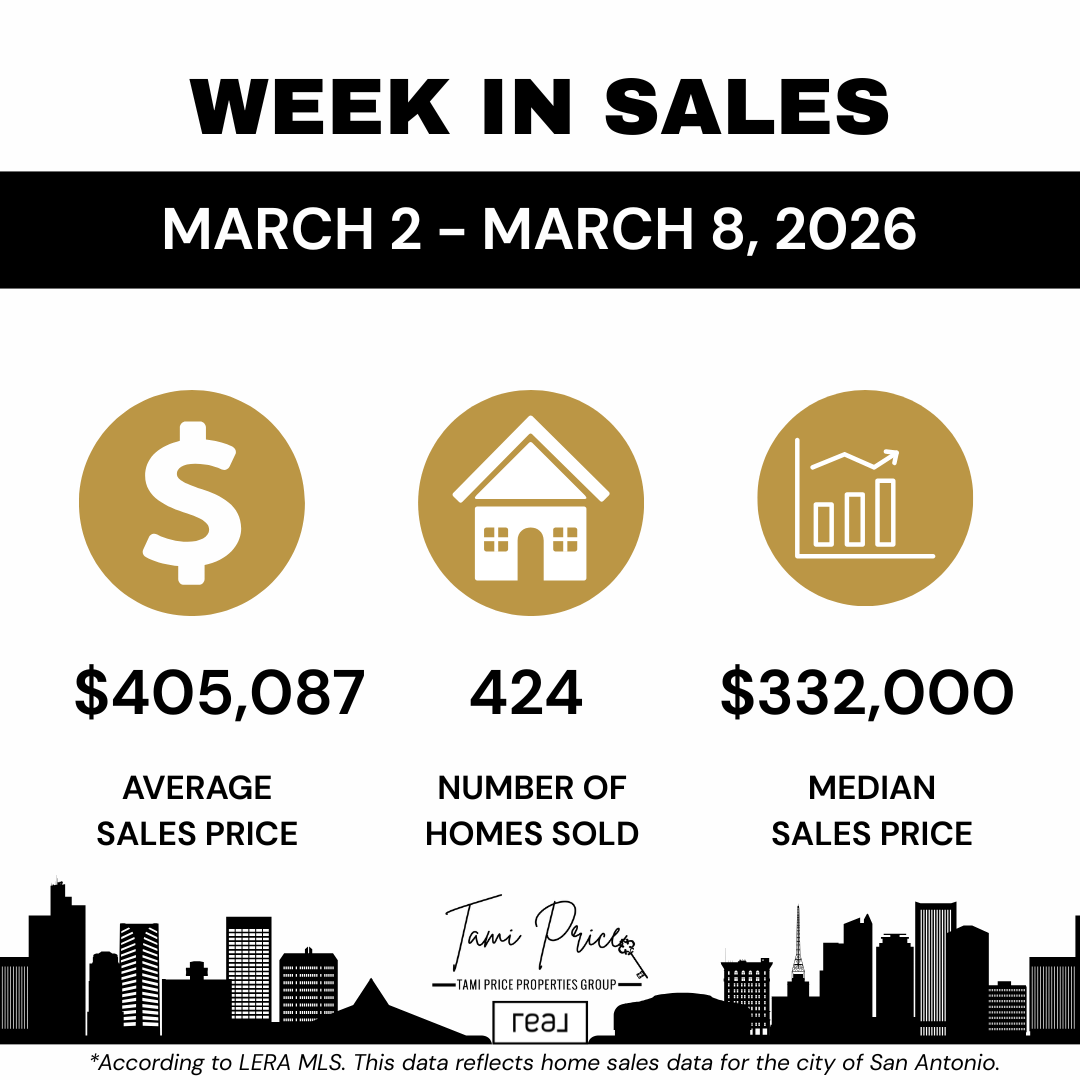
The San Antonio housing market continues to show steady activity as the spring season approaches, with weekly sales data from LERA MLS® providing valuable insight into how buyer demand, pricing trends, and transaction volume are evolving across the city and surrounding communities. When comparing the final week of February with the first week of March 2026, the numbers reveal a market that remains active while also showing notable upward movement in home prices across both median and average metrics that directly affects homeowners buying a home in San Antonio or selling a home in San Antonio.
The transition from February into March demonstrated a $31,250 median price increase alongside a dramatic $36,042 jump in average sales prices, even as weekly sales volume moderated from the exceptional 618-home closing week. Tami Price, REALTOR®, notes that this particular combination of rising prices with declining volume typically signals inventory composition shifts rather than uniform market appreciation, as higher-priced homes represented a larger share of total transactions during the first March week compared to the final February week. For buyers and sellers watching the market closely and making strategic decisions, these weekly trends provide valuable, real-time guidance on how pricing dynamics and demand patterns are shifting across different price segments throughout San Antonio, Schertz, Cibolo, Helotes, Converse, and Boerne.
Why This Matters for San Antonio Home Buyers and Sellers
Understanding the relationship between pricing changes and volume shifts reveals critical intelligence about market composition, buyer concentration, and segment-specific dynamics that monthly summaries completely obscure. When median prices rise by $31,250 and average prices jump by $36,042 while volume drops from 618 to 424 closings, this pattern indicates specific changes in which types of properties are reaching closing rather than sudden appreciation across all San Antonio real estate.
For buyers, recognizing that price increases reflect inventory composition rather than uniform value appreciation prevents panic reactions or rushed decisions based on fear that affordability is disappearing rapidly. Different price segments experience different competitive dynamics, and understanding where your target properties fall within the market structure helps calibrate appropriate offer strategies.
For sellers, these weekly variations confirm the importance of pricing based on recent comparable sales in your specific neighborhood and price range rather than citywide averages that may reflect transactions in completely different market segments. A seller with a $320,000 home gains no strategic positioning advantage from knowing that the citywide average reached $405,087 if that figure is heavily influenced by luxury closings above $600,000.
The early March data demonstrates that San Antonio's spring market is developing with strong underlying momentum while maintaining the price tier differentiation that requires segment-specific strategy rather than uniform approaches.
What Did the Week of February 23 Through March 1, 2026, Show?
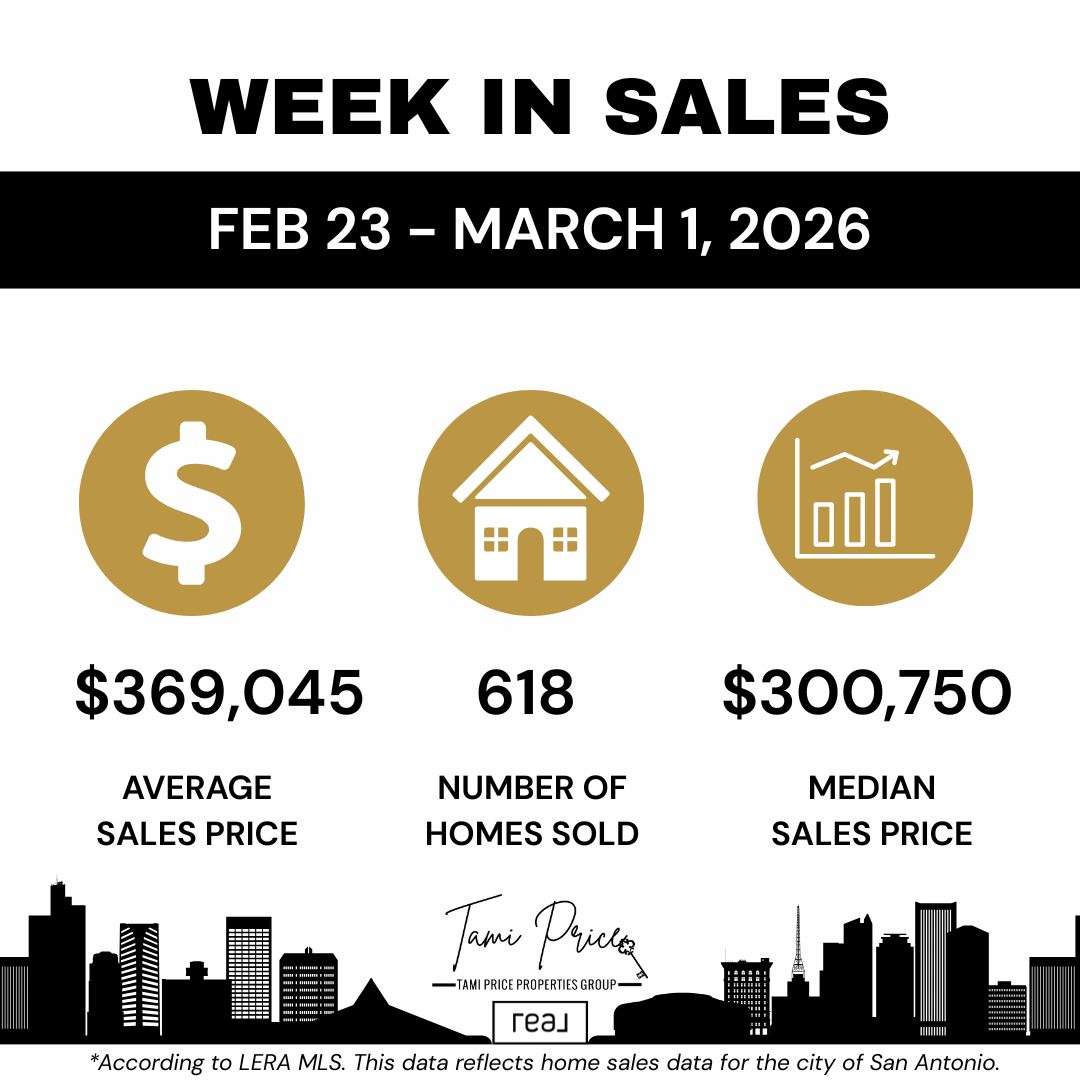
According to LERA MLS® data for the City of San Antonio, the week of February 23 through March 1, 2026, recorded exceptional transaction volume and pricing patterns that provided important baseline context for interpreting subsequent weekly performance.
This week saw impressive market metrics:
- 618 homes sold, representing one of the highest weekly volumes in recent data
- Average sales price of $369,045 indicating balanced activity across price tiers
- Median sales price of $300,750 showing the center of market activity just above $300,000
- Strong buyer engagement heading into the traditional spring selling season
- The $68,295 gap between average and median suggesting diverse price tier participation
A total of 618 homes closed during this period, indicating strong buyer activity and healthy market momentum approaching the spring market. The median sales price remaining just above $300,000 suggested that a large share of homes sold within mid-range price points, with entry-level and lower mid-range segments contributing significantly to overall transaction volume.
The difference between the median of $300,750 and average of $369,045 reflects how higher-priced homes continue to influence the overall average while the majority of buyers remained active in more moderate price ranges. This pattern indicated balanced market function across multiple segments rather than extreme concentration in any single price tier.
For sellers listing during this high-volume week, market conditions demonstrated robust buyer demand and consistent closing activity across diverse neighborhoods and price ranges. For buyers competing during this period, the strong volume confirmed that motivated buyers were successfully securing properties and reaching closing when financial preparation and decisive action aligned with appropriately priced inventory.
Q: Does the 618-home closing week represent sustainable market volume for San Antonio? A: No, 618 closings in one week typically represents closing timing concentration rather than new baseline activity level. Weekly volume around 350-450 closings represents more sustainable San Antonio market function. Single-week spikes often result from builder closings clustering, contract bunching from prior periods, or holiday delays clearing. Subsequent weeks typically show moderation toward historical averages.
What Did the Week of March 2 Through March 8, 2026, Reveal?
The following week showed a meaningful shift in both transaction volume and pricing metrics that provides important signals about inventory composition and market segment performance as March began. During the week of March 2 through March 8, 2026, San Antonio recorded 424 homes sold with dramatically different pricing characteristics compared to the prior week.
This week's data demonstrates several striking patterns:
- 424 total sales representing a 194-home decrease from the prior week's exceptional volume
- Average sales price surging to $405,087, a $36,042 increase from the prior week
- Median sales price rising to $332,000, a $31,250 increase from $300,750
- Both pricing metrics increasing substantially despite significantly lower volume
- Higher-priced homes representing a larger share of total transaction mix
While the number of homes sold decreased by 31% compared with the prior week, both the median and average sales prices increased substantially. The median price rose by more than $31,000, and the average price surpassed $405,000 for the first time in the recent weekly tracking period.
This pattern suggests that a larger share of sales occurred in higher price ranges during this particular week. The simultaneous increase in both median and average prices despite lower volume indicates that mid-range, upper-mid-range, and luxury properties comprised a higher percentage of total closings compared to the prior week's more balanced distribution.
Q: Does the $31,250 median price increase mean San Antonio home values appreciated 10% in one week? A: No. This reflects inventory composition changes, not appreciation. When the prior week closed heavy volume of entry-level and mid-range homes below $300,000, the median stayed around $300,750. When the current week closed a higher proportion of homes in the $320,000 to $450,000 range, the median naturally rose to $332,000. Individual home values did not appreciate 10% in seven days. This demonstrates why weekly median tracking requires understanding composition effects.
Understanding Price Increases with Volume Decreases
The combination of rising prices with declining volume represents a specific market signal that requires professional interpretation to avoid misunderstanding. This pattern does not indicate that buyer demand surged so dramatically that prices spiked despite fewer transactions. Instead, it reveals changes in which price segments dominated weekly closing activity.
When affordable homes below $280,000 represent 40% of one week's closings but only 25% of the next week's closings, the median naturally shifts upward even when no individual property appreciated in value. Similarly, when luxury homes above $500,000 represent 8% of one week's closings but 15% of the next week's closings, the average rises substantially.
Professional market analysis distinguishes these composition effects from genuine market-wide appreciation requiring strategic response from buyers and sellers. Understanding this distinction prevents reactive decisions based on statistical variations that have no bearing on individual property values or strategic positioning requirements.
What Can Rising Prices with Lower Volume Signal About Market Dynamics?
A decrease in the number of homes sold alongside an increase in pricing metrics often reflects shifts in the types of homes closing during a given week rather than sudden market-wide value appreciation. Higher-priced homes representing a larger share of total transactions raises both median and average price metrics even when individual property values remain stable.
In the San Antonio market, this particular weekly pattern does not necessarily signal a sudden surge in prices across all neighborhoods, price ranges, or property types. Instead, it reflects the normal timing of closings from contracts written in previous weeks, with March's first week happening to include a higher concentration of upper-mid-range and luxury transactions.
Several factors can create these inventory composition shifts:
- Luxury home closings clustering based on contract timing and contingency clearance
- Builder closings in higher-priced subdivisions concentrating in specific weeks
- Seasonal patterns where higher-priced buyers close transactions early in months
- Statistical variation in which price segments happen to reach closing simultaneously
- Normal market function where different segments move through closing processes independently
Understanding this distinction between composition effects and genuine appreciation is critically important when interpreting short-term market data and making strategic decisions. Buyers who see median prices rise by $31,250 and panic into rushed purchases may overpay for properties that would have been available at similar prices with patient evaluation. Sellers who see these weekly figures and immediately increase their list prices above recent comparable sales create positioning problems that extend market time unnecessarily.
Working with Tami Price, REALTOR®, buyers and sellers receive interpretation of weekly pricing variations within proper context, distinguishing composition effects from genuine trends requiring strategic adjustment to offer positioning or listing prices.
What Do These Weekly Trends Mean for San Antonio Home Buyers?
For buyers watching the San Antonio market and evaluating whether to proceed with purchases or continue searching, the early March weekly trends highlight several important strategic considerations. The $31,250 median price increase and $36,042 average price surge might initially suggest that affordability is deteriorating rapidly and that immediate action is necessary to avoid being priced out of target neighborhoods.
However, proper interpretation reveals that these price increases reflect inventory composition during one particular week rather than market-wide appreciation affecting all properties uniformly. Buyers should focus on recent comparable sales in their specific target neighborhoods and price ranges rather than reacting to citywide weekly statistics that may reflect transactions in completely different market segments.
Effective buyer strategy in current early spring conditions requires:
- Pre-approval from reputable lenders demonstrating financial capacity to sellers
- Focus on comparable sales in specific neighborhoods rather than citywide averages
- Understanding that weekly price variations often reflect composition, not appreciation
- Preparation to evaluate multiple properties before making purchase decisions
- Discipline to maintain offer strategies grounded in value analysis, not panic
Buyers who are pre-approved and familiar with current comparable sales analysis in their target areas are better positioned to move forward confidently when the right homes become available. Working with an experienced REALTOR® who tracks weekly market changes and provides proper interpretation helps buyers avoid overpaying in competitive situations while recognizing genuine opportunities when they appear.
The approaching spring season brings increased inventory as more sellers list properties, creating more choices for buyers evaluating options. However, spring also brings increased buyer competition as families prefer moving during summer months and weather improves for property evaluation and relocation timing.
Q: Should buyers increase their budgets if median prices are rising week to week? A: No. Buyers should maintain budgets based on their financial capacity and long-term affordability analysis, not weekly statistical variations. Weekly median shifts often reflect composition rather than uniform appreciation. Focus on whether specific target properties represent fair value based on recent comparable sales in those particular neighborhoods. Budget flexibility should come from genuine financial capacity changes, not reactive responses to weekly price statistics.
Comprehensive guidance on the home buying process in San Antonio from experienced REALTOR® representation helps buyers navigate weekly variations, seasonal transitions, and inventory composition effects with strategies grounded in comparable sales analysis rather than emotional reactions to statistical shifts.
What Do These Trends Signal for San Antonio Home Sellers?
For sellers contemplating listing their properties or currently on market seeking offers, the early March pricing data demonstrates that buyers continue moving forward with purchases across all price ranges, including mid-range, upper-mid-range, and luxury segments. The increase in both median and average sales prices demonstrates that buyers are still willing to pay strong prices when homes are positioned correctly in the market based on recent comparable sales and competitive inventory evaluation.
However, this weekly pricing data does not eliminate the fundamental importance of realistic, accurate pricing grounded in neighborhood-specific comparable sales analysis. The $332,000 median and $405,087 average from March's first week reflect specific homes that closed during that particular period, not baseline values that all properties should target regardless of individual characteristics.
Successful seller strategy in current spring market conditions requires:
- Pricing based on recent comparable sales from past 30-60 days in specific neighborhoods
- Recognition that citywide median and average prices reflect diverse transactions across all segments
- Investment in proper preparation including repairs, cleaning, staging, and professional photography
- Marketing that reaches qualified buyers actively searching in your specific price range
- Responsive adjustment when showing feedback indicates positioning problems
Homes priced in line with recent comparable sales in their specific neighborhoods and price ranges continue to attract the most serious buyer interest and generate offers leading to successful closings. Overpricing based on optimistic weekly citywide statistics leads to longer days on market, reduced showing activity, and eventual price adjustments that could have been avoided through accurate initial positioning.
As spring approaches and inventory traditionally increases from March through May, sellers who prepare their homes well and price strategically based on current neighborhood-specific data may benefit from increased buyer visibility and engagement. However, spring also brings increased seller competition as more properties enter the market simultaneously.
Tami Price's comprehensive approach to pricing your San Antonio home incorporates weekly trend monitoring, seasonal pattern analysis, neighborhood-specific comparable sales evaluation, and current inventory assessment. This multi-layered methodology prevents pricing errors driven by misinterpreted weekly statistics while ensuring accurate positioning that captures buyer attention and generates appropriate offer activity.
Q: Can sellers increase their list prices mid-listing if weekly median prices are rising? A: Price increases mid-listing are rarely effective and often signal positioning problems. If your home is priced correctly based on comparable sales, it should generate offers without price increases. If it's not generating offers, the issue is likely overpricing relative to market value, not underpricing. Rising weekly medians reflecting composition effects provide no justification for raising already-listed prices. Focus on whether your current pricing aligns with recent comparable sales in your neighborhood and segment.
Preparing Properties for Spring Market Competition
The spring season from March through May represents the traditional peak period for San Antonio real estate inventory and buyer activity. Sellers who list during this window benefit from maximum buyer engagement but also face maximum competition from other sellers employing identical timing strategies.
Differentiation through superior property preparation, professional marketing, and accurate pricing becomes essential during high-inventory periods. Homes that stand out through excellent condition, compelling presentation, and competitive pricing capture disproportionate buyer attention while adequately prepared but overpriced properties languish despite strong overall market activity.
Comprehensive pre-listing consultation evaluating current weekly trends, seasonal expectations, competitive inventory, and property-specific positioning requirements provides the foundation for successful spring listing strategy.
How Should Weekly Market Data Be Interpreted Within Broader Context?
Weekly housing data provides valuable short-term snapshots of market activity, pricing dynamics, and transaction volume that reveal patterns monthly summaries obscure. However, weekly data requires proper interpretation within broader context to extract meaningful strategic guidance while avoiding reactive decisions based on statistical noise or composition effects.
Because real estate transactions close weeks after contracts are signed following inspection periods, appraisal completion, financing approval, and title work, weekly sales numbers reflect contract activity from 30 to 60 days earlier. This timing lag means that any particular week's closing composition may not represent current buyer behavior or market conditions.
Professional real estate market analysis monitors both weekly trends and broader monthly patterns to provide accurate guidance:
- Weekly data reveals short-term momentum, composition shifts, and segment-specific activity
- Monthly data provides statistical stability and reduces composition effect noise
- Quarterly data establishes seasonal patterns and year-over-year comparisons
- Annual data reveals long-term trends and market cycle positioning
The most effective market intelligence comes from integrating multiple timeframes and recognizing which patterns represent genuine trends requiring strategic response versus which reflect normal statistical variation that should be acknowledged but not overweighted in decision-making.
For military families managing PCS moves to or from San Antonio, understanding both weekly tactical intelligence and broader strategic context helps inform housing decisions made under compressed timelines. Working with REALTOR® representation holding the Military Relocation Professional designation ensures access to proper data interpretation alongside specialized knowledge of VA loan requirements, military clause provisions, and timeline management.
How Does Tami Price, REALTOR®, Guide Clients Using Weekly Market Intelligence?
Tami Price, REALTOR®, closely monitors weekly LERA MLS® sales data to help buyers and sellers understand current market conditions through professional interpretation that distinguishes meaningful signals from statistical noise. By analyzing trends including sales volume, median pricing shifts, average sales price changes, and inventory composition effects, she helps clients make informed decisions based on real-time information properly contextualized within broader market patterns.
Her approach focuses on clarity about what weekly data actually reveals, realistic expectations grounded in comparable sales analysis rather than reactive responses to statistics, and strategies that protect client interests throughout the buying or selling process regardless of short-term market variations.
For buyers, this means understanding which weekly price changes reflect composition effects versus genuine appreciation, recognizing when target neighborhoods show actual value movement versus statistical artifacts, and structuring offers based on recent comparable sales rather than citywide averages influenced by transactions in unrelated market segments.
For sellers, this means setting initial list prices based on neighborhood-specific comparable sales rather than citywide median or average figures, responding to actual showing feedback and buyer response rather than weekly statistical variations, and making strategic adjustments grounded in market reality rather than emotional reactions to perceived pricing trends.
This commitment to accurate data interpretation serves clients across all segments, from first-time home buyers navigating their initial purchase to move-up buyers coordinating sale and purchase timing to sellers managing estate situations or relocations to buyers exploring new construction alternatives with builder incentives and rate buydowns.
Expert Insight from Tami Price
With nearly two decades representing San Antonio buyers and sellers and approximately 1,000 closed transactions across multiple market cycles, Tami Price, REALTOR®, understands that early March's pricing increases with volume decrease represent normal inventory composition effects rather than sudden market transformation requiring immediate strategic response from all buyers and sellers.
"The $31,250 median increase and $36,042 average increase between late February and early March initially look dramatic, but proper analysis reveals this reflects which homes happened to close during each specific week," Tami explains. "The 618-home February week included heavy representation from entry-level and mid-range segments, keeping the median around $300,750. The 424-home March week included a higher proportion of upper-mid-range and luxury closings, naturally pushing both the median and average upward substantially."
Tami holds multiple designations including Pricing Strategy Advisor (PSA), Seller Representative Specialist (SRS), Accredited Buyer's Representative (ABR), Graduate REALTOR® Institute (GRI), and Military Relocation Professional (MRP). These certifications reflect ongoing education in pricing methodology, market analysis, statistical interpretation, and specialized service for military families managing relocations.
Her experience across boom markets, corrections, balanced markets, and recovery phases provides perspective that prevents reactive decision-making based on dramatic short-term statistics without proper understanding of underlying composition effects versus genuine market shifts.
"What I emphasize to clients evaluating early March data is that weekly statistics provide useful momentum indicators but should never drive individual transaction decisions without proper comparable sales analysis," Tami notes. "A buyer purchasing a $340,000 home should price their offer based on what similar homes in that specific neighborhood sold for recently, not on whether this week's citywide median was $300,750 or $332,000. A seller listing a $380,000 home should price based on comparable sales in their neighborhood and segment, not on whether this week's citywide average reached $405,087."
This commitment to grounding strategy in comparable sales analysis rather than reactive interpretation of weekly statistics has earned Tami recognition as a RealTrends Verified Top Agent, 15-time Five Star Professional® Award winner, and top real estate agent in San Antonio with more than 650 five-star reviews from satisfied buyers and sellers.
Three Key Takeaways
- The $31,250 median price increase and $36,042 average price surge between late February and early March reflect inventory composition shifts rather than uniform market appreciation, demonstrating why buyers and sellers must analyze recent comparable sales in their specific neighborhoods and price segments rather than reacting to citywide weekly statistics. When 618 homes closed in late February with balanced distribution across price tiers, the median stayed at $300,750 and average at $369,045. When 424 homes closed in early March with higher representation from upper-mid-range and luxury segments, both metrics rose substantially despite lower volume. This pattern illustrates composition effects that create statistical variations without indicating that individual home values appreciated 10% in one week. Buyers who panic into rushed purchases based on weekly median increases risk overpaying, while sellers who raise prices based on weekly averages risk overpricing relative to actual comparable sales in their neighborhoods.
- San Antonio's early March market demonstrates that rising prices with declining volume typically signal inventory mix changes rather than surging demand overwhelming supply, requiring professional interpretation to distinguish statistical artifacts from genuine appreciation trends that warrant strategic response. When both median and average prices rise simultaneously despite 31% lower volume, this combination indicates that higher-priced homes represented a larger share of total closings rather than that all properties across all segments appreciated uniformly. Genuine demand-driven appreciation typically shows rising prices with stable or increasing volume as buyers compete aggressively for limited inventory. Current patterns show balanced market function with normal segment rotation through closing processes. Understanding this distinction prevents reactive decisions that compromise buyer and seller outcomes through panic purchases or optimistic overpricing disconnected from comparable sales reality.
- Spring market development creates both opportunities and intensified competition for buyers and sellers, making accurate positioning based on neighborhood-specific comparable sales essential while weekly citywide statistics provide limited guidance for individual transaction strategy despite their value as momentum indicators. The transition from late February into March brings increased buyer engagement and rising inventory levels that define traditional spring market dynamics. Buyers benefit from more property choices but face more competition for well-positioned homes in desirable neighborhoods. Sellers benefit from peak buyer activity but compete against more alternative inventory for buyer attention. Success for both sides depends on accurate market knowledge at the neighborhood and price segment level rather than on citywide weekly statistics that aggregate diverse transactions across unrelated market segments. Working with experienced REALTOR® representation that monitors both weekly trends and comparable sales specific to your situation creates optimal strategic foundation.
Frequently Asked Questions
Q: What causes both median and average prices to increase substantially in the same week? A: Simultaneous increases in both metrics typically indicate that higher-priced homes represented a larger share of total closing volume during that week. When luxury and upper-mid-range properties comprise 30% of weekly closings instead of 20%, both the median (center point) and average (arithmetic mean) rise even when individual property values remain stable. This reflects inventory composition effects rather than market-wide appreciation.
Q: Should buyers increase their offer prices if weekly median prices show upward trends? A: No. Buyers should base offers on recent comparable sales of similar properties in specific target neighborhoods, not citywide weekly statistics. Weekly median variations often reflect composition changes rather than genuine appreciation affecting all properties. Overpaying based on weekly statistical trends rather than comparable sales analysis creates poor long-term value outcomes. Focus on whether specific properties represent fair value relative to recent neighborhood transactions.
Q: Can sellers justify higher list prices based on increasing weekly average sales prices? A: Not without comparable sales support in their specific neighborhood and price segment. Citywide averages aggregate transactions across all segments, many irrelevant to any individual property's market positioning. A seller with a $340,000 home cannot justify pricing at $380,000 because the citywide average reached $405,087 if recent comparable sales in their neighborhood show similar homes selling around $335,000 to $350,000. Price based on relevant comparables, not citywide statistics.
Q: Does declining sales volume with rising prices indicate a weakening or strengthening market? A: Neither automatically. This combination typically indicates inventory composition shifts where higher-priced homes represented larger share of weekly closings. Weakening markets show declining volume with declining prices. Strengthening markets show increasing volume with increasing prices. Current pattern shows normal composition variation within balanced market function. Examine multiple consecutive weeks to identify genuine directional trends versus single-week statistical noise.
Q: How many consecutive weeks of price increases are needed to confirm genuine appreciation versus composition effects? A: Examine at least 4-6 consecutive weeks of rising prices with stable or increasing volume to confirm genuine appreciation trends. Single or double-week price increases with declining or variable volume typically reflect composition effects. Also analyze whether increases occur uniformly across neighborhoods and price segments or concentrate in specific areas. Genuine market-wide appreciation affects most segments simultaneously while composition effects create isolated variations.
Q: Should military PCS buyers accelerate purchase timelines if prices appear to be rising? A: Military buyers should focus on achieving housing goals within PCS timeline constraints based on comparable sales analysis rather than reacting to weekly price statistics. Working with REALTOR® representation holding the Military Relocation Professional designation provides access to proper data interpretation alongside VA loan expertise and timeline management. Weekly variations reflecting composition effects should not drive accelerated decision-making that compromises due diligence or value evaluation.
Q: How does new construction pricing affect resale home weekly statistics in San Antonio? A: New construction activity influences weekly statistics when builder closings cluster in specific weeks based on construction completion timing. Heavy builder closing weeks may skew averages upward if new construction concentrates in higher price tiers or downward if builders focus on entry-level segments. Resale sellers must understand that new construction alternatives with rate buydowns and incentives create competitive pressure requiring value demonstration through pricing, location, or immediate availability advantages.
Q: What showing activity level during the first two weeks indicates accurate pricing in spring market? A: Accurately priced properties in moderately active segments typically generate 10-20 showings within the first two weeks during spring peak season. Lower showing counts despite adequate marketing suggest pricing exceeds market support. Strong showings without offers indicate pricing slightly above value or condition concerns requiring attention. Regional variations and price segment differences affect these benchmarks, making neighborhood-specific guidance from your REALTOR® essential for accurate interpretation.
The Bottom Line
The San Antonio real estate market remains active and shows strong momentum as March 2026 begins, with early spring data revealing important patterns about inventory composition, price segment dynamics, and market function that require professional interpretation to translate into effective buyer and seller strategy. While weekly sales volume moderated from exceptional February levels, both median and average prices increased substantially, reflecting higher-priced homes' larger representation in early March closings rather than uniform market appreciation.
For buyers deciding to buy a home in San Antonio, early March trends confirm that opportunities exist across all price ranges while emphasizing the critical importance of basing purchase decisions on recent comparable sales in specific target neighborhoods rather than reacting to citywide weekly statistics that may reflect transactions in unrelated market segments. Financial preparation, disciplined value analysis, and strategic positioning create competitive advantages during spring market development.
For sellers deciding to sell your San Antonio home, early March data demonstrates that buyers continue moving forward with purchases across all segments including mid-range, upper-mid-range, and luxury properties. However, pricing success depends absolutely on accurate comparable sales analysis within your specific neighborhood and price range rather than on citywide median or average figures aggregating diverse transactions across unrelated market areas.
Understanding weekly market trends within proper context provides valuable strategic intelligence while recognizing that individual transaction success depends on comparable sales analysis, property-specific positioning, and responsive strategy rather than reactive decisions based on statistical variations reflecting composition effects.
Ready to discuss how current San Antonio market trends and early spring dynamics specifically affect your buying or selling strategy? Contact Tami Price, REALTOR®, for guidance grounded in weekly market intelligence, comparable sales analysis, and nearly two decades of San Antonio real estate experience.

Contact Tami Price, REALTOR® | San Antonio, TX
Tami Price provides expert buyer and seller representation throughout Greater San Antonio with comprehensive market analysis incorporating weekly trends, seasonal patterns, and neighborhood-specific comparable sales data. Schedule a consultation to discuss your real estate goals with guidance grounded in current market realities and professional data interpretation.
📞 210-620-6681
Tami Price's Specialties
- Buyer and Seller Representation
- Military Relocations and PCS Moves
- VA Loan Guidance and VA Loan Assumptions
- New Construction Representation
- First Time Home Buyers
- Move Up Buyers
- Downsizing and Rightsizing
- Strategic Pricing and Market Analysis
- San Antonio, Schertz, Cibolo, Helotes, Converse, and Boerne
Disclaimer
This blog is for informational purposes only and does not constitute legal, financial, or real estate advice. Market conditions change, and individual circumstances vary. Readers should consult qualified professionals before making real estate decisions. Tami Price, REALTOR®, is licensed in Texas and affiliated with Real Broker, LLC. Fair Housing principles apply to all content.
Categories
- All Blogs (644)
- Home Buying (21)
- Neighborhood Guides (41)
- 10 Incentive and Rate Buydown Questions (1)
- 10 Military Neighborhood (1)
- 10 Mistakes Sellers Make (1)
- 10 Strategies to Coordinate a Same Day Close (1)
- 12 Lifestyle Questions to Move In (1)
- 12 PCS What Ifs (1)
- 12 Photos and Marketing Assets (1)
- 13 PCS Hunting Trip Tips (1)
- 14 Design Center Decisions (1)
- 15 Red Flags Touring Home in San Antonio (1)
- 2026 Market (1)
- 30 days after closing your home (1)
- 7 Offer Terms Beyond Price (1)
- 7 VA Specific Questions (1)
- 78015 Ranked One (1)
- 8 Bridge (1)
- 8 Myths Buyers Believe about Down Payments (1)
- 8 Reasons VA Buyers Love New Construction (1)
- 9 Mistakes Move Up Buyers Make (1)
- 9 Questions to Decide If You Keep Your PCS Home (1)
- 9 Timeline Questions Every Buyer Need to Ask (1)
- 9 Warranty Questions to Ask (1)
- 9 Ways to Attract VA & Military Buyers (1)
- 90 days before your move (1)
- About Tami Price (6)
- Active Adult Homes (1)
- Affordable Communities (2)
- Affordable Homes (1)
- Affordable Housing & Community Development (3)
- Agent Qualifications and Credentials (1)
- Agent Qualifications and Experience (1)
- Agent Recognition (3)
- Agent Selection (1)
- AI and Real Estate Tools (1)
- Alamo Heights (4)
- Alamo Heights ISD (1)
- Alamo Ranch (2)
- Amenities in Helotes, Texas (3)
- Appraisals (1)
- Arts and Culture (1)
- Awards and Recognition (7)
- Balcones Creek (1)
- Best Neighborhoods to Live in Cibolo, TX (3)
- Best Neighborhoods to Live in San Antonio (15)
- Best Places to Live in Northeast Inner Loop: A Neighborhood Guide (1)
- Bexar County Property Tax (1)
- Bexar County Real Estate (3)
- Blue Tape Walkthrough (1)
- Boerne Home Sellers (1)
- Boerne Texas (4)
- Builder Contracts & Warranties (3)
- Builder Incentives (1)
- Builder Warranties (1)
- Buyer (64)
- Buyer Activity San Antonio (1)
- Buyer and Seller Guidance (3)
- Buyer Due Diligence (1)
- Buyer Education (45)
- Buyer Guide (9)
- Buyer Guides (7)
- Buyer Protection Strategies (1)
- Buyer Representation (1)
- Buyer Representation Expertise (1)
- Buyer Resources (91)
- Buyer Strategy (2)
- Buyers (13)
- Buyers Agent (1)
- Buying a Foreclosed Home in San Antonio (10)
- Buying a Home (4)
- Buying a Home in San Antonio (6)
- Buying Near JBSA (1)
- Buying Timeline (1)
- Buying vs Renting (1)
- Castroville, TX (8)
- Central Texas Growth (1)
- Choosing a Real Estate Agent (1)
- Choosing an Agent (1)
- Cibolo Communities (1)
- Cibolo Home Sellers (1)
- Cibolo TX (12)
- Client Reviews and Testimonials (1)
- Client Satisfaction (1)
- Client Stories (1)
- Client Testimonial (4)
- Clients review (4)
- Closing (1)
- Cobblestone (1)
- Comal County (1)
- Commercial & Retail Development (2)
- Commercial Development (1)
- Community (1)
- Community Development (2)
- Community Development and Real Estate (1)
- Community Guides (1)
- Community Investment Impact (1)
- Community Spotlights (1)
- Commuter Neighborhoods (1)
- Cons of Living in Helotes, TX (4)
- Conservation Communities (1)
- Contingency Questions (1)
- Converse Home Sellers (1)
- Converse Homes For Sale (3)
- Converse Real Estate (1)
- Converse TX (10)
- Cost of Living Guides (1)
- Cost of Living in San Antonio TX (23)
- Custom Homes (5)
- Davis Ranch (1)
- Days on Market (1)
- Down Payment Assistance (1)
- Downtown Revitalization (1)
- Downtown San Antonio (2)
- Dual Military (1)
- East Side Living (1)
- Economic Development (1)
- Education, Texas Hill Country (1)
- Emerald Pointe (1)
- Employment (1)
- Employment Corridors (1)
- Encino Forest (1)
- Equity and Pricing Strategy (2)
- Equity Q&A (1)
- Established Communities (3)
- Events in San Antonio (34)
- Expert Advice from Tami Price, Realtor® (7)
- Fair Oak Ranch (1)
- Family Homes (3)
- FAQ (1)
- Far Northwest San Antonio (1)
- Far West San Antonio (1)
- Farmer Markets in San Antonio (1)
- Fastest Growing Zip Codes in America (1)
- Featured Homes for Sale (2)
- Featured Properties (1)
- Final Walkthrough (1)
- Financial Planning (11)
- Financing Strategy (1)
- First Time Buyers (23)
- First Time Sellers (1)
- First-Time Buyers (6)
- First-Time Homebuyer Resources (4)
- First-Time Homebuyer Tips (2)
- First-Time Homebuyers (6)
- First-Time Investors (1)
- Fort Sam Houston (3)
- Fort Sam Houston Real Estate (1)
- Fort Sam Houston, TX (2)
- Fox Grove (1)
- FSBO vs Agent Representation (1)
- Future Rental (1)
- Gated Communities (5)
- Golf Communities (1)
- Great Northwest (1)
- Greater San Antonio Housing Trends (2)
- Greater San Antonio Real Estate (5)
- Growth and Development (11)
- HELOC (1)
- Helotes Home Sellers (1)
- Hill Country (1)
- Hill Country Communities (2)
- Hill Country Development (1)
- Hill Country Homes for Sale (1)
- Hill Country Real Estate (2)
- Hill Country Retreat (1)
- Historic Districts (5)
- Historic Neighborhoods (4)
- Holiday Guide (1)
- Home Buyers (1)
- Home Buying (7)
- Home Buying Education (3)
- Home Buying Guide (7)
- Home Buying Process (8)
- Home Buying Strategy (2)
- Home Buying Tips (5)
- Home Energy Efficiency San Antonio (5)
- Home Financing (3)
- Home Improvement ROI (1)
- Home Inspections (3)
- Home Maintenance (1)
- Home Preparation (2)
- Home Pricing Strategy (14)
- Home Renovation for Resale (1)
- Home Sellers (1)
- Home Selling (12)
- Home Selling Guide (12)
- Home Selling Strategies (3)
- Home Selling Strategy (3)
- Home Selling Tips (23)
- Home Staging and Updates (2)
- Home Values (2)
- Homebuyer Education (15)
- Homebuyer Resources (1)
- Homebuying Guide (1)
- Homebuying Tips (3)
- Homeowner (32)
- Homeowner Tax Benefits (1)
- Homeownership Costs (1)
- Homes for Sale (2)
- Homes for sale near Lackland AFB (2)
- Homestead amenities (1)
- Horizon Pointe (1)
- House Hunting Guide (1)
- Housing Development (1)
- Housing Market Updates (3)
- How to Buy a House in San Antonio TX (43)
- Hunters Ranch (1)
- Hybrid (1)
- In Person (1)
- Incorporated Cities (6)
- Industry News (2)
- Industry Recognition (1)
- Infrastructure & Growth Projects (2)
- Interest Rates (2)
- Invest in San Antonio (32)
- Investment Opportunities (1)
- Investment Property San Antonio (3)
- JBSA (8)
- JBSA Housing (11)
- JBSA Real Estate (2)
- JBSA Resources (7)
- Joint Base San Antonio (4)
- Joint Base San Antonio Housing (1)
- Judson ISD (2)
- Lackland AFB (5)
- Lackland AFB Housing (1)
- Land Use Planning (1)
- Lera MLS (15)
- Lifestyle & Community Growth (2)
- Lifestyle & Local Growth (1)
- Lifestyle Communities (1)
- Listing Preparation (1)
- Listing Strategy (1)
- Live Oak (1)
- Living in San Antonio, TX (44)
- Living Near Randolph AFB (5)
- Loan Programs (1)
- Local Development News (2)
- Local Market Insights (4)
- Local News Around San Antonio (1)
- Luxury Communities (3)
- Luxury Homes (4)
- Luxury Real Estate (2)
- MacArthur Park (1)
- Making Offers on Homes (1)
- Market Analysis (24)
- Market Conditions (47)
- Market Expertise (1)
- Market Insights (5)
- Market Strategy (2)
- Market Timing (2)
- Market Trends (6)
- Market Trends & Insights (2)
- Market Update (17)
- Market Update 2026 (1)
- Market Updates (17)
- Master Planned Communities (12)
- Medical Center Area Real Estate (1)
- Medina Valley ISD (2)
- Midtown Living (1)
- Military & Economic Impact (3)
- Military Buyers (3)
- Military Communities (1)
- Military Families (1)
- Military Family Resources (1)
- Military Homebuying (3)
- Military Homeownership (1)
- Military Housing (2)
- Military Housing Market in Texas (14)
- Military Life in San Antonio (2)
- Military Neighborhoods (1)
- Military PCS Relocations (3)
- Military Real Estate (2)
- Military Relocation (100)
- Military Relocation & VA Loans (10)
- Military Relocation San Antonio (4)
- Military Relocation Services (3)
- Military Relocation to San Antonio (46)
- Military Relocations (18)
- Military Relocations & VA Home Loans (5)
- MLS Accuracy & Data Transparency (1)
- Mortgage Programs (1)
- Mothers Day in San Antonio (1)
- Move to Boerne TX (15)
- Move to Castroville TX (9)
- Move to Converse TX (14)
- Move to New Braunfels (1)
- Move to North San Antonio (16)
- Move to San Antonio TX (64)
- Move to Selma TX (17)
- Move to Shertz TX (10)
- Move to Texas (45)
- Move Up Buyer Resources (1)
- Move Up Buyers (24)
- Move-In Ready Homes (3)
- Move-In Ready Homes San Antonio (2)
- Move-Up Buyers (2)
- Moving to Helotes, TX (14)
- Moving to San Antonio (61)
- MUD Taxes (1)
- Natalia Homes For Sale (1)
- Near East Side Living (1)
- Negotiation Strategy (2)
- Neighborhood Amenities (1)
- Neighborhood Guides (7)
- Neighborhood Spotlights (3)
- Neighborhoods near Randolph AFB (9)
- New Braunfels (4)
- New Braunfels Homes For Sale (1)
- New Braunfels News (2)
- New Braunfels Real Estate (2)
- New Construction (63)
- New Construction Communities (1)
- New Construction Homes (12)
- New Construction Homes San Antonio (5)
- New Construction vs Resale (2)
- New Construction Without Customization (1)
- New Construction Without the Wait (1)
- New Contruction Cost (1)
- New Listing (13)
- News (21)
- News & updates (23)
- No City Tax (1)
- No HOA Homes (1)
- North Central San Antonio (5)
- North East ISD (4)
- North San Antonio (7)
- North Side Neighborhoods (1)
- North Side San Antonio Development (1)
- Northeast Inner Loop (1)
- Northeast Inner Loop Neighborhoods (1)
- Northeast San Antonio (1)
- Northside ISD (5)
- Northwest San Antonio (6)
- Northwest San Antonio Real Estate (2)
- Northwood (1)
- Olympia Hills (1)
- One-Story Homes (1)
- Outdoor Living (1)
- PCS and JBSA (2)
- PCS checklist (1)
- PCS Guide (4)
- PCS Moves (12)
- PCS Moves to Joint Base San Antonio (4)
- PCS Planning (16)
- PCS Randolph AFB (15)
- PCS Relocation (1)
- PCS Resources (6)
- PCS San Antonio (42)
- PCS to San Antonio (38)
- PID Assessments (1)
- Pinon Creek (1)
- Pipe Creek (1)
- Places to Eat Near Randolph AFB (1)
- Pool Homes (1)
- Pre Approval (1)
- Pre-Listing Preparation (2)
- Pre-Listing Process (1)
- Prescott Oaks (1)
- Preserve at Medina (1)
- Pricing and Marketing Strategy (3)
- Professional Awards and Achievements (2)
- Professional Real Estate Representation (1)
- Property Tax Exemptions Texas (1)
- pros and cons living in Converse TX (3)
- Pros and Cons Living in Selma TX (6)
- Pros and Cons of Living in Castroville, TX (4)
- Pros and Cons of Living in San Antonio (30)
- PT500 List (1)
- Purchase Negotiation (1)
- Quick Close Real Estate (1)
- Randolph AFB Neighborhoods (2)
- Real Estate (1)
- Real Estate Advice (1)
- Real Estate Agent Recognition (6)
- Real Estate Agent Selection (2)
- Real Estate Agent Value (1)
- Real Estate Consultation (1)
- Real Estate Finance (1)
- Real Estate Financing (1)
- Real Estate Impact (1)
- Real Estate Investment San Antonio (1)
- Real Estate Market Trends (3)
- Real Estate Professional Designations (1)
- Real Estate Strategy (1)
- Real Estate Technology & Trends (1)
- Real Estate Tips (1)
- Real Estate Tips and Guides (2)
- Real Estate Trends (2)
- RealTrends Verified (1)
- Relocating to San Antonio (2)
- Relocation (4)
- Relocation Resources (2)
- Relocation to San Antonio (49)
- Remote Homebuying (1)
- Rental Housing (1)
- Rental Property (1)
- Rental Strategy (1)
- Resale Properties (1)
- Retail Development (1)
- Retire in Boerne TX (10)
- Retire in San Antonio (31)
- Retirement Communities (1)
- Reviews and Recognition (1)
- Rockwall Ranch (1)
- Rural Living (2)
- Ryland Homes (1)
- SABOR (27)
- San Antonio Buyer Resources (2)
- San Antonio Communities (3)
- San Antonio Community Events (1)
- San Antonio Growth (1)
- San Antonio Home Buying and Selling (2)
- San Antonio Home Buying Guide (5)
- San Antonio Home Improvement (1)
- San antonio home prices (3)
- San Antonio Home Sellers (3)
- San Antonio Homeowner Guide (1)
- San Antonio Homes for Sale (13)
- San Antonio Housing Market (2)
- San Antonio Housing Market & Mortgage Financing (1)
- San Antonio Housing Market Analysis (1)
- San Antonio Housing Trends & Market Analysis (3)
- San Antonio Lifestyle Amenities (1)
- San Antonio Listing (1)
- San Antonio Living (1)
- San Antonio Market (3)
- San Antonio Market Updates (7)
- San Antonio Military Relocation (3)
- San Antonio Neighborhoods (48)
- San Antonio New Construction & Master-Planned Communities (2)
- San Antonio New Home Communities (1)
- San Antonio News (22)
- San Antonio Property Taxes (2)
- San Antonio Real Estate (164)
- San Antonio Real Estate Agents (6)
- San Antonio Real Estate Excellence (1)
- San Antonio Real Estate Guide (6)
- San Antonio Real Estate Market (32)
- San Antonio Real Estate Market Analysis (2)
- San Antonio REALTOR Awards (1)
- San Antonio Seller Resources (2)
- San Antonio Sellers (1)
- San Antonio Spec Homes (1)
- San Antonio Spurs Community Programs (1)
- San Antonio Urban Living (1)
- Scenic Loop (1)
- Schertz Home Sellers (1)
- Schertz Real Estate (1)
- Schertz, TX (11)
- School Information (1)
- SCUCISD Schools (1)
- Secured Quick Offer (1)
- Sell Home In San Antonio TX (50)
- Seller (50)
- Seller Education (24)
- Seller Guide (4)
- Seller Guides (1)
- Seller Representation Expertise (1)
- Seller Resources (69)
- Seller Should Understand (1)
- Seller Strategy (3)
- Seller Tips (2)
- Sellers (10)
- Selling A Home in San Antonio (49)
- Selling Your San Antonio Home (3)
- Selma TX (9)
- Single-Story Homes (4)
- Smart Homes (1)
- Solar Homes (3)
- Southtown (1)
- Spec Homes and Inventory Homes (2)
- Stone Oak (2)
- Suburban Housing Growth (2)
- Suburban Living (2)
- Talise De Culebra (1)
- Terrell Hills (2)
- Texas Acreage Properties (4)
- Texas Homestead Exemption (1)
- Things to do in San Antonio TX (16)
- Things to do Near Randolph AFB (3)
- Time Planning (1)
- Time-Sensitive Home Buying (1)
- Timing Strategy (1)
- Tips for Buying New Construction (9)
- Top Real Estate Agent in San Antonio (3)
- Transaction Coordination (1)
- Transportation Infrastructure (1)
- Two-Story Homes (2)
- Universal City (1)
- Updated Homes (2)
- Upscale Communities (1)
- Urban Communities (2)
- Urban Living (1)
- Urban Neighborhoods (4)
- VA Buyers (1)
- VA Home Loan Benefits (3)
- VA Loan Assumptions (3)
- VA loan benefits (27)
- VA Loan Guidance (1)
- VA Loan Home Buying Assistance (2)
- VA Loans (71)
- VA Loans and Military Benefits (3)
- VA Loans and Military Home Buying (3)
- VA Loans San Antonio (41)
- VET Benefits Living in San Antonio (3)
- Veterans Resources (3)
- Village Northwest (1)
- Virtual Buyers (1)
- Von Ormy Homes For Sale (1)
- week in sales (41)
- Weekly Sales Report (42)
- West San Antonio (2)
- West San Antonio Real Estate (1)
- Westover Hills Employment Corridor (1)
- Westover Valley (1)
- Windcrest Homes for Sale (1)
Recent Posts