Whitney Hotel Converting to 220 Affordable Housing Units in Downtown San Antonio
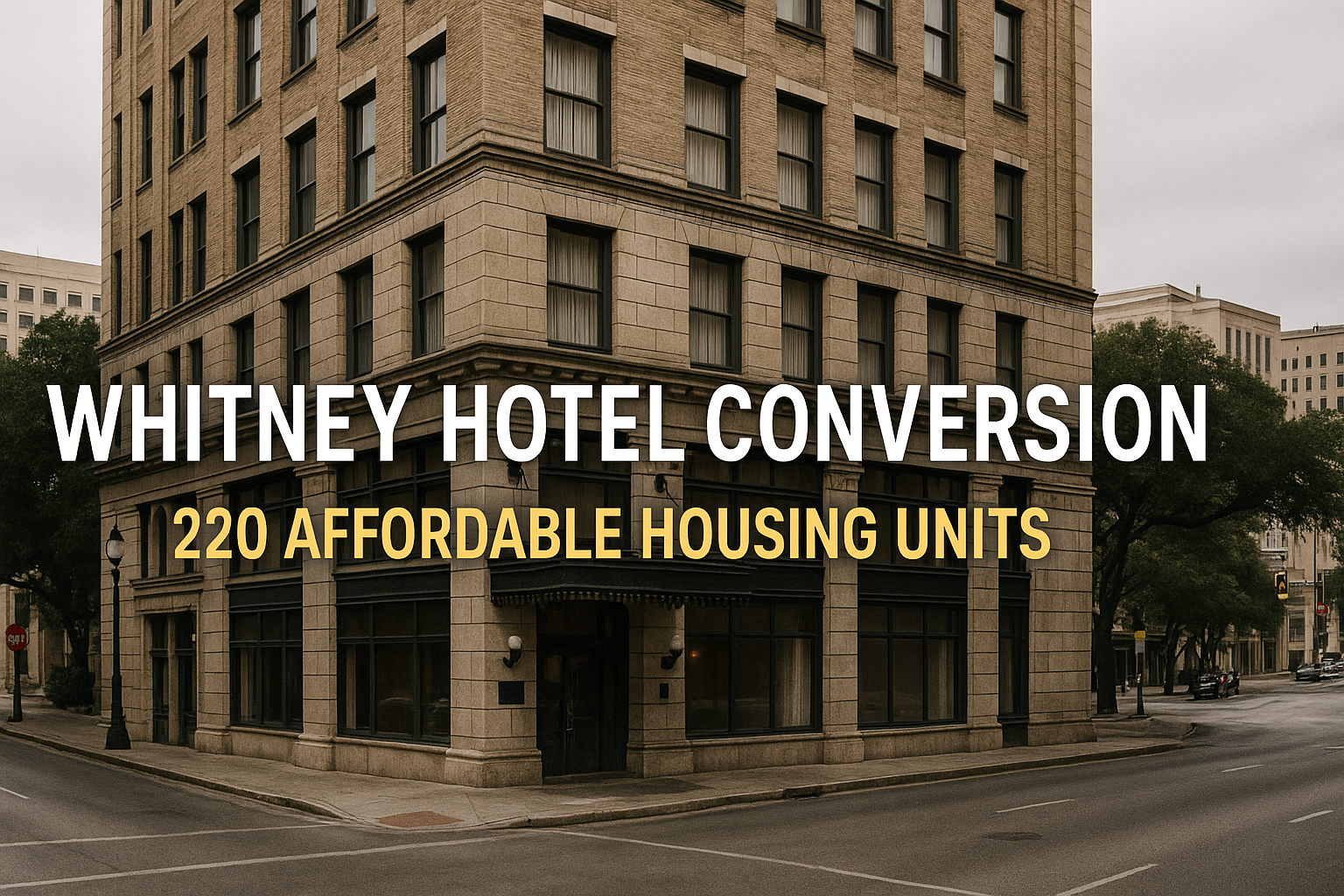
The Whitney Hotel at 425 Bonham will become 220 affordable housing units through a conversion that adapts the existing building for residential use rather than constructing new. The project received San Antonio City Council approval, reflecting support from city leadership for expanding affordable housing options in the downtown area. Housing advocates have backed the initiative as part of broader efforts to address housing affordability challenges throughout the region.
Affordable housing projects operate under income restrictions that determine eligibility for residency. Units are typically reserved for households earning below certain percentages of Area Median Income, with specific thresholds varying by project and funding sources. The exact income limits for the Whitney conversion will be established based on local and federal guidelines, with details becoming clearer as the project progresses toward completion.
Q: What does adaptive reuse mean for this project?
A: Adaptive reuse involves converting existing buildings to new purposes rather than demolishing and rebuilding. The Whitney Hotel conversion transforms a structure originally designed for hospitality into residential apartments. This approach preserves the building's historic exterior and character while modernizing interiors to meet residential standards. Adaptive reuse often proceeds faster and at lower cost than new construction while maintaining architectural heritage.
The project emphasizes historic preservation alongside functional conversion. The building's original facade and historic character will remain while interior spaces are reconfigured and updated to serve as apartments. Infrastructure including electrical, plumbing, and safety systems will be modernized to meet current residential building codes. This balance between preservation and modernization reflects contemporary approaches to urban development that value existing structures.
Whitney Hotel conversion project elements:
- 220 affordable housing units created through conversion
- City Council approval supporting the development
- Historic preservation maintaining building character
- Interior modernization meeting residential standards
- Income based eligibility determining resident qualification
- Adaptive reuse approach rather than new construction
- Location at 425 Bonham near downtown core
Why Does Downtown San Antonio Need Affordable Housing?
Understanding the context for affordable housing downtown helps explain why projects like the Whitney conversion matter for the city. Downtown areas face particular dynamics that can make housing affordability challenging, and San Antonio's urban core reflects patterns seen in many growing cities. Examining these dynamics provides context for evaluating housing development initiatives.
Downtown San Antonio has experienced substantial investment in recent decades across tourism, hospitality, entertainment, and commercial development. The River Walk, convention facilities, sports venues, and cultural attractions draw visitors and generate economic activity. Hotels, restaurants, retail establishments, and entertainment venues employ significant workforces. This concentration of investment and employment creates demand for nearby housing among workers who would benefit from reduced commute times and transportation costs.
Q: Why is affordable housing near employment centers important?
A: When workers can live near their jobs, they spend less time and money on transportation. Reduced commute times improve quality of life and allow more time for family, education, and community involvement. Lower transportation costs leave more household income available for other needs. Employers benefit from workforce stability when employees can afford nearby housing. These factors combine to make housing near employment centers particularly valuable for working households.
Market rate housing development in desirable urban areas often prices out workers in service, retail, hospitality, and other industries that may not command wages sufficient for market rents. This dynamic can create situations where the people who make downtown function cannot afford to live there. Affordable housing development provides alternatives that enable diverse households to access urban living and its associated benefits.
Factors making downtown affordable housing valuable:
- Employment concentration in hospitality, retail, and service industries
- Market rate housing costs potentially exceeding worker wages
- Transportation cost savings for residents living near jobs
- Commute time reduction improving quality of life
- Workforce stability benefiting employers and employees
- Diverse neighborhoods creating economic mixing
- Urban amenity access for households across income levels
What Does District 1 Offer Residents?
The Whitney Hotel's location in District 1 places future residents within one of San Antonio's most amenity rich areas. Understanding what the surrounding neighborhood offers helps appreciate why affordable housing in this location provides particular value. Access to services, employment, transit, and cultural resources distinguishes downtown living from other parts of the metropolitan area.
District 1 encompasses downtown San Antonio and surrounding neighborhoods that contain concentrated employment, services, and cultural institutions. The area includes major employers, educational institutions, healthcare facilities, and government offices. This concentration creates proximity advantages for residents who can access employment, services, and activities within walking distance or short transit rides.
Q: What specific amenities exist near the Whitney Hotel location?
A: The building sits just blocks from Hemisfair Park, the Alamodome, and other downtown landmarks. San Antonio College provides educational opportunities within the area. VIA transit hubs offer public transportation connections throughout the city. Healthcare facilities, grocery stores, and schools serve daily needs. Cultural landmarks, restaurants, and entertainment options contribute to urban lifestyle opportunities. This amenity concentration distinguishes downtown from suburban locations.
Walkability represents a significant advantage of downtown living for many households. The ability to accomplish daily tasks without vehicle dependency can reduce costs and improve quality of life, particularly for households where vehicle ownership is financially challenging. Transit access extends the effective range residents can reach, connecting downtown to other parts of the city.
District 1 amenities near the Whitney Hotel location:
- Hemisfair Park providing green space and recreation
- Alamodome hosting events and entertainment
- San Antonio College offering educational opportunities
- VIA transit hubs connecting to the broader city
- Healthcare facilities serving medical needs
- Grocery stores and daily services within reach
- Cultural landmarks and entertainment options nearby
- Major employers providing job opportunities
How Does Adaptive Reuse Benefit Historic Preservation?
The Whitney Hotel conversion exemplifies adaptive reuse approaches that transform existing buildings for new purposes while preserving architectural heritage. Understanding how these projects work helps appreciate their value for communities seeking both development and preservation. The balance between maintaining historic character and creating functional contemporary spaces requires thoughtful design and execution.
Historic buildings carry cultural value beyond their original functions. Architecture, craftsmanship, and design from earlier eras contribute to community identity and visual character that new construction cannot replicate. Demolishing historic structures eliminates these irreplaceable elements. Adaptive reuse allows buildings to remain while gaining new purposes that ensure their continued relevance and maintenance.
Q: What challenges do adaptive reuse projects face?
A: Converting buildings designed for one purpose to another requires addressing structural, mechanical, and layout differences between original and new uses. Hotels and residences share some characteristics but differ in unit sizes, common areas, and infrastructure needs. Historic preservation standards may limit exterior modifications, constraining design options. Older buildings may require significant infrastructure upgrades to meet current codes. These challenges add complexity compared to new construction but can produce unique results.
The Whitney Hotel project plans to maintain the building's historic facade while modernizing interiors for residential use. This approach preserves the visual contribution the building makes to downtown's character while creating functional housing that meets contemporary standards. The combination honors the past while serving present needs.
Adaptive reuse project characteristics:
- Preserving historic architectural character and design
- Converting interior spaces for new functional purposes
- Upgrading infrastructure to meet current building codes
- Balancing preservation requirements with modernization needs
- Maintaining visual contribution to neighborhood character
- Creating unique spaces that new construction cannot replicate
- Ensuring continued building relevance and maintenance
How Does Affordable Housing Affect Surrounding Neighborhoods?
Understanding how affordable housing projects interact with surrounding areas helps residents and property owners evaluate what developments like the Whitney conversion mean for their communities. The effects of affordable housing on neighborhoods involve multiple factors that research has examined extensively. Informed perspectives recognize complexity rather than assuming simple positive or negative outcomes.
Affordable housing can contribute to neighborhood stability by providing housing options that enable residents to remain in areas despite market pressure. Displacement from gentrifying neighborhoods disrupts communities, schools, and support networks. Affordable housing preservation helps maintain diverse neighborhoods where different income levels coexist. This diversity can strengthen communities by maintaining connections across economic circumstances.
Q: Does affordable housing negatively affect nearby property values?
A: Research on affordable housing and property values has produced varied findings depending on project characteristics, location context, and methodology. Well designed and managed affordable housing often has neutral or positive effects on surrounding property values. Poorly designed or managed projects may create negative effects. Quality, design, management, and integration with neighborhood context matter more than affordability status alone. Individual projects require evaluation based on specific characteristics rather than categorical assumptions.
Mixed income neighborhoods can attract sustainable investment by creating diverse customer bases for local businesses and services. Economic mixing can strengthen demand for retail, dining, and service businesses by providing varied customer demographics. Affordable housing residents contribute to neighborhood economic activity through spending on local goods and services.
Affordable housing neighborhood effects considerations:
- Neighborhood stability through displacement prevention
- Community diversity maintenance across income levels
- Mixed income dynamics supporting local businesses
- Project quality and management affecting outcomes
- Design integration with neighborhood context mattering
- Research showing varied outcomes based on circumstances
- Individual project evaluation more meaningful than categorical assumptions
What Does This Project Signal About San Antonio's Housing Priorities?
The Whitney Hotel conversion reflects policy choices about housing development priorities in San Antonio. Understanding what the project signals about city priorities helps residents appreciate the context for housing decisions affecting different communities. City Council approval and housing advocate support indicate alignment between the project and broader housing policy goals.
San Antonio, like many growing cities, faces housing affordability challenges that policy initiatives attempt to address. Population growth creates housing demand that can outpace supply, particularly at price points accessible to moderate and lower income households. Market rate development alone may not produce housing serving all income levels. Policy interventions including affordable housing development aim to address gaps that market forces do not fill.
Q: How do affordable housing projects get funded and approved?
A: Affordable housing development typically involves multiple funding sources including federal programs like Low Income Housing Tax Credits, state housing finance agency programs, local government contributions, and private investment. Projects must meet program requirements regarding income limits, rent restrictions, and compliance periods. City approval processes evaluate projects for consistency with local plans and policies. The combination of funding complexity and approval requirements means successful projects demonstrate broad support and careful planning.
The location of affordable housing development reflects policy choices about where to concentrate investment. Downtown locations like the Whitney provide access to employment and amenities but involve higher land costs. Suburban locations may offer lower development costs but reduced transit and walkability. The Whitney's downtown location suggests priorities around transit oriented development and employment proximity.
Housing policy signals from this project:
- City Council support for downtown affordable housing
- Housing advocate backing indicating alignment with affordability goals
- Adaptive reuse approach balancing preservation and housing needs
- Downtown location prioritizing employment and transit access
- Mixed income neighborhood development strategy
- Multiple funding sources enabling development
- Policy commitment to diverse housing options
How Should Renters Evaluate Affordable Housing Opportunities?
Those interested in affordable housing options benefit from understanding how to evaluate opportunities and navigate application processes. While the Whitney conversion's specific details will emerge as completion approaches, general guidance helps potential applicants prepare. Understanding affordable housing systems enables households to identify and pursue appropriate opportunities.
Affordable housing eligibility depends on household income relative to Area Median Income thresholds established for specific programs and projects. Different affordability levels serve different income ranges, with some projects targeting very low income households while others serve moderate income workers. Understanding which income bands different projects serve helps households identify appropriate opportunities.
Q: How do affordable housing applications typically work?
A: Application processes vary by property and program but generally require income documentation, household composition verification, and background screening. Many affordable properties maintain waiting lists when demand exceeds availability. Some programs use lottery systems when more qualified applicants exist than available units. Applicants should apply to multiple properties to increase chances of placement. Housing authorities and nonprofit housing organizations can provide guidance about local opportunities and application processes.
Preparation before applications open improves chances of success. Gathering income documentation including pay stubs, tax returns, and employment verification in advance enables timely application completion. Understanding household income limits helps applicants assess eligibility before investing time in applications. Researching multiple properties provides alternatives if preferred options are unavailable.
Considerations for affordable housing applicants:
- Income eligibility varying by program and project
- Documentation requirements including income verification
- Waiting lists common for popular properties and locations
- Multiple applications increasing placement chances
- Advance preparation improving application success
- Housing authorities providing guidance on local opportunities
- Program rules determining ongoing compliance requirements
What Other Housing Development Is Occurring Downtown?
Placing the Whitney conversion within broader downtown development context helps understand how the area continues evolving. Downtown San Antonio has experienced various housing development types in recent years, with projects ranging from luxury high rises to affordable conversions. Understanding this variety provides perspective on how different developments contribute to downtown's housing landscape.
Market rate development has added apartments and condominiums targeting higher income residents attracted to urban amenities. These projects contribute to downtown vibrancy by adding residents who patronize local businesses and activate streets. However, market rate development alone may not produce housing accessible across income levels, creating rationale for affordable development that complements market rate projects.
Q: How do different housing types contribute to downtown neighborhoods?
A: Diverse housing options create neighborhoods where different household types and income levels coexist. Market rate housing attracts residents able to pay premium prices for urban amenities. Affordable housing enables workers and moderate income households to access the same amenities. Mixed income environments can create more resilient neighborhoods less vulnerable to economic fluctuations affecting single income segments. The combination of housing types supports more complete communities.
The balance between different development types reflects both market forces and policy choices. Market rate development proceeds where private investment sees profitable opportunities. Affordable development requires policy support through funding programs, zoning flexibility, or other mechanisms. The Whitney conversion represents policy supported development complementing market rate activity.
Downtown housing development context:
- Market rate projects adding higher income residents
- Affordable development serving moderate and lower income households
- Mixed income neighborhoods creating diverse communities
- Policy support enabling affordable development
- Market forces driving private investment decisions
- Balance between development types reflecting policy choices
- Various projects contributing different elements to housing landscape
How Does Housing Affordability Affect San Antonio's Broader Real Estate Market?
Understanding connections between affordable housing development and broader market dynamics helps residents appreciate how different policy approaches affect real estate conditions. Housing markets involve complex interactions where different segments affect each other. Affordable housing development plays specific roles within these broader market systems.
Housing supply relative to demand affects pricing across market segments. When housing supply is insufficient relative to population growth and household formation, competition for available units pushes prices upward. Adding housing supply at any price point can help moderate price pressure by providing options that prevent demand from concentrating entirely on limited inventory. Affordable housing adds supply serving specific income ranges while potentially relieving pressure throughout the market.
Q: Does building affordable housing reduce pressure on market rate housing?
A: The relationship is complex and debated among housing economists. Some argue that adding affordable housing prevents lower income households from competing for market rate units, reducing demand pressure. Others suggest that different market segments operate somewhat independently. Most agree that overall housing supply matters for affordability, though the specific effects of affordable versus market rate development depend on local conditions. Comprehensive approaches addressing supply across segments likely produce better outcomes than focusing on single housing types.
For those considering selling a home in San Antonio or buying in different neighborhoods, understanding how housing development patterns affect various areas provides useful context. Different parts of the metropolitan area experience different development pressures and opportunities. Working with experienced representation helps navigate these variations.
Housing market dynamics considerations:
- Supply and demand affecting pricing across segments
- Housing additions potentially moderating price pressure
- Complex relationships between affordable and market rate segments
- Comprehensive supply approaches addressing multiple income levels
- Local conditions affecting specific market interactions
- Different neighborhoods experiencing varied development patterns
- Professional guidance helping navigate market complexity
What Should Buyers Know About Downtown San Antonio Real Estate?
Those exploring downtown San Antonio as a potential location benefit from understanding the area's characteristics and market dynamics. Downtown living offers specific advantages and considerations that differ from suburban alternatives. Evaluating whether downtown fits your priorities requires understanding what the area provides and how it compares to other options.
Downtown San Antonio offers urban amenities including walkability, transit access, cultural institutions, entertainment options, and employment proximity. Residents can access restaurants, shops, events, and services within walking distance. The River Walk, parks, museums, and venues create recreational and cultural opportunities. These characteristics attract households prioritizing urban lifestyle elements.
Q: What housing options exist for buyers in downtown San Antonio?
A: Downtown ownership options include condominiums in various buildings ranging from historic conversions to modern high rises, townhomes in some developments, and limited single family options in adjacent neighborhoods. Price points vary significantly based on building quality, amenities, views, and specific location. Buyers should understand condominium ownership including HOA fees, rules, and shared maintenance responsibilities. Working with representation experienced in downtown transactions helps navigate these considerations.
Downtown living involves tradeoffs that buyers should evaluate against their priorities. Urban density creates different environments than suburban settings. Parking may be limited or costly. Noise levels typically exceed suburban neighborhoods. Schools serving downtown may differ from suburban district options. These factors matter differently for different households depending on circumstances and preferences.
Downtown San Antonio real estate considerations:
- Urban amenities including walkability and transit access
- Cultural institutions and entertainment proximity
- Condominium ownership common with associated fees and rules
- Price points varying by building, amenities, and location
- Parking considerations potentially affecting convenience and cost
- Urban density creating different environment than suburban areas
- School options differing from suburban districts
- Lifestyle priorities determining fit with downtown living
How Does This Project Connect to San Antonio's Growth Story?
The Whitney Hotel conversion represents one element within San Antonio's broader growth and development trajectory. Understanding how individual projects fit into larger patterns helps residents appreciate the cumulative directions the city is taking. Downtown housing development, whether market rate or affordable, contributes to how the urban core evolves.
San Antonio has experienced sustained population growth that creates both opportunities and challenges. More residents mean more demand for housing, services, and amenities. Meeting this demand requires development across the metropolitan area, including both suburban expansion and urban infill. Different development types serve different needs and household preferences within the growing population.
Q: How does downtown development differ from suburban growth?
A: Downtown development typically involves higher density on smaller land parcels, often through vertical construction or adaptive reuse of existing buildings. Suburban development usually involves lower density on larger land areas through new construction. Downtown development leverages existing infrastructure while suburban growth may require infrastructure extension. Different households prefer different environments, with some drawn to urban density and others to suburban space. Both development types serve needs within growing metropolitan areas.
The Whitney conversion specifically demonstrates commitment to ensuring downtown growth includes housing accessible across income levels. Without deliberate affordable housing development, downtown transformation might produce neighborhoods accessible only to higher income residents. Inclusive development approaches aim to create diverse communities reflecting the broader population rather than income exclusive enclaves.
San Antonio growth context for this project:
- Population growth creating housing demand across the region
- Both suburban expansion and urban infill serving different preferences
- Downtown development leveraging existing infrastructure
- Higher density development typical in urban areas
- Affordable housing ensuring income diverse downtown neighborhoods
- Inclusive approaches creating communities reflecting broader population
- Individual projects contributing to cumulative development patterns
What Questions Should Residents Ask About Housing Development?
Those living near housing development or considering areas where development is occurring benefit from asking informed questions. Understanding specific projects rather than relying on assumptions helps residents evaluate what developments mean for their communities. These questions guide productive inquiry about housing initiatives.
Consider what housing types are proposed and who they will serve. Different development types attract different residents and create different community contributions. Market rate, affordable, senior, family, and other housing types each have distinct characteristics. Understanding the specific proposal enables more informed evaluation than generic assumptions about housing development.
Q: What information should residents seek about housing projects?
A: Useful information includes unit counts and sizes, income restrictions if applicable, building design and how it fits neighborhood context, developer track record with similar projects, management approach for completed properties, amenities and services included, parking and traffic considerations, and timeline from approval through occupancy. This information enables specific evaluation rather than categorical reactions.
Questions to ask about housing development:
- What housing type and who does it serve?
- How many units and what sizes are planned?
- What income restrictions apply if affordable?
- How does building design fit neighborhood context?
- What is the developer's track record?
- How will completed property be managed?
- What parking and traffic effects are expected?
- What timeline leads to occupancy?
Expert Insight from Tami Price
"This is a smart, people first investment in our city's future," says Tami Price, REALTOR® and Broker Associate with Real Broker, LLC. "Making affordable housing available right downtown means workers, students, and families can live where life happens. That is good for residents who gain access to urban amenities and employment, and it is good for downtown businesses and employers who benefit from nearby workforce housing."
Price brings nearly two decades of experience and approximately 1,000 closed transactions to her work with buyers and sellers throughout San Antonio, Schertz, Cibolo, Helotes, Converse, and Boerne. Her understanding of how different development types affect various neighborhoods helps clients evaluate options throughout the metropolitan area.
"Housing development takes many forms serving different needs," Price explains. "Market rate, affordable, rental, and ownership all contribute to complete communities. When I work with buyers exploring different parts of San Antonio, we discuss how neighborhood development patterns affect long term satisfaction. Understanding what types of development are occurring helps buyers identify communities aligned with their priorities."
Her recognition as a RealTrends Verified Top Agent reflects consistent client satisfaction across diverse transaction types. Designations including the Pricing Strategy Advisor (PSA) demonstrate specialized expertise in helping clients understand market conditions affecting different areas.
"Projects like the Whitney conversion reflect San Antonio's commitment to inclusive growth," Price notes. "Downtown development that serves diverse income levels creates more complete neighborhoods. Whether buying downtown or in other parts of the city, understanding how development shapes communities helps buyers make informed decisions about where to live."
Three Key Takeaways
1. The Historic Whitney Hotel at 425 Bonham Is Converting to 220 Affordable Housing Units in Downtown San Antonio
The City Council approved project transforms the building through adaptive reuse that preserves historic character while creating residential space. Income based eligibility will determine who qualifies for the units, with specific thresholds established based on local and federal guidelines. The conversion adds affordable housing inventory in an amenity rich downtown location near employment, transit, cultural institutions, and services.
2. The Project Reflects Policy Commitment to Affordable Housing in Central San Antonio Where Market Rate Development Alone May Not Serve All Income Levels
Downtown areas often experience investment concentrations in market rate development, tourism, and entertainment that can make housing unaffordable for workers in service industries. Affordable housing development enables diverse households to access urban living and employment proximity. The Whitney conversion represents deliberate effort to ensure downtown growth includes housing options across income levels rather than serving only higher income residents.
3. Adaptive Reuse Approaches Balance Historic Preservation with Contemporary Housing Needs
Converting existing buildings for new purposes preserves architectural heritage while creating functional spaces serving current needs. The Whitney Hotel's conversion maintains the building's historic facade and character while modernizing interiors for residential use. This approach adds housing without demolishing structures that contribute to downtown's visual character and cultural identity.
Frequently Asked Questions
Q: Who qualifies for the new affordable housing units?
A: Eligibility will be income based, with specific thresholds determined by local and federal guidelines. Affordable housing programs typically serve households earning below certain percentages of Area Median Income. Exact qualification requirements for the Whitney conversion will be established as the project progresses toward completion and leasing. Interested households should monitor announcements for application information.
Q: Will the building keep its original appearance?
A: Yes, the project emphasizes historic preservation while upgrading interior infrastructure and safety systems. The building's facade and historic character will be maintained while interior spaces are reconfigured and modernized to meet residential standards. This adaptive reuse approach preserves the building's contribution to downtown's architectural character.
Q: When will the affordable housing units be available?
A: Specific timeline information for completion and occupancy has not been detailed in available announcements. Adaptive reuse projects involve various phases including design, permitting, construction, and leasing preparation. Interested households should monitor project announcements for updates about application periods and move in dates.
Q: How does affordable housing differ from market rate housing?
A: Affordable housing operates under income restrictions limiting eligibility to households below specified income thresholds and typically caps rents at levels below market rates. Market rate housing sets rents based on market demand without income restrictions. Affordable housing programs often receive public funding or tax benefits in exchange for serving income qualified households.
Q: Does affordable housing negatively affect nearby property values?
A: Research shows varied outcomes depending on project quality, design, management, and location context. Well designed and managed affordable housing often has neutral or positive effects on surrounding areas. Project characteristics matter more than affordability status alone. Individual developments should be evaluated based on specific circumstances rather than categorical assumptions.
Q: What amenities exist near the Whitney Hotel location?
A: The location places residents near Hemisfair Park, the Alamodome, San Antonio College, VIA transit hubs, healthcare facilities, and downtown employers. Cultural landmarks, restaurants, entertainment, and services exist within walking distance or short transit rides. This amenity concentration distinguishes the location from suburban alternatives.
Q: How can interested households apply for affordable housing?
A: Application processes vary by property and program. Generally, applicants must document income and household composition, undergo background screening, and meet program requirements. Many affordable properties maintain waiting lists. Applying to multiple properties increases placement chances. Housing authorities and nonprofit organizations can provide guidance about local opportunities.
Q: Does San Antonio have other affordable housing projects?
A: San Antonio has various affordable housing developments across the metropolitan area serving different populations and income levels. The city has pursued multiple strategies to expand affordable housing including new construction, adaptive reuse, and preservation of existing affordable units. The Whitney conversion represents one project within broader housing affordability efforts.
The Bottom Line
The Whitney Hotel conversion at 425 Bonham brings 220 affordable housing units to downtown San Antonio through adaptive reuse that preserves historic character while creating needed residential space. The City Council approved project reflects commitment to ensuring downtown growth includes housing accessible across income levels, not just market rate development serving higher income residents. For workers, students, and families earning below program income thresholds, the project creates opportunity to live in an amenity rich urban location near employment, transit, and services.
Adaptive reuse approaches like the Whitney conversion demonstrate how cities can address housing needs while preserving architectural heritage. Rather than demolishing the historic building, the project maintains its exterior character while modernizing interiors for residential function. This balance between preservation and practical adaptation represents thoughtful urban development that values both past and present.
For residents throughout San Antonio, understanding how different development types affect various neighborhoods provides useful context for real estate decisions. Whether interested in downtown living or exploring options in other parts of the metropolitan area, working with experienced representation helps navigate how development patterns shape community trajectories and housing markets.

Contact Tami Price, REALTOR®
Whether exploring downtown San Antonio or evaluating communities throughout the metropolitan area, working with an experienced REALTOR® provides guidance through the home buying process. Tami Price brings local market knowledge and professional expertise to help buyers understand how development patterns affect different neighborhoods and find homes matching their priorities.
From first time buyers to experienced homeowners evaluating location options, personalized service makes the difference in successful transactions.
Tami Price, REALTOR®, Broker Associate
📞 210-620-6681
Tami Price's Specialties
- Comprehensive Buyer and Seller Representation
- Military Relocations and PCS Moves
- VA Loan Guidance and Assumptions
- New Construction Navigation
- Strategic Pricing and Market Analysis
- Professional Property Marketing
- First Time Buyer Education
- Move Up and Downsizing Transitions
- Residential Real Estate Throughout San Antonio, Schertz, Cibolo, Helotes, Converse, and Boerne
Disclaimer
This blog post is provided for informational purposes only and should not be construed as guarantees regarding affordable housing eligibility, availability, application processes, or project outcomes. Information about the Whitney Hotel conversion reflects publicly available details as of the publication date and is subject to change. Affordable housing eligibility requirements are determined by program guidelines and may differ from general descriptions provided. Real estate decisions should be based on individual circumstances, professional guidance, and current market conditions. Tami Price, REALTOR®, and Real Broker, LLC make no warranties regarding accuracy, completeness, or applicability of information to specific circumstances.
Categories
- All Blogs (942)
- Home Buying (19)
- Neighborhood Guides (45)
- 10 Incentive and Rate Buydown Questions (1)
- 10 Military Neighborhood (1)
- 10 Mistakes Sellers Make (1)
- 10 Strategies to Coordinate a Same Day Close (1)
- 12 Lifestyle Questions to Move In (1)
- 12 PCS What Ifs (1)
- 12 Photos and Marketing Assets (1)
- 13 PCS Hunting Trip Tips (1)
- 14 Design Center Decisions (1)
- 15 Red Flags Touring Home in San Antonio (1)
- 2026 Market (1)
- 30 days after closing your home (1)
- 7 Offer Terms Beyond Price (1)
- 7 VA Specific Questions (1)
- 78015 Ranked One (1)
- 8 Bridge (1)
- 8 Myths Buyers Believe about Down Payments (1)
- 8 Reasons VA Buyers Love New Construction (1)
- 9 Mistakes Move Up Buyers Make (1)
- 9 Questions to Decide If You Keep Your PCS Home (1)
- 9 Timeline Questions Every Buyer Need to Ask (1)
- 9 Warranty Questions to Ask (1)
- 9 Ways to Attract VA & Military Buyers (1)
- 90 days before your move (1)
- About Tami Price (6)
- Active Adult Homes (1)
- Affordable Communities (2)
- Affordable Housing & Community Development (5)
- Agent Qualifications and Credentials (1)
- Agent Qualifications and Experience (1)
- Agent Recognition (3)
- Agent Selection (1)
- AI and Real Estate Tools (1)
- Alamo Heights (5)
- Alamo Heights ISD (1)
- Alamo Heights Real Estate (1)
- Alamo Ranch (3)
- Amenities in Helotes, Texas (3)
- Apartment Market (1)
- Appraisals (1)
- Arts and Culture (1)
- Awards and Recognition (7)
- Balcones Creek (1)
- Best Neighborhoods to Live in Cibolo, TX (3)
- Best Neighborhoods to Live in San Antonio (16)
- Best Places to Live in Leon Valley: A Neighborhood Guide (1)
- Best Places to Live in Northeast Inner Loop: A Neighborhood Guide (1)
- Bexar County Property Tax (1)
- Bexar County Real Estate (3)
- Blue Tape Walkthrough (1)
- Boerne Home Sellers (1)
- Boerne Neighborhoods (2)
- Boerne Texas (9)
- Broadway Corridor Development (1)
- Build-to-Rent Communities (1)
- Builder Contracts & Warranties (3)
- Builder Incentives (1)
- Builder Warranties (1)
- Buyer (97)
- Buyer Activity San Antonio (1)
- Buyer and Seller Guidance (4)
- Buyer Due Diligence (1)
- Buyer Education (46)
- Buyer Guide (9)
- Buyer Guides (7)
- Buyer Protection Strategies (1)
- Buyer Representation (1)
- Buyer Representation Expertise (1)
- Buyer Resources (90)
- Buyer Strategy (2)
- Buyers (13)
- Buyers Agent (1)
- Buying a Foreclosed Home in San Antonio (10)
- Buying a Home (3)
- Buying a Home in San Antonio (6)
- Buying Near JBSA (1)
- Buying Timeline (1)
- Buying vs Renting (1)
- Castroville, TX (8)
- Central San Antonio (1)
- Central San Antonio Development (2)
- Central Texas Growth (1)
- Choosing a Real Estate Agent (1)
- Choosing an Agent (1)
- Cibolo Communities (1)
- Cibolo Home Sellers (1)
- Cibolo TX (15)
- Client Reviews and Testimonials (1)
- Client Satisfaction (1)
- Client Stories (1)
- Client Testimonial (4)
- Clients review (4)
- Closing (1)
- Cobblestone (1)
- Comal County (1)
- Commercial & Retail Development (27)
- Commercial Development (13)
- Commercial Development Impact on Home Values (1)
- Commercial Real Estate (1)
- Community (1)
- Community Amenities (2)
- Community Development (23)
- Community Development and Real Estate (3)
- Community Events & Development (1)
- Community Guides (1)
- Community Infrastructure (1)
- Community Investment Impact (2)
- Community Landmarks (1)
- Community News (4)
- Community Planning (2)
- Community Revitalization (1)
- Community Spotlights (1)
- Commuter Neighborhoods (1)
- Cons of Living in Helotes, TX (4)
- Conservation Communities (1)
- Contingency Questions (1)
- Converse Home Sellers (1)
- Converse Homes For Sale (3)
- Converse Real Estate (1)
- Converse TX (10)
- Converse TX Real Estate (1)
- Cost of Living Guides (1)
- Cost of Living in San Antonio TX (25)
- CPS Energy Programs (1)
- Custom Homes (5)
- Davis Ranch (1)
- Days on Market (1)
- Deco District San Antonio (1)
- Denver Heights (1)
- Down Payment Assistance (1)
- Downtown Boerne (1)
- Downtown Development (3)
- Downtown Living (1)
- Downtown Revitalization (14)
- Downtown San Antonio (2)
- Downtown San Antonio Real Estate (5)
- Downtown San Antonio Revitalization (1)
- Dual Military (1)
- East Side Living (1)
- East Side Neighborhoods (1)
- East Side San Antonio (4)
- Economic Development (3)
- Economic Growth & Industry (1)
- Education, Texas Hill Country (1)
- Emerald Pointe (1)
- Employment (1)
- Employment Corridors (1)
- Encino Forest (1)
- Entertainment Economy (1)
- Equity and Pricing Strategy (2)
- Equity Q&A (1)
- Established Communities (3)
- Events in San Antonio (207)
- Expert Advice from Tami Price, Realtor® (10)
- Fair Oak Ranch (1)
- Family Activities (2)
- Family Homes (3)
- Family Living in San Antonio (1)
- FAQ (1)
- Far Northwest San Antonio (1)
- Far West San Antonio (1)
- Far Westside Real Estate (4)
- Farmer Markets in San Antonio (1)
- Fastest Growing Zip Codes in America (1)
- Featured Homes for Sale (2)
- Featured Properties (1)
- Final Walkthrough (1)
- Financial Planning (11)
- Financing Strategy (1)
- First Time Buyers (23)
- First Time Sellers (1)
- First-Time Buyers (6)
- First-Time Homebuyer Resources (4)
- First-Time Homebuyer Tips (2)
- First-Time Homebuyers (6)
- First-Time Investors (1)
- Fort Sam Houston (3)
- Fort Sam Houston Real Estate (1)
- Fort Sam Houston, TX (2)
- Fox Grove (1)
- FSBO vs Agent Representation (1)
- Future Rental (1)
- Gated Communities (5)
- Golf Communities (1)
- Great Northwest (1)
- Greater San Antonio Housing Trends (2)
- Greater San Antonio Real Estate (5)
- Green Home Upgrades (1)
- Growth and Development (11)
- Healthcare (1)
- HELOC (1)
- Helotes Home Sellers (1)
- Highway 151 Corridor Growth (1)
- Hill Country Business (1)
- Hill Country Communities (2)
- Hill Country Development (3)
- Hill Country Homes for Sale (1)
- Hill Country Living (3)
- Hill Country Market Updates (1)
- Hill Country Real Estate (4)
- Hill Country Retreat (1)
- Historic Districts (5)
- Historic Neighborhoods (4)
- Historic Preservation (2)
- Holiday Attractions (1)
- Holiday Guide (1)
- Home Buying (7)
- Home Buying Education (3)
- Home Buying Guide (7)
- Home Buying Process (8)
- Home Buying Strategy (2)
- Home Buying Tips (6)
- Home Energy Efficiency San Antonio (5)
- Home Financing (2)
- Home Improvement ROI (1)
- Home Inspections (3)
- Home Preparation (2)
- Home Pricing Strategy (14)
- Home Renovation for Resale (1)
- Home Selling (12)
- Home Selling Guide (11)
- Home Selling Strategies (3)
- Home Selling Strategy (3)
- Home Selling Tips (22)
- Home Staging and Updates (2)
- Home Values (2)
- Homebuyer Education (15)
- Homebuyer Resources (1)
- Homebuying Guide (1)
- Homebuying Tips (3)
- Homeowner (37)
- Homeowner Tax Benefits (1)
- Homeownership Costs (1)
- Homes for Sale (2)
- Homes for sale near Lackland AFB (4)
- Homes Near Military Bases (1)
- Homestead amenities (1)
- Horizon Pointe (1)
- House Hunting Guide (1)
- Housing (1)
- Housing Community Development (1)
- Housing Development (2)
- Housing Market Updates (3)
- How to Buy a House in San Antonio TX (48)
- Huebner Oaks shopping center (1)
- Hunters Ranch (1)
- Hybrid (1)
- I-10 Corridor (1)
- I-35 Corridor (1)
- In Person (1)
- Incorporated Cities (6)
- Industrial Investment Impact (1)
- Industry News (2)
- Industry Recognition (1)
- Infrastructure & Growth Projects (26)
- Infrastructure and Sustainability (1)
- Infrastructure Development (1)
- Infrastructure Investment (1)
- Infrastructure Updates (2)
- Interest Rates (2)
- Invest in San Antonio (46)
- Investment Opportunities (3)
- Investment Property San Antonio (4)
- JBSA (9)
- JBSA Housing (11)
- JBSA Real Estate (4)
- JBSA Resources (7)
- Joint Base San Antonio (5)
- Joint Base San Antonio Housing (1)
- Judson ISD (2)
- Kendall County (1)
- La Cantera Retail Development (1)
- Lackland AFB (7)
- Lackland AFB Housing (1)
- Land Conservation (1)
- Land Use Planning (1)
- Lera MLS (15)
- Lifestyle & Community Growth (18)
- Lifestyle & Local Growth (12)
- Lifestyle Amenities (1)
- Lifestyle Communities (1)
- Listing Preparation (1)
- Listing Strategy (1)
- Live Oak (1)
- Living in San Antonio, TX (52)
- Living Near Randolph AFB (7)
- Loan Programs (1)
- Local Attractions (3)
- Local Business (1)
- Local Business & Development (9)
- Local Business & Economy (3)
- Local Business Spotlight (20)
- Local Business Support (5)
- Local Development (4)
- Local Development News (9)
- Local Market Insights (5)
- Local News (2)
- Local News Around San Antonio (2)
- Local Policy Changes (1)
- Local Real Estate News (1)
- Loop 1604 Corridor Growth (2)
- Loop 410 Corridor Development (1)
- Luxury Communities (3)
- Luxury Homes (2)
- Luxury Real Estate (1)
- Luxury Retail San Antonio (1)
- MacArthur Park (1)
- Major Developments (2)
- Making Offers on Homes (1)
- Market Analysis (26)
- Market Conditions (47)
- Market Expertise (1)
- Market Insights (5)
- Market Strategy (1)
- Market Timing (2)
- Market Trends (10)
- Market Trends & Insights (2)
- Market Update (18)
- Market Update 2026 (1)
- Market Updates (22)
- Master Planned Communities (12)
- Medical Center Area Real Estate (1)
- Medina Valley ISD (2)
- Midtown Living (1)
- Military & Economic Impact (3)
- Military Buyers (3)
- Military Communities (1)
- Military Families (1)
- Military Family Resources (1)
- Military Heritage (1)
- Military Homebuying (3)
- Military Homeownership (1)
- Military Housing (3)
- Military Housing Market in Texas (16)
- Military Life in San Antonio (2)
- Military Neighborhoods (1)
- Military PCS Relocations (3)
- Military Real Estate (2)
- Military Relocation (100)
- Military Relocation & VA Loans (10)
- Military Relocation San Antonio (4)
- Military Relocation Services (3)
- Military Relocation to San Antonio (50)
- Military Relocations (20)
- Military Relocations & VA Home Loans (5)
- Mixed-Income Housing (1)
- MLS Accuracy & Data Transparency (1)
- Mortgage Programs (1)
- Mothers Day in San Antonio (1)
- Move to Boerne TX (18)
- Move to Castroville TX (11)
- Move to Converse TX (16)
- Move to New Braunfels (1)
- Move to North San Antonio (19)
- Move to San Antonio TX (73)
- Move to Selma TX (19)
- Move to Shertz TX (13)
- Move to Texas (53)
- Move Up Buyer Resources (1)
- Move Up Buyers (23)
- Move-In Ready Homes (3)
- Move-In Ready Homes San Antonio (2)
- Move-Up Buyers (2)
- Moving to Helotes, TX (17)
- Moving to San Antonio (69)
- MUD Taxes (1)
- Natalia Homes For Sale (1)
- Near East Side Living (1)
- Negotiation Strategy (2)
- Neighborhood Amenities (1)
- Neighborhood Development (1)
- Neighborhood Guides (7)
- Neighborhood Investment (1)
- Neighborhood News (2)
- Neighborhood Revitalization (2)
- Neighborhood Spotlights (12)
- Neighborhood Updates (1)
- Neighborhoods near Randolph AFB (12)
- New Braunfels (6)
- New Braunfels Homes For Sale (1)
- New Braunfels News (3)
- New Braunfels Real Estate (3)
- New Businesses (2)
- New Construction (63)
- New Construction Communities (1)
- New Construction Homes (13)
- New Construction Homes San Antonio (5)
- New Construction vs Resale (2)
- New Construction Without Customization (1)
- New Construction Without the Wait (1)
- New Contruction Cost (1)
- New Development (3)
- New Listing (19)
- New Restaurants (3)
- News (211)
- News & updates (213)
- No HOA Homes (1)
- North Central San Antonio (5)
- North East ISD (4)
- North San Antonio (9)
- North San Antonio Real Estate (3)
- North Side Neighborhoods (1)
- North Side San Antonio Development (2)
- Northeast Inner Loop (1)
- Northeast Inner Loop Neighborhoods (1)
- Northeast San Antonio (3)
- Northside ISD (5)
- Northwest San Antonio (9)
- Northwest San Antonio Development (1)
- Northwest San Antonio Growth (1)
- Northwest San Antonio Real Estate (3)
- Northwood (1)
- Olympia Hills (1)
- One-Story Homes (1)
- Outdoor Living (1)
- Parks and Recreation (2)
- PCS and JBSA (2)
- PCS checklist (1)
- PCS Guide (4)
- PCS Moves (12)
- PCS Moves to Joint Base San Antonio (4)
- PCS Planning (16)
- PCS Randolph AFB (17)
- PCS Relocation (1)
- PCS Resources (6)
- PCS San Antonio (46)
- PCS to San Antonio (42)
- Pearl District Area Real Estate (2)
- PID Assessments (1)
- Pinon Creek (1)
- Pipe Creek (1)
- Places to Eat Near Randolph AFB (1)
- Pool Homes (1)
- Pre Approval (1)
- Pre-Listing Preparation (2)
- Pre-Listing Process (1)
- Prescott Oaks (1)
- Pricing and Marketing Strategy (3)
- Professional Awards and Achievements (2)
- Professional Real Estate Representation (1)
- Property Tax Exemptions Texas (1)
- Property Value Enhancement (1)
- pros and cons living in Converse TX (3)
- Pros and Cons Living in Selma TX (6)
- Pros and Cons of Living in Castroville, TX (4)
- Pros and Cons of Living in San Antonio (33)
- PT500 List (1)
- Purchase Negotiation (1)
- Quality of Life (1)
- Quick Close Real Estate (1)
- Randolph AFB Neighborhoods (2)
- Real Estate (1)
- Real Estate Advice (1)
- Real Estate Agent Recognition (6)
- Real Estate Agent Selection (2)
- Real Estate Agent Value (1)
- Real Estate Consultation (1)
- Real Estate Finance (1)
- Real Estate Financing (1)
- Real Estate Impact (1)
- Real Estate Investment San Antonio (2)
- Real Estate Legal Issues (1)
- Real Estate Market Insights (2)
- Real Estate Market Trends (5)
- Real Estate Professional Designations (1)
- Real Estate Strategy (1)
- Real Estate Technology & Trends (2)
- Real Estate Tips (1)
- Real Estate Tips and Guides (2)
- Real Estate Trends (4)
- RealTrends Verified (1)
- Regional Development (1)
- Regional Real Estate (2)
- Relocating to San Antonio (2)
- Relocation (4)
- Relocation Resources (2)
- Relocation to San Antonio (55)
- Remote Homebuying (1)
- Rental Housing (1)
- Rental Property (1)
- Rental Strategy (1)
- Resale Properties (1)
- Retail Development (2)
- Retire in Boerne TX (11)
- Retire in San Antonio (37)
- Retirement Communities (1)
- Reviews and Recognition (1)
- Rockwall Ranch (1)
- Rural Living (2)
- SABOR (28)
- San Antonio Area Listings (1)
- San Antonio Business Growth (1)
- San Antonio Buyer Resources (2)
- San Antonio Communities (3)
- San Antonio Community Events (1)
- San Antonio Community News (1)
- San Antonio Data Center Development (1)
- San Antonio Development (5)
- San Antonio Development & East Side Real Estate (1)
- San Antonio Dining and Lifestyle (3)
- San Antonio East Side Development (1)
- San Antonio Employment Growth (1)
- San Antonio Food & Community Development (2)
- San Antonio Growth (8)
- San Antonio Home Buying and Selling (2)
- San Antonio Home Buying Guide (5)
- San Antonio Home Improvement (2)
- San antonio home prices (3)
- San Antonio Home Sellers (3)
- San Antonio Homeowner Guide (1)
- San Antonio Homeowner Resources (1)
- San Antonio Homes for Sale (12)
- San Antonio Housing Market (2)
- San Antonio Housing Market & Mortgage Financing (2)
- San Antonio Housing Market Analysis (2)
- San Antonio Housing Trends & Market Analysis (4)
- San Antonio Industrial Development (1)
- San Antonio Industrial Policy (1)
- San Antonio Investment Properties (2)
- San Antonio Job Market (1)
- San Antonio Lifestyle Amenities (2)
- San Antonio Listing (1)
- San Antonio Living (1)
- San Antonio Market (3)
- San Antonio Market Updates (18)
- San Antonio Military Relocation (3)
- San Antonio Neighborhoods (67)
- San Antonio New Construction & Master-Planned Communities (4)
- San Antonio New Home Communities (1)
- San Antonio News (229)
- San Antonio North Side Development (1)
- San Antonio Parks (1)
- San Antonio Property Investment (1)
- San Antonio Property Taxes (2)
- San Antonio Real Estate (163)
- San Antonio Real Estate Agents (6)
- San Antonio Real Estate Excellence (1)
- San Antonio Real Estate Guide (6)
- San Antonio Real Estate Market (41)
- San Antonio Real Estate Market Analysis (6)
- San Antonio Real Estate News (2)
- San Antonio REALTOR Awards (1)
- San Antonio Restaurant News (2)
- San Antonio Restaurant Openings (1)
- San Antonio Seller Resources (2)
- San Antonio Sellers (1)
- San Antonio Spec Homes (1)
- San Antonio Spurs Community Programs (1)
- San Antonio Suburbs (1)
- San Antonio Transportation (2)
- San Antonio University Area Housing (1)
- San Antonio Urban Living (7)
- San Antonio West Side Development (2)
- San Antonio Zoning Policy (1)
- Scenic Loop (1)
- Schertz Home Sellers (1)
- Schertz Real Estate (1)
- Schertz, TX (13)
- School Districts (1)
- School Information (1)
- SCUCISD Schools (1)
- Secured Quick Offer (1)
- Sell Home In San Antonio TX (64)
- Seller (83)
- Seller Education (24)
- Seller Guide (4)
- Seller Guides (1)
- Seller Representation Expertise (1)
- Seller Resources (68)
- Seller Should Understand (1)
- Seller Strategy (3)
- Seller Tips (2)
- Sellers (10)
- Selling A Home in San Antonio (62)
- Selling Your San Antonio Home (3)
- Selma TX (9)
- Single-Story Homes (4)
- Smart Homes (1)
- Solar Homes (3)
- South San Antonio Real Estate (1)
- South Side Economic Growth (1)
- South Side San Antonio (1)
- Southtown (2)
- Southwest San Antonio Real Estate (1)
- Spec Homes and Inventory Homes (2)
- Spurs Arena Project Marvel (1)
- Stone Oak (2)
- Stone Oak Community News (5)
- Suburban Housing Growth (12)
- Suburban Living (2)
- Talise De Culebra (1)
- Technology Growth (3)
- Technology Sector Growth (1)
- Terrell Hills (3)
- Texas Acreage Properties (3)
- Texas Homestead Exemption (1)
- The Dominion Real Estate (1)
- The Rim Area Real Estate (1)
- Things to do in San Antonio TX (22)
- Things to do Near Randolph AFB (4)
- Time Planning (1)
- Time-Sensitive Home Buying (1)
- Timing Strategy (1)
- Tips for Buying New Construction (9)
- Tobin Hill Neighborhoods (2)
- Top Real Estate Agent in San Antonio (3)
- Tourism and Economic Development (1)
- Traders's Joe San Antonio (1)
- Transaction Coordination (1)
- Transportation Infrastructure (1)
- Two-Story Homes (2)
- Universal City (1)
- Updated Homes (2)
- Upscale Communities (1)
- Urban Communities (2)
- Urban Corridor Real Estate (1)
- Urban Development (5)
- Urban Living (3)
- Urban Neighborhoods (4)
- Urban Real Estate (1)
- Urban Renewal Projects (1)
- Urban Revitalization San Antonio (1)
- Utility Cost Reduction (1)
- UTSA Campus Development (1)
- VA Buyers (1)
- VA Home Loan Benefits (3)
- VA Loan Assumptions (3)
- VA loan benefits (27)
- VA Loan Guidance (1)
- VA Loan Home Buying Assistance (2)
- VA Loans (71)
- VA Loans and Military Benefits (3)
- VA Loans and Military Home Buying (3)
- VA Loans San Antonio (43)
- VET Benefits Living in San Antonio (3)
- Veterans Resources (3)
- Village Northwest (1)
- Virtual Buyers (1)
- Walkable Communities (1)
- week in sales (41)
- Weekly Sales Report (42)
- West San Antonio (2)
- West San Antonio Development (1)
- West San Antonio Real Estate (3)
- West San Antonio Real Estate Market (2)
- West Side Infrastructure Planning (1)
- West Side Real Estate (1)
- West Side San Antonio (2)
- Windcrest Homes for Sale (1)
Recent Posts