How Medical and Educational Growth Shapes San Antonio Real Estate Opportunities
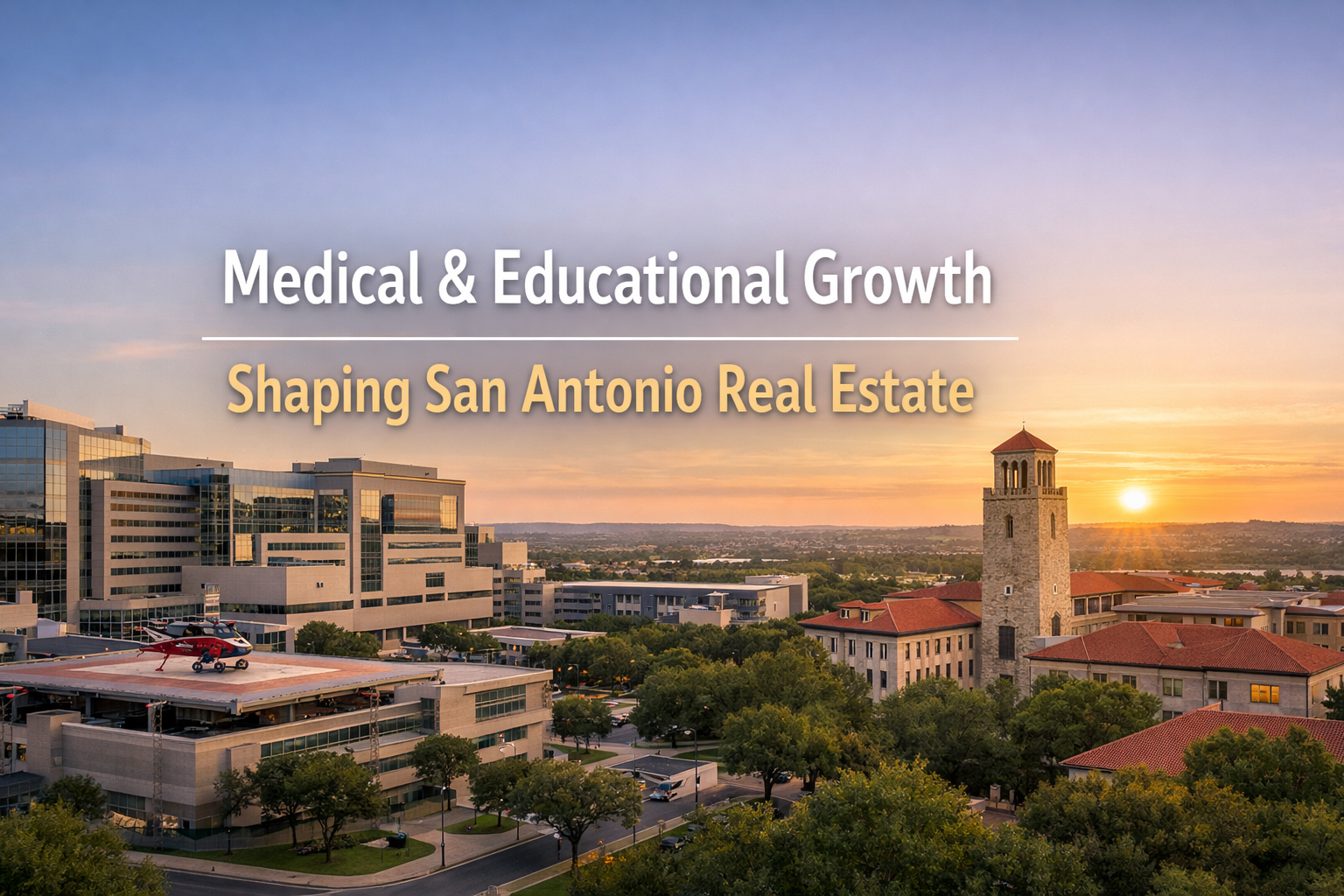
Major medical facilities and educational institutions do more than provide services and jobs. They anchor neighborhoods, drive economic activity, and influence residential real estate patterns for miles around. When hospitals expand, medical schools add programs, or universities grow their campuses, surrounding real estate feels the effects through increased demand, new construction, and evolving neighborhood character.
San Antonio's emergence as a major healthcare hub and its strong educational infrastructure create distinctive real estate dynamics. Understanding how medical and educational growth influences housing markets helps buyers identify opportunities in areas positioned for sustained demand and appreciation.
This guide examines how medical center development, hospital expansions, university growth, and school district strength affect residential real estate decisions throughout the San Antonio metropolitan area.
Why Does Institutional Growth Matter for Real Estate?
The connection between major institutions and residential real estate operates through multiple channels.
Employment Generation:
Medical facilities and educational institutions employ thousands of workers across diverse roles. Doctors, nurses, technicians, administrators, faculty, staff, and support personnel all need housing. This employment base creates sustained demand for homes near major institutional campuses.
Employment characteristics that support housing demand:
- Generally stable positions less affected by economic cycles
- Professional salaries supporting home purchases
- Continuous hiring as institutions grow and replace departing employees
- Diverse income levels from entry positions to specialists
- Tendency for employees to prefer proximity to workplaces
Ancillary Business Development:
Major institutions attract supporting businesses that further increase employment. Medical supply companies, pharmaceutical representatives, specialty retailers, restaurants serving employees and visitors, and professional services all cluster near hospitals and campuses.
This secondary employment multiplies housing demand beyond direct institutional employment, creating broader neighborhood economic vitality.
Infrastructure Investment:
Institutional growth often triggers infrastructure improvements that benefit surrounding areas. Road expansions, utility upgrades, public transportation enhancements, and streetscape improvements frequently accompany major medical or educational development.
These improvements enhance residential desirability beyond serving the institutions directly, creating spillover benefits for nearby homeowners.
Neighborhood Stability:
Major institutions provide stability that purely commercial or residential areas may lack. Hospitals and universities rarely relocate, providing long term anchors that support neighborhood investment confidence. Property owners near established institutions benefit from this permanence.
How Does the South Texas Medical Center Affect Real Estate?
San Antonio's South Texas Medical Center represents one of the largest medical complexes in the region, creating significant real estate implications.
Medical Center Overview:
The South Texas Medical Center along Fredericksburg Road and Medical Drive concentrates major hospital systems, specialty clinics, research facilities, and medical education programs. The complex has grown continuously for decades and continues expanding.
Major facilities include:
- University Hospital and UT Health San Antonio
- Methodist Hospital system facilities
- Baptist Medical Center locations
- Christus Santa Rosa Health System
- Numerous specialty clinics and outpatient facilities
- Medical research institutions
- Support services and medical offices
Employment Impact:
Healthcare represents one of San Antonio's largest employment sectors, with the Medical Center serving as its epicenter. Thousands of employees work within the complex, from physicians and specialists to nurses, technicians, and administrative staff.
This concentrated employment creates housing demand throughout accessible areas. Employees at various income levels seek homes within reasonable commute distances, supporting demand across multiple price points and neighborhoods.
Surrounding Residential Areas:
Neighborhoods surrounding the Medical Center benefit from proximity to this employment hub. Areas within the North Central corridor, including sections along Fredericksburg Road, Babcock Road, and connecting streets, attract buyers seeking convenient Medical Center access.
Housing characteristics in Medical Center adjacent areas:
- Mix of older established neighborhoods and newer developments
- Range of price points from modest to upscale
- Strong rental demand from medical professionals
- Resale activity driven partially by employment transitions
- Investment appeal due to sustained demand
Expansion Implications:
Continued Medical Center expansion creates ongoing real estate implications. New facilities under construction or planning generate additional employment, supporting housing demand. Infrastructure improvements accompanying expansion benefit surrounding residents.
Buyers evaluating Medical Center area properties should consider both current conditions and announced expansion plans that may further enhance the area's employment base and accessibility.
How Do Hospital Expansions Throughout the Region Affect Housing?
Beyond the central Medical Center, hospital development throughout San Antonio influences local real estate markets.
Distributed Hospital Development:
Major healthcare systems have established facilities throughout the metropolitan area, bringing medical employment and services to diverse communities. These distributed facilities create localized real estate effects in their respective areas.
Regional hospital locations include:
- Northeast Side facilities serving growing populations
- Northwest Side hospitals addressing suburban expansion
- South Side medical services in developing areas
- Facilities in surrounding communities like Boerne, Schertz, and New Braunfels
Local Employment Effects:
Each hospital facility generates employment supporting local housing demand. Nurses, technicians, and support staff often prefer living near their workplaces, creating demand in immediately surrounding neighborhoods.
The 24 hour nature of hospital operations means employees work various shifts, valuing proximity that reduces commute burden during overnight or early morning hours.
Supporting Service Development:
Hospital facilities attract supporting businesses including pharmacies, medical supply retailers, specialty clinics, and restaurants. This commercial development enhances neighborhood amenities while generating additional employment.
Areas near newer hospital facilities often experience accelerated commercial development that improves quality of life for residents beyond just medical access.
Property Value Support:
Proximity to quality medical facilities supports property values through multiple mechanisms. Healthcare access matters to all residents but particularly to aging populations. Employment opportunities attract buyers. Commercial development provides convenience. These factors combine to support demand and values in hospital adjacent areas.
How Does Military Medical Presence Influence Real Estate?
San Antonio's significant military medical infrastructure creates distinctive real estate dynamics.
Brooke Army Medical Center:
BAMC at Fort Sam Houston represents one of the military's premier medical facilities, providing advanced care and serving as a training center. The facility employs thousands of military and civilian personnel, creating sustained housing demand in surrounding areas.
Military medical employment characteristics:
- Combination of uniformed and civilian positions
- Specialized medical professionals including trauma care
- Training programs cycling personnel through the facility
- Support services and administrative functions
Military Medical Education:
Military medical training programs bring students, residents, and instructors to San Antonio for varying periods. These temporary populations create rental demand while some choose to remain in the area after completing training.
The reputation of military medical programs attracts medical professionals who may transition to civilian practice locally, adding to permanent housing demand.
Northeast Side Impact:
Fort Sam Houston's location influences Northeast Side real estate significantly. Military families stationed at or working with BAMC often seek housing in Converse, Schertz, Cibolo, and nearby communities offering convenient access.
This demand supports active real estate markets in these areas regardless of broader economic conditions, as military medical operations continue independent of civilian economic cycles.
How Do Universities Affect Surrounding Real Estate?
San Antonio's multiple universities and colleges influence residential markets in their respective areas.
University of Texas at San Antonio:
UTSA's main campus on the far Northwest Side has driven significant development in surrounding areas. Student housing demand, faculty and staff employment, and commercial development serving the university community have transformed formerly rural areas.
UTSA impact characteristics:
- Student rental demand near campus
- Faculty and staff seeking convenient housing
- Commercial development serving university needs
- Infrastructure improvements supporting campus access
- Appreciation in areas benefiting from university presence
Downtown Campus Development:
UTSA's downtown campus expansion has contributed to urban revitalization, adding students and employees to the downtown population. This growth supports residential development and renovation in surrounding urban neighborhoods.
Other Institutions:
Additional universities and colleges throughout San Antonio create localized effects:
- Trinity University's influence on the Alamo Heights and nearby areas
- University of the Incarnate Word's presence in the Broadway corridor
- St. Mary's University's impact on West Side neighborhoods
- San Antonio College and other Alamo Colleges locations affecting their respective areas
- Texas A&M San Antonio's emerging influence on the South Side
Each institution generates employment, attracts students requiring housing, and drives commercial development that affects surrounding residential markets.
Student Housing Dynamics:
Areas near universities experience distinctive rental market dynamics. Demand for student appropriate housing, including apartments, shared houses, and smaller units, creates investment opportunities while potentially affecting neighborhood character.
Buyers evaluating near campus properties should understand student housing dynamics and their implications for neighborhood composition and rental potential.
How Does School District Quality Affect Property Values?
Beyond higher education, K-12 school quality significantly influences residential real estate.
School District Premium:
Homes in highly regarded school districts consistently command premiums over comparable properties in less favored districts. Families prioritize school quality when selecting neighborhoods, creating competitive demand that supports values.
Premium indicators:
- Higher prices per square foot than similar homes elsewhere
- Faster sales times for well priced properties
- Stronger buyer demand during family buying season
- Better value retention during market downturns
- Continued demand regardless of specific property features
San Antonio School District Landscape:
The San Antonio area contains numerous independent school districts with varying reputations and performance. Districts frequently mentioned as attracting buyer premium include Northside, North East, Alamo Heights, Boerne, and portions of others.
However, school quality varies within districts by individual campus. Buyers should research specific schools serving properties of interest rather than relying solely on district reputation.
New School Construction:
School construction often follows residential development, with new campuses opening in growing areas. The announcement of new schools can enhance neighborhood desirability by demonstrating district investment and potentially improving student to teacher ratios.
Buyers in new construction communities should understand which schools currently serve properties and what new construction plans exist. School assignments can change as districts adjust to development patterns.
Private and Charter Options:
The presence of quality private and charter school options influences some buyers' neighborhood calculations. Areas with desirable independent school alternatives may appeal to families whose priorities extend beyond public school assignments.
What Should Buyers Consider When Evaluating Institutional Proximity?
Strategic evaluation of institutional factors helps buyers make informed decisions.
Employment Relevance:
Buyers employed at or anticipating employment with major institutions should prioritize accessible locations. Commute quality affects daily life significantly. Proximity to major employers also supports resale to future buyers with similar employment.
Questions to consider:
- How does commute to current or anticipated employer compare across candidate neighborhoods?
- What transportation options serve the employment location?
- How might shift work or irregular hours affect location preferences?
- What happens to commute if employment changes?
Appreciation Potential:
Areas positioned to benefit from institutional growth may offer appreciation potential beyond general market trends. Expansion announcements, new facility construction, and program growth signal sustained demand.
However, institutional proximity is not universally positive. Some buyers prefer distance from busy medical campuses or student concentrated areas. Understanding personal preferences matters.
Rental Investment Considerations:
Properties near major institutions often present rental investment opportunities due to sustained demand from employees, students, and visiting professionals. Evaluating rental potential requires understanding demand characteristics and regulatory environments.
Investment factors:
- Rental demand strength and consistency
- Typical tenant profiles and lease terms
- Property management requirements
- Municipal regulations affecting rentals
- Competition from purpose built rental properties
Neighborhood Character:
Institutional proximity affects neighborhood character in various ways. Medical district areas may experience commercial development and traffic. Near campus neighborhoods may have student population effects. Understanding these dynamics helps buyers select compatible locations.
How Can Buyers Research Institutional Development Plans?
Several resources help buyers understand institutional growth affecting potential purchase areas.
Institutional Communications:
Major medical systems and universities publish strategic plans, expansion announcements, and development updates. Reviewing institutional websites, press releases, and public documents reveals planned growth that may affect real estate.
Municipal Planning:
City and county planning documents often reference institutional development as part of comprehensive plans. Zoning changes, infrastructure projects, and development approvals connected to institutional growth appear in public records.
Local News Coverage:
Healthcare and education developments receive regular media coverage. Following local news sources provides ongoing awareness of institutional changes affecting various areas.
Professional Guidance:
Experienced agents familiar with institutional impacts provide context that formal documents may not convey. Understanding which announced projects have momentum, how developments typically affect specific neighborhoods, and what historical patterns suggest helps buyers evaluate opportunities.
Expert Insight from Tami Price, REALTOR®
"Medical and educational institutions provide stability that many buyers underappreciate. When I work with healthcare professionals or educators, I help them think strategically about how their career and employment location should influence housing choices. But even buyers without direct institutional connections benefit from understanding how hospital expansions, new medical facilities, and school construction affect neighborhood demand and values. These institutions don't relocate, creating long term anchors that support residential real estate in their vicinity."
Tami Price, REALTOR®, Broker Associate, has helped buyers throughout San Antonio evaluate institutional factors affecting their home purchases over nearly two decades of market experience.
Three Key Takeaways for San Antonio Home Buyers
- Major institutions anchor neighborhoods and drive housing demand. Medical facilities, hospitals, and educational institutions create employment, attract ancillary businesses, and provide stability that supports residential real estate values.
- Institutional expansion signals ongoing opportunity. Areas positioned to benefit from announced medical or educational growth may experience sustained demand and appreciation as projects complete and employment increases.
- School quality significantly affects property values. Homes in highly regarded school districts command premiums and maintain stronger demand regardless of market conditions. Researching specific campus performance matters beyond district reputation.
Frequently Asked Questions
Q: Do homes near hospitals have noise or traffic problems?
A: Proximity to hospital campuses can involve increased traffic, emergency vehicle noise, and commercial development activity. Properties immediately adjacent to facilities experience these effects most directly. Homes in surrounding neighborhoods often enjoy employment access benefits without significant negative impacts. Evaluating specific properties for traffic exposure and noise levels helps identify comfortable distances.
Q: How do I research which schools serve a specific property?
A: School district websites provide boundary maps and address lookup tools showing assigned schools. However, assignments can change with redistricting. Confirming current assignments directly with districts and understanding any planned changes provides most reliable information. Your agent can help navigate this research for specific properties.
Q: Are homes near universities good investments?
A: University proximity can support strong rental demand, but investment quality depends on multiple factors including property condition, competition from purpose built student housing, municipal regulations, and management requirements. Some near campus properties perform excellently as investments while others present challenges. Thorough analysis of specific properties and markets determines investment merit.
Q: Will hospital expansion definitely increase my property value?
A: Hospital expansion generally supports property values in surrounding areas by increasing employment and economic activity. However, specific effects depend on expansion location relative to your property, infrastructure impacts, commercial development patterns, and overall market conditions. Expansion provides positive pressure but does not guarantee specific value increases.
Q: Should I avoid buying in areas with older schools?
A: Older school facilities do not necessarily indicate lower quality education. Many established schools in older buildings maintain excellent performance and strong reputations. Evaluating school quality based on academic outcomes, extracurricular offerings, and community reputation provides better guidance than facility age alone. Some buyers specifically prefer established schools with proven track records.
Q: How do I find out about planned medical or educational developments?
A: Institutional websites, press releases, and strategic plans provide official information about planned developments. Local news coverage highlights major announcements. Municipal planning documents reveal zoning and infrastructure changes connected to institutional growth. Your agent can provide context about announced projects and their potential real estate implications.
The Bottom Line
Medical and educational institutions significantly influence San Antonio real estate markets. The sustained employment, ancillary development, and neighborhood stability these institutions provide create distinctive opportunities for buyers who understand the dynamics.
From the South Texas Medical Center's broad employment impact to distributed hospital facilities, military medical presence, university campuses, and school district quality, institutional factors deserve consideration in residential real estate decisions. Areas positioned to benefit from institutional growth may offer sustained demand and appreciation potential.
For buyers evaluating homes throughout San Antonio, understanding how medical and educational development affects different areas helps identify neighborhoods aligned with both current needs and long term value.

Contact Tami Price, REALTOR®| San Antonio, TX
Tami Price, REALTOR®, Broker Associate, and USAF Veteran, brings nearly two decades of San Antonio experience to helping buyers understand how institutional factors affect real estate decisions. With approximately 1,000 closed transactions including many healthcare professionals, educators, and buyers prioritizing school quality, Tami provides informed guidance on institutional influences throughout the metropolitan area.
Recognized as a 14 time Five Star Professional Award winner with more than 650 five-star reviews and recommendations, Tami delivers trusted representation for buyers navigating San Antonio's diverse neighborhoods.
Tami Price, REALTOR®, Broker Associate
📞 210 620 6681
Tami Price's Specialties
- San Antonio neighborhoods and institutional proximity
- First time buyers evaluating school districts
- Military relocation near military medical facilities
- Healthcare professional home purchases
- New construction in growing areas
- Move up buyers prioritizing school quality
Disclaimer
This blog provides general educational information about institutional factors affecting San Antonio real estate and does not constitute investment, financial, or professional advice. School performance, institutional plans, and development patterns change over time. Individual circumstances vary significantly. Readers should conduct their own research regarding school assignments, institutional developments, and specific properties. Tami Price, REALTOR®, is licensed in the State of Texas.
Categories
- All Blogs (644)
- Home Buying (21)
- Neighborhood Guides (41)
- 10 Incentive and Rate Buydown Questions (1)
- 10 Military Neighborhood (1)
- 10 Mistakes Sellers Make (1)
- 10 Strategies to Coordinate a Same Day Close (1)
- 12 Lifestyle Questions to Move In (1)
- 12 PCS What Ifs (1)
- 12 Photos and Marketing Assets (1)
- 13 PCS Hunting Trip Tips (1)
- 14 Design Center Decisions (1)
- 15 Red Flags Touring Home in San Antonio (1)
- 2026 Market (1)
- 30 days after closing your home (1)
- 7 Offer Terms Beyond Price (1)
- 7 VA Specific Questions (1)
- 78015 Ranked One (1)
- 8 Bridge (1)
- 8 Myths Buyers Believe about Down Payments (1)
- 8 Reasons VA Buyers Love New Construction (1)
- 9 Mistakes Move Up Buyers Make (1)
- 9 Questions to Decide If You Keep Your PCS Home (1)
- 9 Timeline Questions Every Buyer Need to Ask (1)
- 9 Warranty Questions to Ask (1)
- 9 Ways to Attract VA & Military Buyers (1)
- 90 days before your move (1)
- About Tami Price (6)
- Active Adult Homes (1)
- Affordable Communities (2)
- Affordable Homes (1)
- Affordable Housing & Community Development (3)
- Agent Qualifications and Credentials (1)
- Agent Qualifications and Experience (1)
- Agent Recognition (3)
- Agent Selection (1)
- AI and Real Estate Tools (1)
- Alamo Heights (4)
- Alamo Heights ISD (1)
- Alamo Ranch (2)
- Amenities in Helotes, Texas (3)
- Appraisals (1)
- Arts and Culture (1)
- Awards and Recognition (7)
- Balcones Creek (1)
- Best Neighborhoods to Live in Cibolo, TX (3)
- Best Neighborhoods to Live in San Antonio (15)
- Best Places to Live in Northeast Inner Loop: A Neighborhood Guide (1)
- Bexar County Property Tax (1)
- Bexar County Real Estate (3)
- Blue Tape Walkthrough (1)
- Boerne Home Sellers (1)
- Boerne Texas (4)
- Builder Contracts & Warranties (3)
- Builder Incentives (1)
- Builder Warranties (1)
- Buyer (64)
- Buyer Activity San Antonio (1)
- Buyer and Seller Guidance (3)
- Buyer Due Diligence (1)
- Buyer Education (45)
- Buyer Guide (9)
- Buyer Guides (7)
- Buyer Protection Strategies (1)
- Buyer Representation (1)
- Buyer Representation Expertise (1)
- Buyer Resources (91)
- Buyer Strategy (2)
- Buyers (13)
- Buyers Agent (1)
- Buying a Foreclosed Home in San Antonio (10)
- Buying a Home (4)
- Buying a Home in San Antonio (6)
- Buying Near JBSA (1)
- Buying Timeline (1)
- Buying vs Renting (1)
- Castroville, TX (8)
- Central Texas Growth (1)
- Choosing a Real Estate Agent (1)
- Choosing an Agent (1)
- Cibolo Communities (1)
- Cibolo Home Sellers (1)
- Cibolo TX (12)
- Client Reviews and Testimonials (1)
- Client Satisfaction (1)
- Client Stories (1)
- Client Testimonial (4)
- Clients review (4)
- Closing (1)
- Cobblestone (1)
- Comal County (1)
- Commercial & Retail Development (2)
- Commercial Development (1)
- Community (1)
- Community Development (2)
- Community Development and Real Estate (1)
- Community Guides (1)
- Community Investment Impact (1)
- Community Spotlights (1)
- Commuter Neighborhoods (1)
- Cons of Living in Helotes, TX (4)
- Conservation Communities (1)
- Contingency Questions (1)
- Converse Home Sellers (1)
- Converse Homes For Sale (3)
- Converse Real Estate (1)
- Converse TX (10)
- Cost of Living Guides (1)
- Cost of Living in San Antonio TX (23)
- Custom Homes (5)
- Davis Ranch (1)
- Days on Market (1)
- Down Payment Assistance (1)
- Downtown Revitalization (1)
- Downtown San Antonio (2)
- Dual Military (1)
- East Side Living (1)
- Economic Development (1)
- Education, Texas Hill Country (1)
- Emerald Pointe (1)
- Employment (1)
- Employment Corridors (1)
- Encino Forest (1)
- Equity and Pricing Strategy (2)
- Equity Q&A (1)
- Established Communities (3)
- Events in San Antonio (34)
- Expert Advice from Tami Price, Realtor® (7)
- Fair Oak Ranch (1)
- Family Homes (3)
- FAQ (1)
- Far Northwest San Antonio (1)
- Far West San Antonio (1)
- Farmer Markets in San Antonio (1)
- Fastest Growing Zip Codes in America (1)
- Featured Homes for Sale (2)
- Featured Properties (1)
- Final Walkthrough (1)
- Financial Planning (11)
- Financing Strategy (1)
- First Time Buyers (23)
- First Time Sellers (1)
- First-Time Buyers (6)
- First-Time Homebuyer Resources (4)
- First-Time Homebuyer Tips (2)
- First-Time Homebuyers (6)
- First-Time Investors (1)
- Fort Sam Houston (3)
- Fort Sam Houston Real Estate (1)
- Fort Sam Houston, TX (2)
- Fox Grove (1)
- FSBO vs Agent Representation (1)
- Future Rental (1)
- Gated Communities (5)
- Golf Communities (1)
- Great Northwest (1)
- Greater San Antonio Housing Trends (2)
- Greater San Antonio Real Estate (5)
- Growth and Development (11)
- HELOC (1)
- Helotes Home Sellers (1)
- Hill Country (1)
- Hill Country Communities (2)
- Hill Country Development (1)
- Hill Country Homes for Sale (1)
- Hill Country Real Estate (2)
- Hill Country Retreat (1)
- Historic Districts (5)
- Historic Neighborhoods (4)
- Holiday Guide (1)
- Home Buyers (1)
- Home Buying (7)
- Home Buying Education (3)
- Home Buying Guide (7)
- Home Buying Process (8)
- Home Buying Strategy (2)
- Home Buying Tips (5)
- Home Energy Efficiency San Antonio (5)
- Home Financing (3)
- Home Improvement ROI (1)
- Home Inspections (3)
- Home Maintenance (1)
- Home Preparation (2)
- Home Pricing Strategy (14)
- Home Renovation for Resale (1)
- Home Sellers (1)
- Home Selling (12)
- Home Selling Guide (12)
- Home Selling Strategies (3)
- Home Selling Strategy (3)
- Home Selling Tips (23)
- Home Staging and Updates (2)
- Home Values (2)
- Homebuyer Education (15)
- Homebuyer Resources (1)
- Homebuying Guide (1)
- Homebuying Tips (3)
- Homeowner (32)
- Homeowner Tax Benefits (1)
- Homeownership Costs (1)
- Homes for Sale (2)
- Homes for sale near Lackland AFB (2)
- Homestead amenities (1)
- Horizon Pointe (1)
- House Hunting Guide (1)
- Housing Development (1)
- Housing Market Updates (3)
- How to Buy a House in San Antonio TX (43)
- Hunters Ranch (1)
- Hybrid (1)
- In Person (1)
- Incorporated Cities (6)
- Industry News (2)
- Industry Recognition (1)
- Infrastructure & Growth Projects (2)
- Interest Rates (2)
- Invest in San Antonio (32)
- Investment Opportunities (1)
- Investment Property San Antonio (3)
- JBSA (8)
- JBSA Housing (11)
- JBSA Real Estate (2)
- JBSA Resources (7)
- Joint Base San Antonio (4)
- Joint Base San Antonio Housing (1)
- Judson ISD (2)
- Lackland AFB (5)
- Lackland AFB Housing (1)
- Land Use Planning (1)
- Lera MLS (15)
- Lifestyle & Community Growth (2)
- Lifestyle & Local Growth (1)
- Lifestyle Communities (1)
- Listing Preparation (1)
- Listing Strategy (1)
- Live Oak (1)
- Living in San Antonio, TX (44)
- Living Near Randolph AFB (5)
- Loan Programs (1)
- Local Development News (2)
- Local Market Insights (4)
- Local News Around San Antonio (1)
- Luxury Communities (3)
- Luxury Homes (4)
- Luxury Real Estate (2)
- MacArthur Park (1)
- Making Offers on Homes (1)
- Market Analysis (24)
- Market Conditions (47)
- Market Expertise (1)
- Market Insights (5)
- Market Strategy (2)
- Market Timing (2)
- Market Trends (6)
- Market Trends & Insights (2)
- Market Update (17)
- Market Update 2026 (1)
- Market Updates (17)
- Master Planned Communities (12)
- Medical Center Area Real Estate (1)
- Medina Valley ISD (2)
- Midtown Living (1)
- Military & Economic Impact (3)
- Military Buyers (3)
- Military Communities (1)
- Military Families (1)
- Military Family Resources (1)
- Military Homebuying (3)
- Military Homeownership (1)
- Military Housing (2)
- Military Housing Market in Texas (14)
- Military Life in San Antonio (2)
- Military Neighborhoods (1)
- Military PCS Relocations (3)
- Military Real Estate (2)
- Military Relocation (100)
- Military Relocation & VA Loans (10)
- Military Relocation San Antonio (4)
- Military Relocation Services (3)
- Military Relocation to San Antonio (46)
- Military Relocations (18)
- Military Relocations & VA Home Loans (5)
- MLS Accuracy & Data Transparency (1)
- Mortgage Programs (1)
- Mothers Day in San Antonio (1)
- Move to Boerne TX (15)
- Move to Castroville TX (9)
- Move to Converse TX (14)
- Move to New Braunfels (1)
- Move to North San Antonio (16)
- Move to San Antonio TX (64)
- Move to Selma TX (17)
- Move to Shertz TX (10)
- Move to Texas (45)
- Move Up Buyer Resources (1)
- Move Up Buyers (24)
- Move-In Ready Homes (3)
- Move-In Ready Homes San Antonio (2)
- Move-Up Buyers (2)
- Moving to Helotes, TX (14)
- Moving to San Antonio (61)
- MUD Taxes (1)
- Natalia Homes For Sale (1)
- Near East Side Living (1)
- Negotiation Strategy (2)
- Neighborhood Amenities (1)
- Neighborhood Guides (7)
- Neighborhood Spotlights (3)
- Neighborhoods near Randolph AFB (9)
- New Braunfels (4)
- New Braunfels Homes For Sale (1)
- New Braunfels News (2)
- New Braunfels Real Estate (2)
- New Construction (63)
- New Construction Communities (1)
- New Construction Homes (12)
- New Construction Homes San Antonio (5)
- New Construction vs Resale (2)
- New Construction Without Customization (1)
- New Construction Without the Wait (1)
- New Contruction Cost (1)
- New Listing (13)
- News (21)
- News & updates (23)
- No City Tax (1)
- No HOA Homes (1)
- North Central San Antonio (5)
- North East ISD (4)
- North San Antonio (7)
- North Side Neighborhoods (1)
- North Side San Antonio Development (1)
- Northeast Inner Loop (1)
- Northeast Inner Loop Neighborhoods (1)
- Northeast San Antonio (1)
- Northside ISD (5)
- Northwest San Antonio (6)
- Northwest San Antonio Real Estate (2)
- Northwood (1)
- Olympia Hills (1)
- One-Story Homes (1)
- Outdoor Living (1)
- PCS and JBSA (2)
- PCS checklist (1)
- PCS Guide (4)
- PCS Moves (12)
- PCS Moves to Joint Base San Antonio (4)
- PCS Planning (16)
- PCS Randolph AFB (15)
- PCS Relocation (1)
- PCS Resources (6)
- PCS San Antonio (42)
- PCS to San Antonio (38)
- PID Assessments (1)
- Pinon Creek (1)
- Pipe Creek (1)
- Places to Eat Near Randolph AFB (1)
- Pool Homes (1)
- Pre Approval (1)
- Pre-Listing Preparation (2)
- Pre-Listing Process (1)
- Prescott Oaks (1)
- Preserve at Medina (1)
- Pricing and Marketing Strategy (3)
- Professional Awards and Achievements (2)
- Professional Real Estate Representation (1)
- Property Tax Exemptions Texas (1)
- pros and cons living in Converse TX (3)
- Pros and Cons Living in Selma TX (6)
- Pros and Cons of Living in Castroville, TX (4)
- Pros and Cons of Living in San Antonio (30)
- PT500 List (1)
- Purchase Negotiation (1)
- Quick Close Real Estate (1)
- Randolph AFB Neighborhoods (2)
- Real Estate (1)
- Real Estate Advice (1)
- Real Estate Agent Recognition (6)
- Real Estate Agent Selection (2)
- Real Estate Agent Value (1)
- Real Estate Consultation (1)
- Real Estate Finance (1)
- Real Estate Financing (1)
- Real Estate Impact (1)
- Real Estate Investment San Antonio (1)
- Real Estate Market Trends (3)
- Real Estate Professional Designations (1)
- Real Estate Strategy (1)
- Real Estate Technology & Trends (1)
- Real Estate Tips (1)
- Real Estate Tips and Guides (2)
- Real Estate Trends (2)
- RealTrends Verified (1)
- Relocating to San Antonio (2)
- Relocation (4)
- Relocation Resources (2)
- Relocation to San Antonio (49)
- Remote Homebuying (1)
- Rental Housing (1)
- Rental Property (1)
- Rental Strategy (1)
- Resale Properties (1)
- Retail Development (1)
- Retire in Boerne TX (10)
- Retire in San Antonio (31)
- Retirement Communities (1)
- Reviews and Recognition (1)
- Rockwall Ranch (1)
- Rural Living (2)
- Ryland Homes (1)
- SABOR (27)
- San Antonio Buyer Resources (2)
- San Antonio Communities (3)
- San Antonio Community Events (1)
- San Antonio Growth (1)
- San Antonio Home Buying and Selling (2)
- San Antonio Home Buying Guide (5)
- San Antonio Home Improvement (1)
- San antonio home prices (3)
- San Antonio Home Sellers (3)
- San Antonio Homeowner Guide (1)
- San Antonio Homes for Sale (13)
- San Antonio Housing Market (2)
- San Antonio Housing Market & Mortgage Financing (1)
- San Antonio Housing Market Analysis (1)
- San Antonio Housing Trends & Market Analysis (3)
- San Antonio Lifestyle Amenities (1)
- San Antonio Listing (1)
- San Antonio Living (1)
- San Antonio Market (3)
- San Antonio Market Updates (7)
- San Antonio Military Relocation (3)
- San Antonio Neighborhoods (48)
- San Antonio New Construction & Master-Planned Communities (2)
- San Antonio New Home Communities (1)
- San Antonio News (22)
- San Antonio Property Taxes (2)
- San Antonio Real Estate (164)
- San Antonio Real Estate Agents (6)
- San Antonio Real Estate Excellence (1)
- San Antonio Real Estate Guide (6)
- San Antonio Real Estate Market (32)
- San Antonio Real Estate Market Analysis (2)
- San Antonio REALTOR Awards (1)
- San Antonio Seller Resources (2)
- San Antonio Sellers (1)
- San Antonio Spec Homes (1)
- San Antonio Spurs Community Programs (1)
- San Antonio Urban Living (1)
- Scenic Loop (1)
- Schertz Home Sellers (1)
- Schertz Real Estate (1)
- Schertz, TX (11)
- School Information (1)
- SCUCISD Schools (1)
- Secured Quick Offer (1)
- Sell Home In San Antonio TX (50)
- Seller (50)
- Seller Education (24)
- Seller Guide (4)
- Seller Guides (1)
- Seller Representation Expertise (1)
- Seller Resources (69)
- Seller Should Understand (1)
- Seller Strategy (3)
- Seller Tips (2)
- Sellers (10)
- Selling A Home in San Antonio (49)
- Selling Your San Antonio Home (3)
- Selma TX (9)
- Single-Story Homes (4)
- Smart Homes (1)
- Solar Homes (3)
- Southtown (1)
- Spec Homes and Inventory Homes (2)
- Stone Oak (2)
- Suburban Housing Growth (2)
- Suburban Living (2)
- Talise De Culebra (1)
- Terrell Hills (2)
- Texas Acreage Properties (4)
- Texas Homestead Exemption (1)
- Things to do in San Antonio TX (16)
- Things to do Near Randolph AFB (3)
- Time Planning (1)
- Time-Sensitive Home Buying (1)
- Timing Strategy (1)
- Tips for Buying New Construction (9)
- Top Real Estate Agent in San Antonio (3)
- Transaction Coordination (1)
- Transportation Infrastructure (1)
- Two-Story Homes (2)
- Universal City (1)
- Updated Homes (2)
- Upscale Communities (1)
- Urban Communities (2)
- Urban Living (1)
- Urban Neighborhoods (4)
- VA Buyers (1)
- VA Home Loan Benefits (3)
- VA Loan Assumptions (3)
- VA loan benefits (27)
- VA Loan Guidance (1)
- VA Loan Home Buying Assistance (2)
- VA Loans (71)
- VA Loans and Military Benefits (3)
- VA Loans and Military Home Buying (3)
- VA Loans San Antonio (41)
- VET Benefits Living in San Antonio (3)
- Veterans Resources (3)
- Village Northwest (1)
- Virtual Buyers (1)
- Von Ormy Homes For Sale (1)
- week in sales (41)
- Weekly Sales Report (42)
- West San Antonio (2)
- West San Antonio Real Estate (1)
- Westover Hills Employment Corridor (1)
- Westover Valley (1)
- Windcrest Homes for Sale (1)
Recent Posts