Why AI Can't Replace Your San Antonio REALTOR® — And What It Could Cost You

Buyers and sellers across San Antonio, Schertz, Helotes, Cibolo, Converse, Boerne, and New Braunfels are increasingly turning to AI tools as a first step in the real estate process. They type an address into ChatGPT, ask what their home is worth, or search for the best neighborhoods near Joint Base San Antonio. By early 2026, roughly 87 percent of brokerage leaders report that agents in their firms use AI tools in some capacity. That is not a fringe trend. It is the new baseline.
What is not discussed loudly enough is what happens when AI shifts from research assistant to decision advisor. Tami Price, REALTOR® with Real Broker, LLC, notes that the San Antonio market is layered in ways that AI tools are simply not equipped to navigate. The constant cycle of military relocations, VA loan transactions, PCS timelines, and rapidly shifting growth corridors means buyers and sellers who rely too heavily on AI can end up with outdated valuations, inaccurate loan guidance, and neighborhood recommendations that do not actually serve their needs. Understanding where AI helps and where it falls short is one of the most important things a buyer or seller can do before entering this market.
Why Does AI Use in Real Estate Matter for San Antonio Buyers and Sellers?
San Antonio is one of the most complex and layered real estate environments in Texas. The influence of Joint Base San Antonio drives a constant cycle of military relocations, VA loan transactions, and time-sensitive PCS moves that demand precision and current knowledge. Growth corridors push outward through Helotes, Cibolo, and Boerne, while legacy neighborhoods inside Loop 410 behave very differently than new construction communities in Converse or Schertz.
Price-per-square-foot in San Antonio can vary by $50 or more based on a single school district boundary. AI tools rely on publicly available recorded sales data. They cannot account for builder incentive shifts, real-time inventory pressure, or the micro-dynamics of specific zip codes that a local real estate professional observes week to week.
For military families relocating to San Antonio from bases overseas or across the country, the temptation to rely on AI is especially understandable. Researching from thousands of miles away under a tight PCS deadline, AI can feel like a lifeline. But that reliance, when left unchecked, can lead to decisions that cost families time, money, and peace of mind.
Key reasons AI use carries elevated risk in this market:
- San Antonio has one of the highest concentrations of active-duty military personnel in the country
- VA loan transactions involve nuanced timelines and lender-specific overlays that change frequently
- New construction pricing in communities like Schertz and Cibolo shifts month to month
- Resale inventory dynamics differ dramatically by corridor and school district
- Military families face compressed decision timelines that leave little room for correction
Q: Why can't buyers simply use AI to research homes and skip the agent? A: AI can surface general data points, but it cannot interpret current inventory pressure, assess neighborhood fit for a specific lifestyle, or negotiate on a buyer's behalf. In a market as layered as San Antonio, the gap between general information and actionable guidance is precisely where transactions succeed or fall apart.
What Does AI Actually Get Right in Real Estate Research?
Before addressing where AI falls short, it is worth being direct about where it adds genuine value. Dismissing these tools entirely would be inaccurate and unhelpful.
At the informational level, AI performs well in several areas:
- Summarizing recently sold comparable properties from public records
- Explaining real estate terminology for first-time home buyers unfamiliar with the process
- Describing the general character and demographics of San Antonio neighborhoods
- Generating questions buyers and sellers should ask their agent before a consultation
- Helping buyers understand the broad structure of the home buying process in San Antonio
These are legitimate starting points. A buyer who arrives at a consultation having done AI research will often have better questions and a clearer sense of what they are looking for. That preparation has real value. The problem arises when buyers and sellers move AI from the research phase into the decision phase. That is where the tool's structural limitations create real risk.
Q: Should buyers use AI tools before contacting a real estate agent? A: AI is a reasonable first step for gathering general information and framing initial questions. The key is treating it as a starting point rather than a source of strategic guidance. Bringing that research to a conversation with a local professional allows them to validate, correct, or build on it with current market knowledge.
How Does AI Misread the San Antonio Real Estate Market?
The specific ways AI fails San Antonio buyers and sellers are not theoretical. They show up in real transactions, often at the moments when accurate information matters most.
Home Valuation Errors
AI valuation tools rely on recorded sales data, which can be weeks or months behind current market conditions. In active new construction communities across Schertz, Cibolo, and Boerne, builder pricing and incentive structures shift on a monthly or even weekly basis. Valuations that do not account for those shifts can be off by $20,000 to $40,000 in either direction. For sellers, that means potentially leaving equity on the table. For buyers, it can mean overpaying significantly. Accurate pricing for a San Antonio home requires a professional Comparative Market Analysis that accounts for current inventory, days on market, and the specific micro-dynamics of the neighborhood in question.
VA Loan Guidance Gaps
This is one of the areas of deepest concern for military families. The VA loan process involves entitlement calculations, lender-specific overlays, and appraisal requirements that change frequently. VA loan assumptions, in particular, involve a multi-step process that AI consistently oversimplifies. A service member PCSing to JBSA who asks ChatGPT about VA loan eligibility may receive information that is technically plausible but does not apply to their specific situation, lender, or timeline.
Inspection Report Interpretation
AI cannot interpret a home inspection report in context. It does not know whether a foundation notation is standard for homes built on San Antonio's expansive clay soil, or whether it signals a genuine structural issue. It cannot weigh a roof's remaining useful life against a seller's motivation to negotiate credits. These are judgment calls that require local knowledge and transaction experience.
Neighborhood Fit for Military Families
AI will generate a list of neighborhoods near Lackland Air Force Base, Fort Sam Houston, or Randolph Air Force Base. It will not identify which HOAs have historically created challenges for families with deployment schedules, which school districts have exceptional programs for military-connected students in transition, or which communities have established veteran support networks already in place.
Q: Can AI give an accurate home value estimate in San Antonio? A: AI tools can produce a general range based on public sales records, but they frequently miss the micro-market factors that determine accurate pricing in San Antonio. In neighborhoods where new construction, school district boundaries, and PCS-driven inventory intersect, AI estimates can be off by tens of thousands of dollars in either direction.
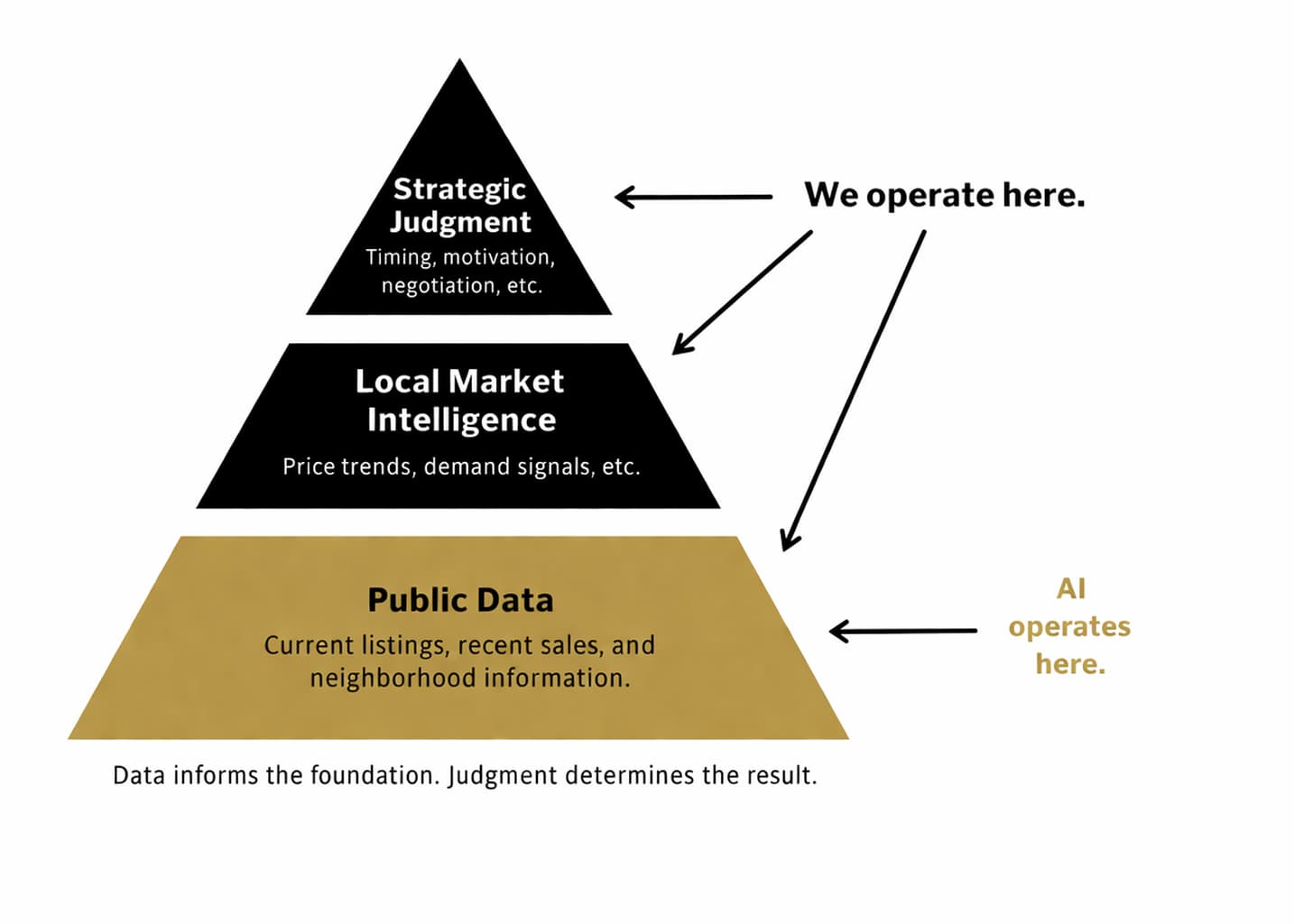
What Is the AI Pyramid and Why Should San Antonio Buyers Understand It?
A useful framework for understanding AI's role in real estate is the three-tier pyramid. Each tier represents a different level of knowledge, and AI operates reliably only at the base.
Base Tier: Public Data
This tier includes current listings, recent sold prices, school ratings, and general neighborhood descriptions. AI operates well here. It can pull sold comparables and summarize publicly available information quickly and efficiently. This is the appropriate zone for AI use, and it provides genuine value when treated as a starting point.
Middle Tier: Local Market Intelligence
This tier includes price trend analysis, absorption rates, demand signals, and the difference between a neighborhood with strong resale velocity versus one where homes are sitting for 90 days. AI can approximate some of this, but it lacks the real-time, ground-level perspective that comes from being physically present in the market every single week.
Top Tier: Strategic Judgment
This is the narrow, consequential peak: timing, motivation, leverage, and the micro-decisions that determine whether a transaction closes in the buyer's favor or the seller's. Despite significant progress in AI capabilities, experienced professionals continue to add qualitative judgment, local market nuance, and contextual interpretation that AI cannot replicate. This is where strategic negotiation happens, where lender relationships matter, and where a buyer's or seller's outcome is actually determined.
At a glance, how the three tiers break down:
- Public data: AI performs reliably
- Local market intelligence: AI approximates, professionals verify and contextualize
- Strategic judgment: AI cannot substitute for human expertise, timing, or relationship knowledge
How Can AI Misinformation Damage a Real Estate Negotiation?
One of the most instructive stories about AI's limitations in real estate involves a transaction where both the buyer and the seller independently consulted ChatGPT to evaluate whether a deal was fair.
ChatGPT told the buyer they were paying too much. It told the seller they were accepting too little. Neither of those conclusions reflected the actual market dynamics of that specific transaction. Both parties walked away rattled, not because the offer was unfair, but because AI gave each side the answer it was psychologically primed to receive. Large language models can generate content with remarkable precision and exude high confidence in their outputs, yet those outputs are not always accurate. In real estate, that false confidence does not just cause confusion. It can kill a deal entirely.
This is the structural bias that rarely receives direct attention. AI does not know a buyer's motivation, timeline, or emotional investment. It does not know the competitive dynamics of a specific price range in a specific zip code. It generates the most statistically plausible answer based on pattern-matching across millions of data points, and it delivers that answer with a confidence that feels authoritative whether or not it is correct. Working with a real estate agent who understands the negotiation dynamics specific to the San Antonio market is the single most effective protection against AI-generated misinformation entering and damaging a transaction.
Q: What happens when both parties in a real estate transaction use AI to evaluate the deal? A: AI tools tend to confirm each party's existing concerns rather than provide balanced, situation-specific analysis. When both sides receive AI input suggesting they are being treated unfairly, the result is often conflict, deal collapse, or renegotiation that serves neither party well.
What Do Military Families Near JBSA Need to Know About AI and Real Estate?
Military families relocating to San Antonio face a specific combination of pressures that make AI reliance particularly risky. PCS timelines are fixed. BAH windows are real. Report dates do not move. These constraints demand accurate, current, situation-specific guidance, which is precisely the opposite of what AI provides.
For families buying a home near JBSA with a VA loan, the stakes are especially high. AI consistently oversimplifies VA loan assumptions, underestimates the complexity of VA funding fee calculations, and cannot account for the lender-specific overlays that apply to different loan types and lender relationships.
Specific risks for JBSA-area military families using AI as a primary real estate resource:
- Receiving outdated or incomplete VA loan eligibility information that does not reflect current lender overlays
- Being directed to neighborhoods based on general proximity rather than military-specific fit criteria
- Misunderstanding PCS timeline requirements and how they interact with contract and closing timelines
- Overestimating the speed of VA appraisals in active inventory conditions
- Missing military-specific protections and strategies available only through an experienced Military Relocation Professional
Selecting an agent with the MRP designation means working with a professional who has been specifically trained in the intersection of military service obligations, VA loan products, and relocation logistics. That training cannot be replicated by any AI tool currently available.
Q: Is it safe for military families to use AI tools to research VA loans before a PCS move to San Antonio? A: AI can help military families understand general VA loan concepts and terminology, but VA loan rules, lender overlays, and entitlement calculations change frequently and vary by individual situation. For guidance specific to a PCS move to JBSA, families should always consult a VA-approved lender and a Military Relocation Professional with current, documented transaction experience in this market.
Why Is Neighborhood Intelligence Still a Human Skill in San Antonio?
Neighborhood knowledge in San Antonio is not a data problem. It is a relationship and experience problem, and no AI tool has solved it.
AI can describe the general character of Converse, Schertz, or Helotes based on publicly available information. What it cannot do is tell a military family which neighborhoods have HOA boards that have historically created complications for households with deployment schedules, or which elementary schools have counselors specifically experienced in supporting children navigating a mid-year PCS transition. It cannot point a buyer toward a block where strong veteran networks are already in place, or away from a subdivision where resale velocity has quietly declined over the past three quarters.
This kind of intelligence accumulates through years of working inside a market, showing homes, attending closings, and maintaining relationships with other professionals who are doing the same. It is the kind of knowledge that cannot be scraped from a database or generated by a pattern-matching algorithm. For buyers looking at homes for sale across San Antonio's neighborhoods and surrounding communities, that professional perspective is one of the most tangible advantages of working with an experienced local real estate agent.
Key areas where local neighborhood intelligence outperforms AI:
- School district transitions and mid-year enrollment support for military families
- HOA responsiveness and history of enforcement flexibility for deployed owners
- Resale velocity trends that do not yet appear in public sales data
- Proximity and commute patterns specific to JBSA installation access points
- Community culture and veteran population density by subdivision
Expert Insight from Tami Price
Tami Price, REALTOR® with Real Broker, LLC, is a U.S. Air Force veteran, Military Relocation Professional, and RealTrends Verified Top Agent with nearly two decades of experience and approximately 1,000 closed transactions in the San Antonio area. She holds the MCNE designation as a Master Certified Negotiation Expert and has personally closed VA loan assumptions multiple times, making her one of the most experienced VA assumption specialists serving the JBSA market. Her work has been recognized with the Five Star Professional Award for 15 consecutive years and more than 650 verified five-star reviews.
"AI is genuinely useful, and it has a place in how real estate professionals work today," Price says. "But after nearly 1,000 closed transactions in this market, I can tell you that the moments that determine whether a transaction succeeds or fails are human moments. They happen when I'm reading the room across the table from a buyer and I know something has shifted. They happen when a seller is emotionally attached to a price that does not reflect current conditions, and I have to navigate that with honesty and care. No AI is in that room with them."
Price draws a clear line between AI as a research tool and AI as a strategic advisor. She encourages buyers and sellers to approach AI output with informed skepticism, particularly when it comes to pricing, VA loan eligibility, and neighborhood recommendations near JBSA. The San Antonio market rewards accurate preparation and precise local knowledge. General information generated by a pattern-matching algorithm is not a substitute for either. For buyers and sellers working with Price, the relationship centers on three things: accurate pricing analysis, skilled negotiation, and the kind of situation-specific guidance that comes from someone who is active in this market every single day. That is the value a qualified San Antonio real estate agent provides, and it is the value no AI tool currently replicates.
Three Key Takeaways
- AI is a starting point for real estate research, not a substitute for strategic guidance. Buyers and sellers across San Antonio, Schertz, Cibolo, Helotes, Converse, Boerne, and New Braunfels can use AI tools productively to gather initial information, understand terminology, and generate questions for a local professional. The risk appears when AI moves from the research phase into the decision phase. Accurate pricing, skilled negotiation, and transaction management require current, ground-level market knowledge that only an experienced local real estate agent can provide.
- Military families face elevated risks when relying on AI for VA loan and PCS guidance. The VA loan process involves lender-specific overlays, entitlement calculations, and assumption procedures that AI consistently oversimplifies or misrepresents. For families operating under the time constraints of a PCS move to JBSA, receiving inaccurate or outdated guidance can mean missed deadlines, financing complications, or neighborhood choices that do not serve the family's actual needs. Working with a Military Relocation Professional who has current, documented JBSA transaction experience is a necessary protection against AI-generated misinformation entering a high-stakes, time-sensitive decision.
- In negotiation, AI has no stake in your outcome and no obligation to give you balanced advice. As documented in real transaction scenarios, AI tools tend to confirm each party's existing concerns rather than provide situation-specific analysis. Strategic negotiation is the highest-value service a real estate professional provides, and it requires human judgment, timing, relationship knowledge, and the ability to read a situation in real time. Buyers and sellers who allow AI-generated assessments to influence their negotiating positions risk damaging deals that would otherwise have closed successfully.
Frequently Asked Questions
Q. Can AI tell me what my San Antonio home is worth?
A. AI tools can provide a general estimate based on recently recorded public sales, but accurate pricing in the San Antonio market requires a professional Comparative Market Analysis. Neighborhoods in Helotes, Boerne, Schertz, and inside Loop 410 behave very differently from one another, and AI tools frequently miss those distinctions. Builder incentive changes in new construction communities can shift valuations by tens of thousands of dollars without appearing in any public data feed.
Q. Is it safe to use ChatGPT to research VA loans before a PCS move to San Antonio?
A. AI can explain general VA loan concepts and terminology, but VA loan rules, lender overlays, and entitlement calculations change frequently and vary by individual situation and lender. For guidance specific to a PCS move to JBSA, buyers should always work with a VA-approved lender and a Military Relocation Professional who has current transaction experience in this market.
Q. What can AI legitimately help with in a real estate transaction?
A. AI is most useful at the informational level: understanding general terminology, researching neighborhood demographics, reviewing recently sold comparable data, and generating questions to bring to a consultation. It works best as a research starting point and loses reliability when used as a source of strategic, situation-specific guidance on pricing, negotiation, or loan decisions.
Q. How do I find the best real estate agent in San Antonio for my specific situation?
A. Look for an agent with documented experience in your specific circumstances, whether that is military relocation, VA loans, new construction, or a particular area of the city. Credentials like the MRP designation, ABR, and MCNE indicate specialized training that goes beyond general licensing. Verified reviews and transaction history tell you what real clients have experienced across real deals in this market.
Q. Why is neighborhood guidance from AI unreliable for military families near JBSA?
A. AI can identify neighborhoods by general proximity to a base, but it cannot assess which communities have HOAs that have created challenges for families with deployment schedules, which school districts excel at supporting military-connected students in mid-year transitions, or which areas have strong established veteran networks. That level of intelligence requires direct professional experience accumulated over years in this specific market.
Q. How does AI mishandle real estate negotiation?
A. AI evaluates fairness based on general data patterns, not the specific dynamics of an individual transaction. It has no knowledge of a buyer's motivation, a seller's timeline, or the competitive pressures at a given price point in a given zip code. When both parties rely on AI to evaluate a deal, the result is often conflicting assessments that create unnecessary friction and can damage or derail transactions that were structured appropriately.
Q. Does working with a real estate agent cost buyers anything in San Antonio?
A. Buyer representation is structured through buyer representation agreements, and compensation arrangements vary. Buyers should have a clear conversation upfront about how buyer representation works, including how the agent is compensated, before they begin the home search process. Transparency about these terms is a standard part of how professional real estate agents in San Antonio operate.
Q. What is the difference between a professional using AI and a buyer using AI independently?
A. A professional real estate agent uses AI as one tool among many, validated by current market knowledge, direct transaction experience, and professional judgment. A buyer using AI independently lacks the context to know when the output is reliable and when it is not. The same output that is useful in the hands of an experienced professional can be misleading or harmful when used in isolation without that professional layer of interpretation.
The Bottom Line
AI is here, it is useful, and it is not going away. The buyers and sellers who will be best served are those who understand precisely what AI can and cannot do inside a real estate transaction.
At the research level, AI adds genuine value. It gives buyers and sellers a faster path to understanding the basics, and buyers who arrive at a consultation with AI-assisted preparation often ask sharper questions. At the strategic level, in pricing, negotiation, VA loan guidance, and neighborhood evaluation, AI falls short in ways that can cost buyers and sellers real money.
For buyers and sellers in San Antonio, Schertz, Cibolo, Helotes, Converse, Boerne, and New Braunfels, and especially for military families navigating a PCS move to Joint Base San Antonio, the most effective approach combines solid AI research with an experienced local professional who can validate, contextualize, and act on that information. Tami Price, REALTOR®, offers the ground-level market knowledge, negotiation expertise, and military relocation experience that turns information into results. Start a conversation today about what your real estate goals actually look like with someone who knows this market.

Contact Tami Price, REALTOR® | San Antonio, TX
Tami Price serves buyers, sellers, and military families across San Antonio, Schertz, Cibolo, Helotes, Converse, Boerne, and New Braunfels. Whether you are buying a home in San Antonio, selling your current home, or navigating a PCS move to JBSA, Tami provides the strategic guidance and local expertise to get you to closing with confidence.
📞 210 620 6681
Tami Price's Specialties
- Buyer and Seller Representation
- Military Relocations and PCS Moves
- VA Loan Guidance
- New Construction
- First-Time Home Buyers
- Move-Up Buyers
- Downsizing and Rightsizing
- Strategic Pricing and Market Analysis
- San Antonio, Schertz, Cibolo, Helotes, Converse, Boerne, and New Braunfels
Disclaimer
This blog is for informational purposes only and does not constitute legal, financial, or real estate advice. Market conditions change, and individual circumstances vary. Readers should consult qualified professionals before making real estate decisions. Tami Price, REALTOR®, is licensed in Texas and affiliated with Real Broker, LLC. Fair Housing principles apply to all content.
Categories
- All Blogs (643)
- Home Buying (21)
- Neighborhood Guides (41)
- 10 Incentive and Rate Buydown Questions (1)
- 10 Military Neighborhood (1)
- 10 Mistakes Sellers Make (1)
- 10 Strategies to Coordinate a Same Day Close (1)
- 12 Lifestyle Questions to Move In (1)
- 12 PCS What Ifs (1)
- 12 Photos and Marketing Assets (1)
- 13 PCS Hunting Trip Tips (1)
- 14 Design Center Decisions (1)
- 15 Red Flags Touring Home in San Antonio (1)
- 2026 Market (1)
- 30 days after closing your home (1)
- 7 Offer Terms Beyond Price (1)
- 7 VA Specific Questions (1)
- 78015 Ranked One (1)
- 8 Bridge (1)
- 8 Myths Buyers Believe about Down Payments (1)
- 8 Reasons VA Buyers Love New Construction (1)
- 9 Mistakes Move Up Buyers Make (1)
- 9 Questions to Decide If You Keep Your PCS Home (1)
- 9 Timeline Questions Every Buyer Need to Ask (1)
- 9 Warranty Questions to Ask (1)
- 9 Ways to Attract VA & Military Buyers (1)
- 90 days before your move (1)
- About Tami Price (6)
- Active Adult Homes (1)
- Affordable Communities (2)
- Affordable Homes (1)
- Affordable Housing & Community Development (3)
- Agent Qualifications and Credentials (1)
- Agent Qualifications and Experience (1)
- Agent Recognition (3)
- Agent Selection (1)
- AI and Real Estate Tools (1)
- Alamo Heights (4)
- Alamo Heights ISD (1)
- Alamo Ranch (2)
- Amenities in Helotes, Texas (3)
- Appraisals (1)
- Arts and Culture (1)
- Awards and Recognition (7)
- Balcones Creek (1)
- Best Neighborhoods to Live in Cibolo, TX (3)
- Best Neighborhoods to Live in San Antonio (15)
- Best Places to Live in Northeast Inner Loop: A Neighborhood Guide (1)
- Bexar County Property Tax (1)
- Bexar County Real Estate (3)
- Blue Tape Walkthrough (1)
- Boerne Home Sellers (1)
- Boerne Texas (4)
- Builder Contracts & Warranties (3)
- Builder Incentives (1)
- Builder Warranties (1)
- Buyer (64)
- Buyer Activity San Antonio (1)
- Buyer and Seller Guidance (3)
- Buyer Due Diligence (1)
- Buyer Education (45)
- Buyer Guide (9)
- Buyer Guides (7)
- Buyer Protection Strategies (1)
- Buyer Representation (1)
- Buyer Representation Expertise (1)
- Buyer Resources (91)
- Buyer Strategy (2)
- Buyers (13)
- Buyers Agent (1)
- Buying a Foreclosed Home in San Antonio (10)
- Buying a Home (4)
- Buying a Home in San Antonio (6)
- Buying Near JBSA (1)
- Buying Timeline (1)
- Buying vs Renting (1)
- Castroville, TX (8)
- Central Texas Growth (1)
- Choosing a Real Estate Agent (1)
- Choosing an Agent (1)
- Cibolo Communities (1)
- Cibolo Home Sellers (1)
- Cibolo TX (12)
- Client Reviews and Testimonials (1)
- Client Satisfaction (1)
- Client Stories (1)
- Client Testimonial (4)
- Clients review (4)
- Closing (1)
- Cobblestone (1)
- Comal County (1)
- Commercial & Retail Development (2)
- Commercial Development (1)
- Community (1)
- Community Development (2)
- Community Development and Real Estate (1)
- Community Guides (1)
- Community Investment Impact (1)
- Community Spotlights (1)
- Commuter Neighborhoods (1)
- Cons of Living in Helotes, TX (4)
- Conservation Communities (1)
- Contingency Questions (1)
- Converse Home Sellers (1)
- Converse Homes For Sale (3)
- Converse Real Estate (1)
- Converse TX (10)
- Cost of Living Guides (1)
- Cost of Living in San Antonio TX (23)
- Custom Homes (5)
- Davis Ranch (1)
- Days on Market (1)
- Down Payment Assistance (1)
- Downtown Revitalization (1)
- Downtown San Antonio (2)
- Dual Military (1)
- East Side Living (1)
- Economic Development (1)
- Education, Texas Hill Country (1)
- Emerald Pointe (1)
- Employment (1)
- Employment Corridors (1)
- Encino Forest (1)
- Equity and Pricing Strategy (2)
- Equity Q&A (1)
- Established Communities (3)
- Events in San Antonio (34)
- Expert Advice from Tami Price, Realtor® (7)
- Fair Oak Ranch (1)
- Family Homes (3)
- FAQ (1)
- Far Northwest San Antonio (1)
- Far West San Antonio (1)
- Farmer Markets in San Antonio (1)
- Fastest Growing Zip Codes in America (1)
- Featured Homes for Sale (2)
- Featured Properties (1)
- Final Walkthrough (1)
- Financial Planning (11)
- Financing Strategy (1)
- First Time Buyers (23)
- First Time Sellers (1)
- First-Time Buyers (6)
- First-Time Homebuyer Resources (4)
- First-Time Homebuyer Tips (2)
- First-Time Homebuyers (6)
- First-Time Investors (1)
- Fort Sam Houston (3)
- Fort Sam Houston Real Estate (1)
- Fort Sam Houston, TX (2)
- Fox Grove (1)
- FSBO vs Agent Representation (1)
- Future Rental (1)
- Gated Communities (5)
- Golf Communities (1)
- Great Northwest (1)
- Greater San Antonio Housing Trends (2)
- Greater San Antonio Real Estate (5)
- Growth and Development (11)
- HELOC (1)
- Helotes Home Sellers (1)
- Hill Country (1)
- Hill Country Communities (2)
- Hill Country Development (1)
- Hill Country Homes for Sale (1)
- Hill Country Real Estate (2)
- Hill Country Retreat (1)
- Historic Districts (5)
- Historic Neighborhoods (4)
- Holiday Guide (1)
- Home Buying (7)
- Home Buying Education (3)
- Home Buying Guide (7)
- Home Buying Process (8)
- Home Buying Strategy (2)
- Home Buying Tips (5)
- Home Energy Efficiency San Antonio (5)
- Home Financing (3)
- Home Improvement ROI (1)
- Home Inspections (3)
- Home Maintenance (1)
- Home Preparation (2)
- Home Pricing Strategy (14)
- Home Renovation for Resale (1)
- Home Selling (12)
- Home Selling Guide (12)
- Home Selling Strategies (3)
- Home Selling Strategy (3)
- Home Selling Tips (23)
- Home Staging and Updates (2)
- Home Values (2)
- Homebuyer Education (15)
- Homebuyer Resources (1)
- Homebuying Guide (1)
- Homebuying Tips (3)
- Homeowner (32)
- Homeowner Tax Benefits (1)
- Homeownership Costs (1)
- Homes for Sale (2)
- Homes for sale near Lackland AFB (2)
- Homestead amenities (1)
- Horizon Pointe (1)
- House Hunting Guide (1)
- Housing Development (1)
- Housing Market Updates (3)
- How to Buy a House in San Antonio TX (43)
- Hunters Ranch (1)
- Hybrid (1)
- In Person (1)
- Incorporated Cities (6)
- Industry News (2)
- Industry Recognition (1)
- Infrastructure & Growth Projects (2)
- Interest Rates (2)
- Invest in San Antonio (32)
- Investment Opportunities (1)
- Investment Property San Antonio (3)
- JBSA (8)
- JBSA Housing (11)
- JBSA Real Estate (2)
- JBSA Resources (7)
- Joint Base San Antonio (4)
- Joint Base San Antonio Housing (1)
- Judson ISD (2)
- Lackland AFB (5)
- Lackland AFB Housing (1)
- Land Use Planning (1)
- Lera MLS (15)
- Lifestyle & Community Growth (2)
- Lifestyle & Local Growth (1)
- Lifestyle Communities (1)
- Listing Preparation (1)
- Listing Strategy (1)
- Live Oak (1)
- Living in San Antonio, TX (44)
- Living Near Randolph AFB (5)
- Loan Programs (1)
- Local Development News (2)
- Local Market Insights (4)
- Local News Around San Antonio (1)
- Luxury Communities (3)
- Luxury Homes (4)
- Luxury Real Estate (2)
- MacArthur Park (1)
- Making Offers on Homes (1)
- Market Analysis (24)
- Market Conditions (47)
- Market Expertise (1)
- Market Insights (5)
- Market Strategy (2)
- Market Timing (2)
- Market Trends (6)
- Market Trends & Insights (2)
- Market Update (17)
- Market Update 2026 (1)
- Market Updates (16)
- Master Planned Communities (12)
- Medical Center Area Real Estate (1)
- Medina Valley ISD (2)
- Midtown Living (1)
- Military & Economic Impact (3)
- Military Buyers (3)
- Military Communities (1)
- Military Families (1)
- Military Family Resources (1)
- Military Homebuying (3)
- Military Homeownership (1)
- Military Housing (2)
- Military Housing Market in Texas (14)
- Military Life in San Antonio (2)
- Military Neighborhoods (1)
- Military PCS Relocations (3)
- Military Real Estate (2)
- Military Relocation (99)
- Military Relocation & VA Loans (10)
- Military Relocation San Antonio (4)
- Military Relocation Services (3)
- Military Relocation to San Antonio (46)
- Military Relocations (18)
- Military Relocations & VA Home Loans (5)
- MLS Accuracy & Data Transparency (1)
- Mortgage Programs (1)
- Mothers Day in San Antonio (1)
- Move to Boerne TX (15)
- Move to Castroville TX (9)
- Move to Converse TX (14)
- Move to New Braunfels (1)
- Move to North San Antonio (16)
- Move to San Antonio TX (64)
- Move to Selma TX (17)
- Move to Shertz TX (10)
- Move to Texas (45)
- Move Up Buyer Resources (1)
- Move Up Buyers (24)
- Move-In Ready Homes (3)
- Move-In Ready Homes San Antonio (2)
- Move-Up Buyers (2)
- Moving to Helotes, TX (14)
- Moving to San Antonio (61)
- MUD Taxes (1)
- Natalia Homes For Sale (1)
- Near East Side Living (1)
- Negotiation Strategy (2)
- Neighborhood Amenities (1)
- Neighborhood Guides (7)
- Neighborhood Spotlights (3)
- Neighborhoods near Randolph AFB (9)
- New Braunfels (4)
- New Braunfels Homes For Sale (1)
- New Braunfels News (2)
- New Braunfels Real Estate (2)
- New Construction (62)
- New Construction Communities (1)
- New Construction Homes (12)
- New Construction Homes San Antonio (5)
- New Construction vs Resale (2)
- New Construction Without Customization (1)
- New Construction Without the Wait (1)
- New Contruction Cost (1)
- New Listing (13)
- News (21)
- News & updates (23)
- No City Tax (1)
- No HOA Homes (1)
- North Central San Antonio (5)
- North East ISD (4)
- North San Antonio (7)
- North Side Neighborhoods (1)
- North Side San Antonio Development (1)
- Northeast Inner Loop (1)
- Northeast Inner Loop Neighborhoods (1)
- Northeast San Antonio (1)
- Northside ISD (5)
- Northwest San Antonio (6)
- Northwest San Antonio Real Estate (2)
- Northwood (1)
- Olympia Hills (1)
- One-Story Homes (1)
- Outdoor Living (1)
- PCS and JBSA (2)
- PCS checklist (1)
- PCS Guide (4)
- PCS Moves (12)
- PCS Moves to Joint Base San Antonio (4)
- PCS Planning (16)
- PCS Randolph AFB (15)
- PCS Relocation (1)
- PCS Resources (6)
- PCS San Antonio (42)
- PCS to San Antonio (38)
- PID Assessments (1)
- Pinon Creek (1)
- Pipe Creek (1)
- Places to Eat Near Randolph AFB (1)
- Pool Homes (1)
- Pre Approval (1)
- Pre-Listing Preparation (2)
- Pre-Listing Process (1)
- Prescott Oaks (1)
- Preserve at Medina (1)
- Pricing and Marketing Strategy (3)
- Professional Awards and Achievements (2)
- Professional Real Estate Representation (1)
- Property Tax Exemptions Texas (1)
- pros and cons living in Converse TX (3)
- Pros and Cons Living in Selma TX (6)
- Pros and Cons of Living in Castroville, TX (4)
- Pros and Cons of Living in San Antonio (30)
- PT500 List (1)
- Purchase Negotiation (1)
- Quick Close Real Estate (1)
- Randolph AFB Neighborhoods (2)
- Real Estate (1)
- Real Estate Advice (1)
- Real Estate Agent Recognition (6)
- Real Estate Agent Selection (2)
- Real Estate Agent Value (1)
- Real Estate Consultation (1)
- Real Estate Finance (1)
- Real Estate Financing (1)
- Real Estate Impact (1)
- Real Estate Investment San Antonio (1)
- Real Estate Market Trends (3)
- Real Estate Professional Designations (1)
- Real Estate Strategy (1)
- Real Estate Technology & Trends (1)
- Real Estate Tips (1)
- Real Estate Tips and Guides (2)
- Real Estate Trends (2)
- RealTrends Verified (1)
- Relocating to San Antonio (2)
- Relocation (4)
- Relocation Resources (2)
- Relocation to San Antonio (49)
- Remote Homebuying (1)
- Rental Housing (1)
- Rental Property (1)
- Rental Strategy (1)
- Resale Properties (1)
- Retail Development (1)
- Retire in Boerne TX (10)
- Retire in San Antonio (31)
- Retirement Communities (1)
- Reviews and Recognition (1)
- Rockwall Ranch (1)
- Rural Living (2)
- Ryland Homes (1)
- SABOR (27)
- San Antonio Buyer Resources (2)
- San Antonio Communities (3)
- San Antonio Community Events (1)
- San Antonio Growth (1)
- San Antonio Home Buying and Selling (2)
- San Antonio Home Buying Guide (5)
- San Antonio Home Improvement (1)
- San antonio home prices (3)
- San Antonio Home Sellers (3)
- San Antonio Homeowner Guide (1)
- San Antonio Homes for Sale (13)
- San Antonio Housing Market (2)
- San Antonio Housing Market & Mortgage Financing (1)
- San Antonio Housing Market Analysis (1)
- San Antonio Housing Trends & Market Analysis (3)
- San Antonio Lifestyle Amenities (1)
- San Antonio Listing (1)
- San Antonio Living (1)
- San Antonio Market (3)
- San Antonio Market Updates (7)
- San Antonio Military Relocation (3)
- San Antonio Neighborhoods (48)
- San Antonio New Construction & Master-Planned Communities (2)
- San Antonio New Home Communities (1)
- San Antonio News (22)
- San Antonio Property Taxes (2)
- San Antonio Real Estate (163)
- San Antonio Real Estate Agents (6)
- San Antonio Real Estate Excellence (1)
- San Antonio Real Estate Guide (6)
- San Antonio Real Estate Market (32)
- San Antonio Real Estate Market Analysis (2)
- San Antonio REALTOR Awards (1)
- San Antonio Seller Resources (2)
- San Antonio Sellers (1)
- San Antonio Spec Homes (1)
- San Antonio Spurs Community Programs (1)
- San Antonio Urban Living (1)
- Scenic Loop (1)
- Schertz Home Sellers (1)
- Schertz Real Estate (1)
- Schertz, TX (11)
- School Information (1)
- SCUCISD Schools (1)
- Secured Quick Offer (1)
- Sell Home In San Antonio TX (50)
- Seller (50)
- Seller Education (24)
- Seller Guide (4)
- Seller Guides (1)
- Seller Representation Expertise (1)
- Seller Resources (69)
- Seller Should Understand (1)
- Seller Strategy (3)
- Seller Tips (2)
- Sellers (10)
- Selling A Home in San Antonio (49)
- Selling Your San Antonio Home (3)
- Selma TX (9)
- Single-Story Homes (4)
- Smart Homes (1)
- Solar Homes (3)
- Southtown (1)
- Spec Homes and Inventory Homes (2)
- Stone Oak (2)
- Suburban Housing Growth (2)
- Suburban Living (2)
- Talise De Culebra (1)
- Terrell Hills (2)
- Texas Acreage Properties (4)
- Texas Homestead Exemption (1)
- Things to do in San Antonio TX (16)
- Things to do Near Randolph AFB (3)
- Time Planning (1)
- Time-Sensitive Home Buying (1)
- Timing Strategy (1)
- Tips for Buying New Construction (9)
- Top Real Estate Agent in San Antonio (3)
- Transaction Coordination (1)
- Transportation Infrastructure (1)
- Two-Story Homes (2)
- Universal City (1)
- Updated Homes (2)
- Upscale Communities (1)
- Urban Communities (2)
- Urban Living (1)
- Urban Neighborhoods (4)
- VA Buyers (1)
- VA Home Loan Benefits (3)
- VA Loan Assumptions (3)
- VA loan benefits (27)
- VA Loan Guidance (1)
- VA Loan Home Buying Assistance (2)
- VA Loans (71)
- VA Loans and Military Benefits (3)
- VA Loans and Military Home Buying (3)
- VA Loans San Antonio (41)
- VET Benefits Living in San Antonio (3)
- Veterans Resources (3)
- Village Northwest (1)
- Virtual Buyers (1)
- Von Ormy Homes For Sale (1)
- week in sales (40)
- Weekly Sales Report (41)
- West San Antonio (2)
- West San Antonio Real Estate (1)
- Westover Hills Employment Corridor (1)
- Westover Valley (1)
- Windcrest Homes for Sale (1)
Recent Posts