How Will Population Growth Influence San Antonio Housing Over Time?
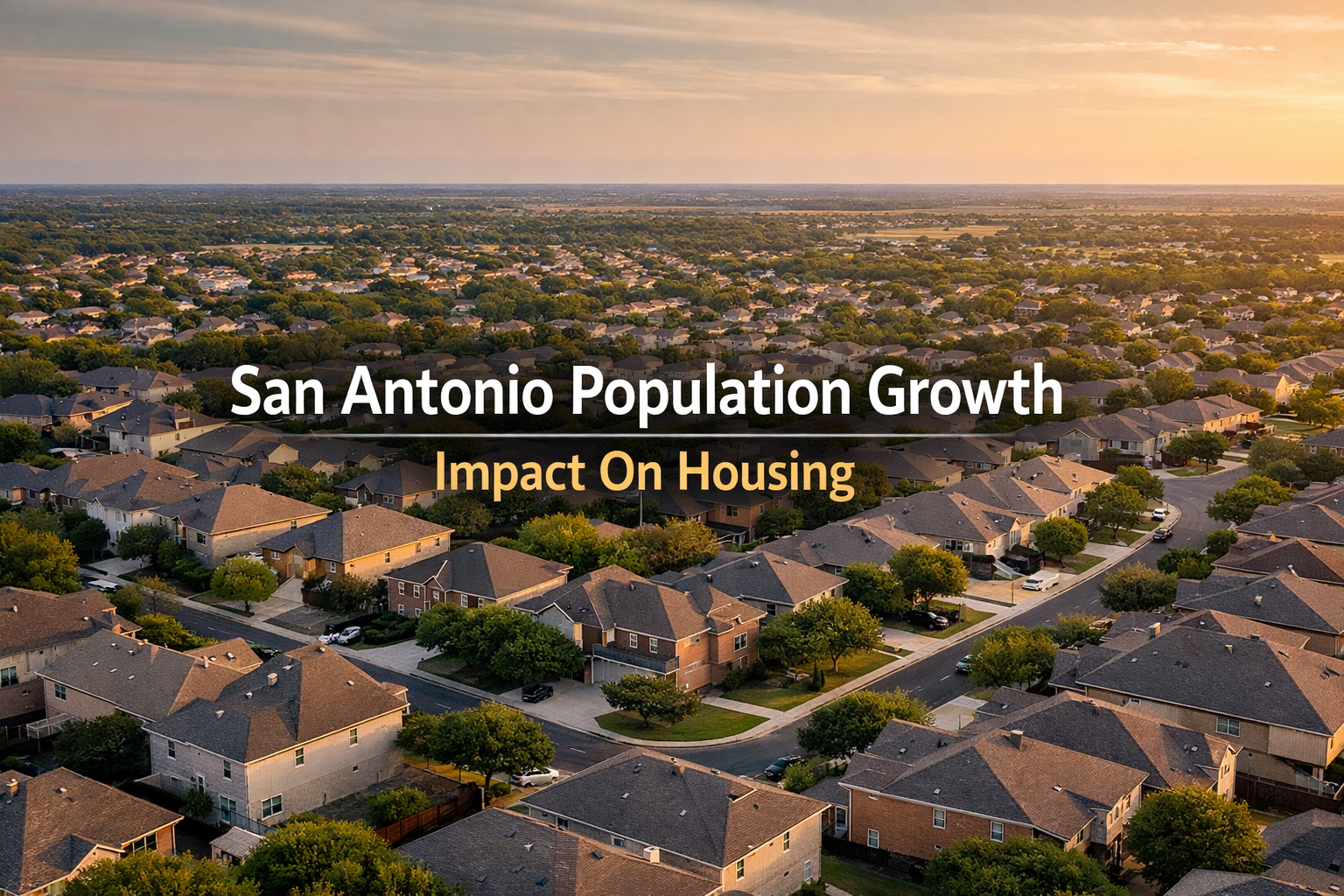
San Antonio's long-term population growth is one of the strongest underlying drivers of housing demand in Bexar County and surrounding areas like Cibolo, Schertz, Boerne, Helotes, and expanding communities throughout Comal, Guadalupe, and Kendall counties. As more people move to the Greater San Antonio region for job opportunities, relative affordability, military relocation, and quality of life, housing supply dynamics, pricing patterns, and neighborhood development adjust accordingly across the metro. For buyers, sustained population growth typically supports long-term appreciation potential and resale demand, but it also increases competition in the most desirable areas and neighborhoods. Understanding how growth patterns influence inventory availability, new construction activity, pricing trends, infrastructure development, and property tax assessments helps buyers make smarter, more informed long-term decisions in the Greater San Antonio market.
Direct Answer
Population growth increases long-term housing demand across Greater San Antonio, which can support home values, drive new construction development, and fundamentally reshape neighborhood character and development patterns over time. For buyers, this generally means stronger long-term equity potential and reliable resale demand—but also more competition for well-positioned properties and evolving affordability challenges in high-demand areas.
Key Points at a Glance
- Population growth drives long-term housing demand across Greater San Antonio
- Sustained growth supports home value appreciation and resale market stability
- New construction activity expands into surrounding counties as core areas fill
- Infrastructure development follows population centers and housing growth
- School districts expand and neighborhoods evolve with population increases
- Property tax assessments tend to rise with growth and increased values
- Military presence at JBSA creates structural demand stability
- Affordability ripple effect pushes buyers toward suburban and outlying areas
- Long-term equity building benefits from sustained growth patterns
Understanding What Population Growth Means for San Antonio Housing
When more people consistently move into an area over time, housing demand rises proportionally. Over the long term, that sustained demand fundamentally influences multiple aspects of the real estate market:
How population growth affects housing markets:
- Home prices and appreciation: Demand supporting values over time
- Inventory levels and availability: Competition for existing homes
- New construction activity: Builder response to demand
- Infrastructure development: Roads, utilities, schools, services
- School district expansion: New schools and boundary changes
- Neighborhood character evolution: Density, amenities, demographics
- Property tax assessments: Rising values increasing tax burden
- Rental market dynamics: Demand from population influx
Why San Antonio attracts new residents consistently:
San Antonio has long attracted new residents from across Texas, the United States, and internationally due to multiple compelling factors:
- Military presence at Joint Base San Antonio: Constant rotational relocations
- Healthcare and bioscience sector growth: Medical Center expansion, research facilities
- Technology sector expansion: Growing tech industry and corporate relocations
- Lower cost of living: Compared to Austin, Dallas, Houston, and coastal markets
- No state income tax: Texas tax advantage for relocating residents
- Relative housing affordability: Compared to other major Texas metros
- Quality of life factors: Culture, food scene, weather, entertainment
- Growing employment opportunities: Diverse and expanding job market
As demand from population growth increases, housing markets adjust through pricing changes, construction activity, and development patterns that reshape where and how people live.
Quick Takeaway: Population growth doesn't just raise prices mechanically—it fundamentally reshapes where people choose to live, what they can afford to buy, and how neighborhoods evolve and develop over time.
How Population Growth Impacts Home Values Over Time
Understanding the distinction between short-term market reactions and long-term value trends helps buyers make strategic rather than reactive decisions.
Short-Term Effects of Rapid Population Growth
In the short term, periods of rapid population growth can create specific market conditions:
- Competitive buyer conditions: Multiple buyers competing for limited inventory
- Multiple-offer situations: Particularly in certain price ranges and neighborhoods
- Low inventory in high-demand areas: Fast-selling properties, limited choices
- Pricing pressure: Values rising faster than normal appreciation rates
- Builder backlogs: Construction timelines extending due to demand
- Rental market tightness: Limited rental availability, rising rents
Long-Term Effects of Sustained Population Growth
Over the long term, sustained consistent growth tends to create different dynamics:
- Support for appreciation: Baseline demand preventing significant value declines
- Stable resale demand: Constant buyer pool when you eventually sell
- Commercial development attraction: Retail, dining, entertainment following population
- Infrastructure investment: City and county improving roads, utilities, services
- School district expansion: New schools built to accommodate growth
- Neighborhood maturation: Amenities, character, community developing
How growth spreads across Greater San Antonio:
In San Antonio specifically, growth has historically expanded outward from central urban areas into suburban communities, creating distinct patterns:
Suburban expansion corridors:
- Cibolo and Schertz (northeast)
- Helotes and northwest developments (west/northwest)
- Boerne and Hill Country areas (northwest)
- Converse and southeast areas (southeast)
- New Braunfels corridor (northeast in Comal County)
This outward expansion fundamentally changes where value creation happens and which areas experience the most growth impact.
Impact on Established Central Neighborhoods
In central San Antonio and mature Bexar County communities like Alamo Heights, Monte Vista, King William, and established neighborhoods:
- Limited land availability = limited new supply: Can't build more land in urban core
- Increased demand from growth = upward pricing pressure: Scarcity supporting values
- Renovations and redevelopment increase: Older homes updated to meet demand
- Infill development on vacant lots: Maximizing existing land use
- Neighborhood character preservation: Historic districts protecting character
Buyers in established central neighborhoods often benefit from scarcity-driven value stability and appreciation as population growth creates more buyers than available inventory.
Impact on Growth Corridors and Suburban Areas
In developing corridors and suburban expansion areas:
- Builders actively add inventory: New construction addressing demand
- Master-planned communities expand: Large-scale organized development
- Schools and retail follow rooftops: Commercial following residential growth
- Infrastructure gradually improves: Roads widened, services added
- Values may appreciate more slowly initially: Supply moderating price growth
These areas may see slower appreciation rates initially due to abundant new supply, but they often provide long-term stability if growth continues and infrastructure keeps pace with population.
Quick Takeaway: Growth supports home values over the long term—but specific location and supply dynamics significantly affect how growth translates to appreciation.
Inventory, New Construction, and Supply Pressure Dynamics
When population rises faster than housing supply can accommodate, affordability naturally tightens and competition increases throughout the market.
San Antonio has substantial land availability compared to geographically constrained markets like Austin, which allows for:
- Continued outward new construction expansion
- Large master-planned community developments
- Expansion into Comal, Guadalupe, and Kendall Counties
- Multiple development corridors accommodating growth
However, available land doesn't automatically equal instant housing supply. Builders face significant constraints:
What limits how fast supply can respond to growth:
- Labor shortages and constraints: Limited construction workforce availability
- Material costs and supply chains: Lumber, concrete, fixtures availability and pricing
- Development timelines and approvals: Permitting, inspections, utility connections
- Infrastructure capacity limits: Water, sewer, roads must expand with development
- Financing and economic conditions: Builder access to development capital
This means even with San Antonio's growth capacity and land availability, supply often lags behind demand during growth periods, creating market dynamics that affect buyers.
For buyers, supply lag during growth periods often creates:
- Price segmentation by area and neighborhood: Different pricing dynamics across metro
- Highly competitive entry-level markets: Most demand concentration at affordable price points
- More negotiation room in certain price brackets: Less competition at higher prices
- Varying days on market: Fast sales in hot areas, slower in others
For comprehensive guidance on navigating the complete buying process, The Home Buying Process in San Antonio provides step-by-step context.
Quick Takeaway: San Antonio can continue building outward to accommodate growth, but supply timing and infrastructure development significantly affect how quickly housing can respond to population demand.
How Population Growth Changes Where Buyers Should Consider Looking
As core San Antonio neighborhoods experience pricing increases driven by growth and limited supply, buyers naturally shift their search patterns to maintain affordability.
The affordability ripple effect in action:
As pricing rises in one area, buyers shift to adjacent areas offering better value:
Historical pattern:
- Central San Antonio prices rise beyond many buyers' budgets
- Buyers expand search to North San Antonio and established suburbs
- Those areas appreciate, prompting further outward movement
- Next wave moves to Schertz, Cibolo, Converse, Far Northwest
- Pattern continues outward into surrounding counties
Current affordability alternatives to core San Antonio:
- Schertz: Northeast, good schools, JBSA Randolph access, growing retail
- Cibolo: Northeast, family-oriented, new development, value positioning
- Converse: Southeast, affordable entry point, improving amenities
- Far Northwest San Antonio: Expanding corridor, new construction, space
- Areas near Medina County: Western expansion, larger lots, Hill Country access
- New Braunfels area: Comal County, growing employment, lifestyle appeal
This affordability ripple effect creates predictable patterns where buyers can anticipate future demand based on current growth trajectories.
What happens over time in affordability ripple areas:
- Previously affordable areas gradually appreciate: Yesterday's bargain becomes tomorrow's norm
- Commute patterns shift and evolve: Acceptance of longer commutes for affordability
- Infrastructure improves to accommodate growth: Roads widened, services added
- Retail and restaurant expansion follows: Commercial development trailing residential
- School districts expand capacity: New schools built, boundaries adjusted
Understanding these growth patterns and affordability dynamics helps strategic buyers anticipate where demand may move next and position themselves accordingly.
For exploring neighborhood options and understanding local dynamics, San Antonio Neighborhoods and Communities provides comprehensive area comparisons.
Quick Takeaway: Growth creates predictable affordability ripple effects that push buyers outward—understanding this pattern helps identify future opportunity areas.
"Tami helped us understand not just the house—but the area's long-term growth. She explained how development and expansion would impact our resale value. We felt confident buying because we understood the bigger picture." — Strategic Buyer
Questions Buyers Often Ask About Population Growth
Q: Does population growth automatically guarantee higher home prices in San Antonio? A: Not automatically or uniformly, but sustained population growth creates baseline housing demand that typically supports long-term price stability and appreciation. However, supply responses, interest rates, economic conditions, and local factors also significantly affect pricing beyond just population alone.
Q: Is it risky to buy in a fast-growing area with lots of new construction? A: It depends on supply balance. Areas with heavy ongoing new construction may see flatter short-term appreciation due to abundant supply competing with resale homes, but they can perform well long term if infrastructure development keeps pace, employment grows, and quality of life improves.
Q: Are suburban areas safer long-term investments than the urban core? A: Both can perform well with different dynamics. Core urban areas benefit from limited supply and scarcity, supporting values. Suburbs benefit from expansion room, new amenities, and growing employment centers. Choose based on lifestyle and long-term plans rather than assumptions.
Q: How does population growth affect property taxes over time? A: Growth often increases assessed property values as demand rises, which can raise property tax bills even if rates stay constant. Buyers should factor long-term tax exposure into affordability planning, especially in rapidly appreciating growth corridors.
Q: Can population growth ever negatively impact housing values? A: If growth significantly outpaces infrastructure development—creating traffic congestion, school overcrowding, or declining quality of life—it can slow appreciation or affect desirability. Balanced growth with infrastructure investment typically supports values best.
Common Misconceptions About Population Growth and Housing
Misconception: "If a city is growing rapidly, home prices will skyrocket forever without correction." Reality: Markets move in cycles despite growth trends. While growth supports baseline demand, other factors matter significantly: interest rates affect affordability, inventory levels influence competition, job growth stability matters, and economic conditions create ups and downs. Growth is one important factor—not the only determinant of price movement.
Misconception: "More construction and building activity means prices will fall dramatically." Reality: Increased construction can moderate pricing pressure and slow appreciation rates, but if population demand continues rising steadily, prices typically stabilize at higher levels rather than decline significantly. Supply helps prevent dramatic spikes more than it creates crashes.
Misconception: "I should wait to buy until population growth slows down." Reality: Timing markets based on growth predictions is extremely difficult and uncertain. Buyers focused on long-term homeownership (5+ years) often benefit more from entering when personally financially ready rather than waiting for uncertain shifts in growth patterns that may or may not materialize.
Misconception: "Population growth only benefits investors and landlords, not homeowners." Reality: Growth benefits both groups. Homeowners build equity through appreciation and have strong resale demand when eventually selling. Investors benefit from rental demand and appreciation. Primary residence owners participate in appreciation without active management.
Misconception: "All growing areas will appreciate at the same rate." Reality: Growth affects different areas differently based on supply constraints, infrastructure development, employment proximity, school quality, and many other hyperlocal factors. Location selection within growing markets matters enormously for outcomes.
Important Considerations for Buyers in Growing Markets
Before purchasing in Greater San Antonio with population growth as a consideration, carefully evaluate:
Think Long-Term Rather Than Short-Term
If population growth remains steady over time, long-term homeownership often benefits significantly from:
- Equity growth through appreciation: Home values rising with demand
- Strong rental demand: Option to rent if relocating rather than selling
- Resale market liquidity: Easy to sell with consistent buyer pool
- Neighborhood amenity expansion: Retail, dining, services improving
- Infrastructure improvements: Better roads, schools, public services
Understand Infrastructure and Development Plans
Areas near major highways, employment centers, or planned infrastructure often benefit disproportionately from growth:
- Retail and commercial expansion: Shopping, dining, entertainment arriving
- School district growth and investment: New schools, facility improvements
- Transportation improvements: Road widening, new connections, public transit
- Increased buyer demand over time: Following employment and amenities
Evaluate School District Trends and Capacity
Growing school districts may experience:
- Bond initiatives for facility expansion: New schools, renovations
- Facility overcrowding in transition: Temporary capacity issues
- Attendance boundary shifts: Rezoning as enrollment changes
- Quality variations during growth: Some growing districts improve, others struggle
Watch Builder Activity and New Construction Patterns
Heavy new construction nearby can affect your resale positioning:
- Increased competition when selling: New homes competing with resales
- Moderate resale price growth temporarily: Supply dampening appreciation
- Potential negotiating leverage as buyer: Builders offering incentives
Understanding complete decision-making frameworks is covered in Deciding to Buy a Home in San Antonio.
Quick Takeaway: Growth creates opportunities, but strategic location selection, infrastructure awareness, and long-term planning determine how successfully you capitalize on growth trends.
How Military Relocation Influences Growth and Housing Stability
San Antonio's substantial military presence is a major structural stabilizer for housing demand that distinguishes it from purely civilian-driven markets.
Joint Base San Antonio brings consistent housing demand through:
- Rotational relocation demand: Constant PCS cycles creating buyers and renters
- Rental market demand stability: Military families renting during assignments
- Active VA loan buyer activity: Zero-down financing supporting purchases
- PCS-driven purchase and sale cycles: Predictable transaction patterns
- Steady baseline demand floor: Military presence providing demand regardless of economic cycles
How military presence stabilizes San Antonio housing:
- Entry-level housing demand consistency: Junior enlisted and officers buying first homes
- Mid-range home turnover regularity: Rotations creating consistent sales
- Rental market strength: Military renters supporting investment properties
- Economic recession resilience: Military employment stable during downturns
Military buyers can learn more about relocation support and VA financing through Military Homebuying in San Antonio.
Quick Takeaway: Military presence provides structural stability and baseline demand in the San Antonio housing market that civilian-only markets lack, reducing volatility and supporting values.
How Population Growth Affects First-Time Buyers Specifically
First-time buyers feel population growth impacts more quickly and intensely than other buyer segments because they compete in the most demand-concentrated market segments.
Why first-time buyers feel growth pressure more acutely:
- Entry-level inventory is most competitive: Highest buyer concentration at affordable price points
- Affordability shifts faster in starter segments: Price appreciation more dramatic at entry level
- Limited financial flexibility: Smaller down payments, tighter budgets, less negotiating room
- Builder pricing adjusts rapidly to demand: New construction targeting first-time buyers prices to demand
- Investor competition: Some investors targeting same entry-level properties
Strategies that help first-time buyers navigate growth markets:
- Strong mortgage pre-approval: Competitive positioning requires financing certainty
- Flexible neighborhood search: Willingness to consider multiple areas expands options
- Understanding future development plans: Anticipating where growth creates value
- Long-term ownership mindset: Planning to stay 5+ years to ride out short-term fluctuations
- Professional guidance: Experienced representation understanding growth dynamics
"As first-time buyers, we were overwhelmed by how fast some homes were moving. Tami helped us focus on areas where growth was happening but still within budget. We never felt pressured—just informed." — First-Time Buyers
Long-Term Outlook for Buyers in San Antonio's Growing Market
If population growth remains steady over the coming years, buyers throughout Greater San Antonio can reasonably expect:
Likely long-term market outcomes:
- Continued suburban and outlying expansion: Development spreading into Comal, Guadalupe, Kendall counties
- Strong rental market demand: Population influx supporting investment properties
- Incremental appreciation in established areas: Limited supply supporting central values
- Infrastructure and retail expansion: Commercial development following residential growth
- School district capacity expansion: New schools addressing enrollment increases
- Employment center diversification: Growing job market supporting population growth
Important reality check:
However, housing markets remain fundamentally cyclical despite growth trends. Buyers should base purchase decisions on:
- Personal financial readiness: Stable income, adequate savings, manageable debt
- Job stability and security: Confidence in employment continuity
- Long-term ownership plans: Minimum 5-year timeline to weather cycles
- Comfort with monthly payment: Sustainable housing costs within budget
- Realistic expectations: Understanding cycles exist despite growth
Quick Takeaway: Growth creates favorable long-term conditions, but individual financial readiness and realistic expectations matter more than growth predictions alone.
Frequently Asked Questions
Q: Will San Antonio eventually become as unaffordable as Austin has become? A: San Antonio has substantially more land availability for continued expansion, which helps moderate extreme price acceleration that land-constrained Austin experienced. However, strong sustained growth can still increase affordability pressure over time even with expansion capacity.
Q: Does population growth benefit real estate investors more than primary residence homeowners? A: Growth benefits both groups through different mechanisms. Homeowners build personal equity through appreciation and benefit from strong resale demand. Investors benefit from rental demand, cash flow, and appreciation. Both participate in growth-driven value increases.
Q: Should I buy in Bexar County proper or consider surrounding counties? A: It depends entirely on your commute requirements, lifestyle preferences, and budget constraints. Surrounding counties (Comal, Guadalupe, Kendall) often offer more space and affordability; central Bexar locations offer proximity and established amenities.
Q: How can I identify future growth corridors before they become obvious? A: Look for indicators like major infrastructure projects announced, new school construction, commercial development permits filed, master-planned community announcements, and employment center expansion plans. Professional local representation helps identify these patterns.
Q: Does population growth guarantee my home will appreciate significantly? A: Growth supports appreciation potential but doesn't guarantee specific returns. Location within the growth area, supply dynamics, infrastructure development, and broader economic conditions all significantly affect individual property appreciation regardless of overall population trends.
The Bottom Line
Population growth is one of the most powerful and fundamental long-term forces shaping Greater San Antonio real estate markets. It influences pricing trajectories, supply dynamics, neighborhood expansion patterns, infrastructure investment priorities, and future resale demand across Bexar County and surrounding areas.
Buyers who understand how growth patterns affect location desirability, inventory availability, and infrastructure development can make strategic, informed decisions rather than reactive emotional ones based on short-term headlines or assumptions.
San Antonio's unique combination of available land for expansion, diverse employment base, military presence providing demand stability, and relative affordability compared to other major Texas metros creates favorable conditions for long-term homeownership during growth periods.
However, success requires matching growth understanding with personal financial readiness, realistic expectations about market cycles, and strategic location selection based on your specific needs and timeline.
Whether you're considering established central neighborhoods in Bexar County, growing suburban communities in Schertz, Cibolo, or Helotes, or expanding areas in Boerne and surrounding Comal, Guadalupe, and Kendall counties, understanding growth dynamics helps you position for long-term success.
The most successful buyers in growing markets combine population growth awareness with thorough financial preparation, clear long-term plans, and professional guidance from experienced local representation who understand both current conditions and future trajectories.

Contact Tami Price, REALTOR® | San Antonio, TX
Tami Price is a REALTOR® and Broker Associate serving the Greater San Antonio area, including Bexar, Comal, Guadalupe, Kendall, and Medina counties. With nearly two decades of experience and over 650+ five-star reviews across multiple platforms, she provides clear, strategic guidance for buyers understanding population growth impacts, evaluating long-term investment potential, and making informed decisions aligned with market fundamentals and personal goals.
Tami Price, REALTOR®, Broker Associate
📞 210 620 6681
✉️ tami@tamiprice.com
🌐 TamiPrice.com
📅 Book a Consultation
Disclaimer: This content is for educational purposes only and reflects general market conditions in Greater San Antonio at the time of writing. Real estate conditions vary by neighborhood, property type, and buyer profile. Always consult with a licensed real estate professional, lender, or legal advisor before making any real estate decision.
Categories
- All Blogs (642)
- Home Buying (21)
- Neighborhood Guides (41)
- 10 Incentive and Rate Buydown Questions (1)
- 10 Military Neighborhood (1)
- 10 Mistakes Sellers Make (1)
- 10 Strategies to Coordinate a Same Day Close (1)
- 12 Lifestyle Questions to Move In (1)
- 12 PCS What Ifs (1)
- 12 Photos and Marketing Assets (1)
- 13 PCS Hunting Trip Tips (1)
- 14 Design Center Decisions (1)
- 15 Red Flags Touring Home in San Antonio (1)
- 2026 Market (1)
- 30 days after closing your home (1)
- 7 Offer Terms Beyond Price (1)
- 7 VA Specific Questions (1)
- 78015 Ranked One (1)
- 8 Bridge (1)
- 8 Myths Buyers Believe about Down Payments (1)
- 8 Reasons VA Buyers Love New Construction (1)
- 9 Mistakes Move Up Buyers Make (1)
- 9 Questions to Decide If You Keep Your PCS Home (1)
- 9 Timeline Questions Every Buyer Need to Ask (1)
- 9 Warranty Questions to Ask (1)
- 9 Ways to Attract VA & Military Buyers (1)
- 90 days before your move (1)
- About Tami Price (6)
- Active Adult Homes (1)
- Affordable Communities (2)
- Affordable Homes (1)
- Affordable Housing & Community Development (3)
- Agent Qualifications and Credentials (1)
- Agent Qualifications and Experience (1)
- Agent Recognition (3)
- Agent Selection (1)
- AI and Real Estate Tools (1)
- Alamo Heights (4)
- Alamo Heights ISD (1)
- Alamo Ranch (2)
- Amenities in Helotes, Texas (3)
- Appraisals (1)
- Arts and Culture (1)
- Awards and Recognition (7)
- Balcones Creek (1)
- Best Neighborhoods to Live in Cibolo, TX (3)
- Best Neighborhoods to Live in San Antonio (15)
- Best Places to Live in Northeast Inner Loop: A Neighborhood Guide (1)
- Bexar County Property Tax (1)
- Bexar County Real Estate (3)
- Blue Tape Walkthrough (1)
- Boerne Home Sellers (1)
- Boerne Texas (4)
- Builder Contracts & Warranties (3)
- Builder Incentives (1)
- Builder Warranties (1)
- Buyer (64)
- Buyer Activity San Antonio (1)
- Buyer and Seller Guidance (3)
- Buyer Due Diligence (1)
- Buyer Education (45)
- Buyer Guide (9)
- Buyer Guides (7)
- Buyer Protection Strategies (1)
- Buyer Representation (1)
- Buyer Representation Expertise (1)
- Buyer Resources (91)
- Buyer Strategy (2)
- Buyers (13)
- Buyers Agent (1)
- Buying a Foreclosed Home in San Antonio (10)
- Buying a Home (4)
- Buying a Home in San Antonio (6)
- Buying Near JBSA (1)
- Buying Timeline (1)
- Buying vs Renting (1)
- Castroville, TX (8)
- Central Texas Growth (1)
- Choosing a Real Estate Agent (1)
- Choosing an Agent (1)
- Cibolo Communities (1)
- Cibolo Home Sellers (1)
- Cibolo TX (12)
- Client Reviews and Testimonials (1)
- Client Satisfaction (1)
- Client Stories (1)
- Client Testimonial (4)
- Clients review (4)
- Closing (1)
- Cobblestone (1)
- Comal County (1)
- Commercial & Retail Development (2)
- Commercial Development (1)
- Community (1)
- Community Development (2)
- Community Development and Real Estate (1)
- Community Guides (1)
- Community Investment Impact (1)
- Community Spotlights (1)
- Commuter Neighborhoods (1)
- Cons of Living in Helotes, TX (4)
- Conservation Communities (1)
- Contingency Questions (1)
- Converse Home Sellers (1)
- Converse Homes For Sale (3)
- Converse Real Estate (1)
- Converse TX (10)
- Cost of Living Guides (1)
- Cost of Living in San Antonio TX (23)
- Custom Homes (5)
- Davis Ranch (1)
- Days on Market (1)
- Down Payment Assistance (1)
- Downtown Revitalization (1)
- Downtown San Antonio (2)
- Dual Military (1)
- East Side Living (1)
- Economic Development (1)
- Education, Texas Hill Country (1)
- Emerald Pointe (1)
- Employment (1)
- Employment Corridors (1)
- Encino Forest (1)
- Equity and Pricing Strategy (2)
- Equity Q&A (1)
- Established Communities (3)
- Events in San Antonio (34)
- Expert Advice from Tami Price, Realtor® (7)
- Fair Oak Ranch (1)
- Family Homes (3)
- FAQ (1)
- Far Northwest San Antonio (1)
- Far West San Antonio (1)
- Farmer Markets in San Antonio (1)
- Fastest Growing Zip Codes in America (1)
- Featured Homes for Sale (2)
- Featured Properties (1)
- Final Walkthrough (1)
- Financial Planning (11)
- Financing Strategy (1)
- First Time Buyers (23)
- First Time Sellers (1)
- First-Time Buyers (6)
- First-Time Homebuyer Resources (4)
- First-Time Homebuyer Tips (2)
- First-Time Homebuyers (6)
- First-Time Investors (1)
- Fort Sam Houston (3)
- Fort Sam Houston Real Estate (1)
- Fort Sam Houston, TX (2)
- Fox Grove (1)
- FSBO vs Agent Representation (1)
- Future Rental (1)
- Gated Communities (5)
- Golf Communities (1)
- Great Northwest (1)
- Greater San Antonio Housing Trends (2)
- Greater San Antonio Real Estate (5)
- Growth and Development (11)
- HELOC (1)
- Helotes Home Sellers (1)
- Hill Country (1)
- Hill Country Communities (2)
- Hill Country Development (1)
- Hill Country Homes for Sale (1)
- Hill Country Real Estate (2)
- Hill Country Retreat (1)
- Historic Districts (5)
- Historic Neighborhoods (4)
- Holiday Guide (1)
- Home Buying (7)
- Home Buying Education (3)
- Home Buying Guide (7)
- Home Buying Process (8)
- Home Buying Strategy (2)
- Home Buying Tips (5)
- Home Energy Efficiency San Antonio (5)
- Home Financing (3)
- Home Improvement ROI (1)
- Home Inspections (3)
- Home Maintenance (1)
- Home Preparation (2)
- Home Pricing Strategy (14)
- Home Renovation for Resale (1)
- Home Selling (12)
- Home Selling Guide (12)
- Home Selling Strategies (3)
- Home Selling Strategy (3)
- Home Selling Tips (23)
- Home Staging and Updates (2)
- Home Values (2)
- Homebuyer Education (15)
- Homebuyer Resources (1)
- Homebuying Guide (1)
- Homebuying Tips (3)
- Homeowner (32)
- Homeowner Tax Benefits (1)
- Homeownership Costs (1)
- Homes for Sale (2)
- Homes for sale near Lackland AFB (2)
- Homestead amenities (1)
- Horizon Pointe (1)
- House Hunting Guide (1)
- Housing Development (1)
- Housing Market Updates (3)
- How to Buy a House in San Antonio TX (43)
- Hunters Ranch (1)
- Hybrid (1)
- In Person (1)
- Incorporated Cities (6)
- Industry News (2)
- Industry Recognition (1)
- Infrastructure & Growth Projects (2)
- Interest Rates (2)
- Invest in San Antonio (32)
- Investment Opportunities (1)
- Investment Property San Antonio (3)
- JBSA (8)
- JBSA Housing (11)
- JBSA Real Estate (2)
- JBSA Resources (7)
- Joint Base San Antonio (4)
- Joint Base San Antonio Housing (1)
- Judson ISD (2)
- Lackland AFB (5)
- Lackland AFB Housing (1)
- Land Use Planning (1)
- Lera MLS (15)
- Lifestyle & Community Growth (2)
- Lifestyle & Local Growth (1)
- Lifestyle Communities (1)
- Listing Preparation (1)
- Listing Strategy (1)
- Live Oak (1)
- Living in San Antonio, TX (44)
- Living Near Randolph AFB (5)
- Loan Programs (1)
- Local Development News (2)
- Local Market Insights (4)
- Local News Around San Antonio (1)
- Luxury Communities (3)
- Luxury Homes (4)
- Luxury Real Estate (2)
- MacArthur Park (1)
- Making Offers on Homes (1)
- Market Analysis (24)
- Market Conditions (47)
- Market Expertise (1)
- Market Insights (5)
- Market Strategy (2)
- Market Timing (2)
- Market Trends (6)
- Market Trends & Insights (2)
- Market Update (17)
- Market Update 2026 (1)
- Market Updates (16)
- Master Planned Communities (12)
- Medical Center Area Real Estate (1)
- Medina Valley ISD (2)
- Midtown Living (1)
- Military & Economic Impact (3)
- Military Buyers (3)
- Military Communities (1)
- Military Families (1)
- Military Family Resources (1)
- Military Homebuying (3)
- Military Homeownership (1)
- Military Housing (2)
- Military Housing Market in Texas (14)
- Military Life in San Antonio (2)
- Military Neighborhoods (1)
- Military PCS Relocations (3)
- Military Real Estate (2)
- Military Relocation (99)
- Military Relocation & VA Loans (10)
- Military Relocation San Antonio (4)
- Military Relocation Services (3)
- Military Relocation to San Antonio (46)
- Military Relocations (18)
- Military Relocations & VA Home Loans (5)
- MLS Accuracy & Data Transparency (1)
- Mortgage Programs (1)
- Mothers Day in San Antonio (1)
- Move to Boerne TX (15)
- Move to Castroville TX (9)
- Move to Converse TX (14)
- Move to New Braunfels (1)
- Move to North San Antonio (16)
- Move to San Antonio TX (64)
- Move to Selma TX (17)
- Move to Shertz TX (10)
- Move to Texas (45)
- Move Up Buyer Resources (1)
- Move Up Buyers (24)
- Move-In Ready Homes (2)
- Move-In Ready Homes San Antonio (2)
- Move-Up Buyers (2)
- Moving to Helotes, TX (14)
- Moving to San Antonio (61)
- MUD Taxes (1)
- Natalia Homes For Sale (1)
- Near East Side Living (1)
- Negotiation Strategy (2)
- Neighborhood Amenities (1)
- Neighborhood Guides (7)
- Neighborhood Spotlights (3)
- Neighborhoods near Randolph AFB (9)
- New Braunfels (4)
- New Braunfels Homes For Sale (1)
- New Braunfels News (2)
- New Braunfels Real Estate (2)
- New Construction (62)
- New Construction Communities (1)
- New Construction Homes (12)
- New Construction Homes San Antonio (5)
- New Construction vs Resale (2)
- New Construction Without Customization (1)
- New Construction Without the Wait (1)
- New Contruction Cost (1)
- New Listing (12)
- News (21)
- News & updates (23)
- No City Tax (1)
- No HOA Homes (1)
- North Central San Antonio (5)
- North East ISD (4)
- North San Antonio (7)
- North Side Neighborhoods (1)
- North Side San Antonio Development (1)
- Northeast Inner Loop (1)
- Northeast Inner Loop Neighborhoods (1)
- Northeast San Antonio (1)
- Northside ISD (5)
- Northwest San Antonio (6)
- Northwest San Antonio Real Estate (2)
- Northwood (1)
- Olympia Hills (1)
- One-Story Homes (1)
- Outdoor Living (1)
- PCS and JBSA (2)
- PCS checklist (1)
- PCS Guide (4)
- PCS Moves (12)
- PCS Moves to Joint Base San Antonio (4)
- PCS Planning (16)
- PCS Randolph AFB (15)
- PCS Relocation (1)
- PCS Resources (6)
- PCS San Antonio (42)
- PCS to San Antonio (38)
- PID Assessments (1)
- Pinon Creek (1)
- Pipe Creek (1)
- Places to Eat Near Randolph AFB (1)
- Pool Homes (1)
- Pre Approval (1)
- Pre-Listing Preparation (2)
- Pre-Listing Process (1)
- Prescott Oaks (1)
- Preserve at Medina (1)
- Pricing and Marketing Strategy (3)
- Professional Awards and Achievements (2)
- Professional Real Estate Representation (1)
- Property Tax Exemptions Texas (1)
- pros and cons living in Converse TX (3)
- Pros and Cons Living in Selma TX (6)
- Pros and Cons of Living in Castroville, TX (4)
- Pros and Cons of Living in San Antonio (30)
- PT500 List (1)
- Purchase Negotiation (1)
- Quick Close Real Estate (1)
- Randolph AFB Neighborhoods (2)
- Real Estate (1)
- Real Estate Advice (1)
- Real Estate Agent Recognition (6)
- Real Estate Agent Selection (2)
- Real Estate Agent Value (1)
- Real Estate Consultation (1)
- Real Estate Finance (1)
- Real Estate Financing (1)
- Real Estate Impact (1)
- Real Estate Investment San Antonio (1)
- Real Estate Market Trends (3)
- Real Estate Professional Designations (1)
- Real Estate Strategy (1)
- Real Estate Technology & Trends (1)
- Real Estate Tips (1)
- Real Estate Tips and Guides (2)
- Real Estate Trends (2)
- RealTrends Verified (1)
- Relocating to San Antonio (2)
- Relocation (4)
- Relocation Resources (2)
- Relocation to San Antonio (49)
- Remote Homebuying (1)
- Rental Housing (1)
- Rental Property (1)
- Rental Strategy (1)
- Resale Properties (1)
- Retail Development (1)
- Retire in Boerne TX (10)
- Retire in San Antonio (31)
- Retirement Communities (1)
- Reviews and Recognition (1)
- Rockwall Ranch (1)
- Rural Living (2)
- SABOR (27)
- San Antonio Buyer Resources (2)
- San Antonio Communities (3)
- San Antonio Community Events (1)
- San Antonio Growth (1)
- San Antonio Home Buying and Selling (2)
- San Antonio Home Buying Guide (5)
- San Antonio Home Improvement (1)
- San antonio home prices (3)
- San Antonio Home Sellers (3)
- San Antonio Homeowner Guide (1)
- San Antonio Homes for Sale (12)
- San Antonio Housing Market (2)
- San Antonio Housing Market & Mortgage Financing (1)
- San Antonio Housing Market Analysis (1)
- San Antonio Housing Trends & Market Analysis (3)
- San Antonio Lifestyle Amenities (1)
- San Antonio Listing (1)
- San Antonio Living (1)
- San Antonio Market (3)
- San Antonio Market Updates (7)
- San Antonio Military Relocation (3)
- San Antonio Neighborhoods (48)
- San Antonio New Construction & Master-Planned Communities (2)
- San Antonio New Home Communities (1)
- San Antonio News (22)
- San Antonio Property Taxes (2)
- San Antonio Real Estate (163)
- San Antonio Real Estate Agents (6)
- San Antonio Real Estate Excellence (1)
- San Antonio Real Estate Guide (6)
- San Antonio Real Estate Market (32)
- San Antonio Real Estate Market Analysis (2)
- San Antonio REALTOR Awards (1)
- San Antonio Seller Resources (2)
- San Antonio Sellers (1)
- San Antonio Spec Homes (1)
- San Antonio Spurs Community Programs (1)
- San Antonio Urban Living (1)
- Scenic Loop (1)
- Schertz Home Sellers (1)
- Schertz Real Estate (1)
- Schertz, TX (11)
- School Information (1)
- SCUCISD Schools (1)
- Secured Quick Offer (1)
- Sell Home In San Antonio TX (50)
- Seller (50)
- Seller Education (24)
- Seller Guide (4)
- Seller Guides (1)
- Seller Representation Expertise (1)
- Seller Resources (69)
- Seller Should Understand (1)
- Seller Strategy (3)
- Seller Tips (2)
- Sellers (10)
- Selling A Home in San Antonio (49)
- Selling Your San Antonio Home (3)
- Selma TX (9)
- Single-Story Homes (4)
- Smart Homes (1)
- Solar Homes (3)
- Southtown (1)
- Spec Homes and Inventory Homes (2)
- Stone Oak (2)
- Suburban Housing Growth (2)
- Suburban Living (2)
- Talise De Culebra (1)
- Terrell Hills (2)
- Texas Acreage Properties (4)
- Texas Homestead Exemption (1)
- Things to do in San Antonio TX (16)
- Things to do Near Randolph AFB (3)
- Time Planning (1)
- Time-Sensitive Home Buying (1)
- Timing Strategy (1)
- Tips for Buying New Construction (9)
- Top Real Estate Agent in San Antonio (3)
- Transaction Coordination (1)
- Transportation Infrastructure (1)
- Two-Story Homes (2)
- Universal City (1)
- Updated Homes (2)
- Upscale Communities (1)
- Urban Communities (2)
- Urban Living (1)
- Urban Neighborhoods (4)
- VA Buyers (1)
- VA Home Loan Benefits (3)
- VA Loan Assumptions (3)
- VA loan benefits (27)
- VA Loan Guidance (1)
- VA Loan Home Buying Assistance (2)
- VA Loans (71)
- VA Loans and Military Benefits (3)
- VA Loans and Military Home Buying (3)
- VA Loans San Antonio (41)
- VET Benefits Living in San Antonio (3)
- Veterans Resources (3)
- Village Northwest (1)
- Virtual Buyers (1)
- Von Ormy Homes For Sale (1)
- week in sales (40)
- Weekly Sales Report (41)
- West San Antonio (2)
- West San Antonio Real Estate (1)
- Windcrest Homes for Sale (1)
Recent Posts