9 Ways to Use Your BAH Strategically When Buying Near JBSA in 2026
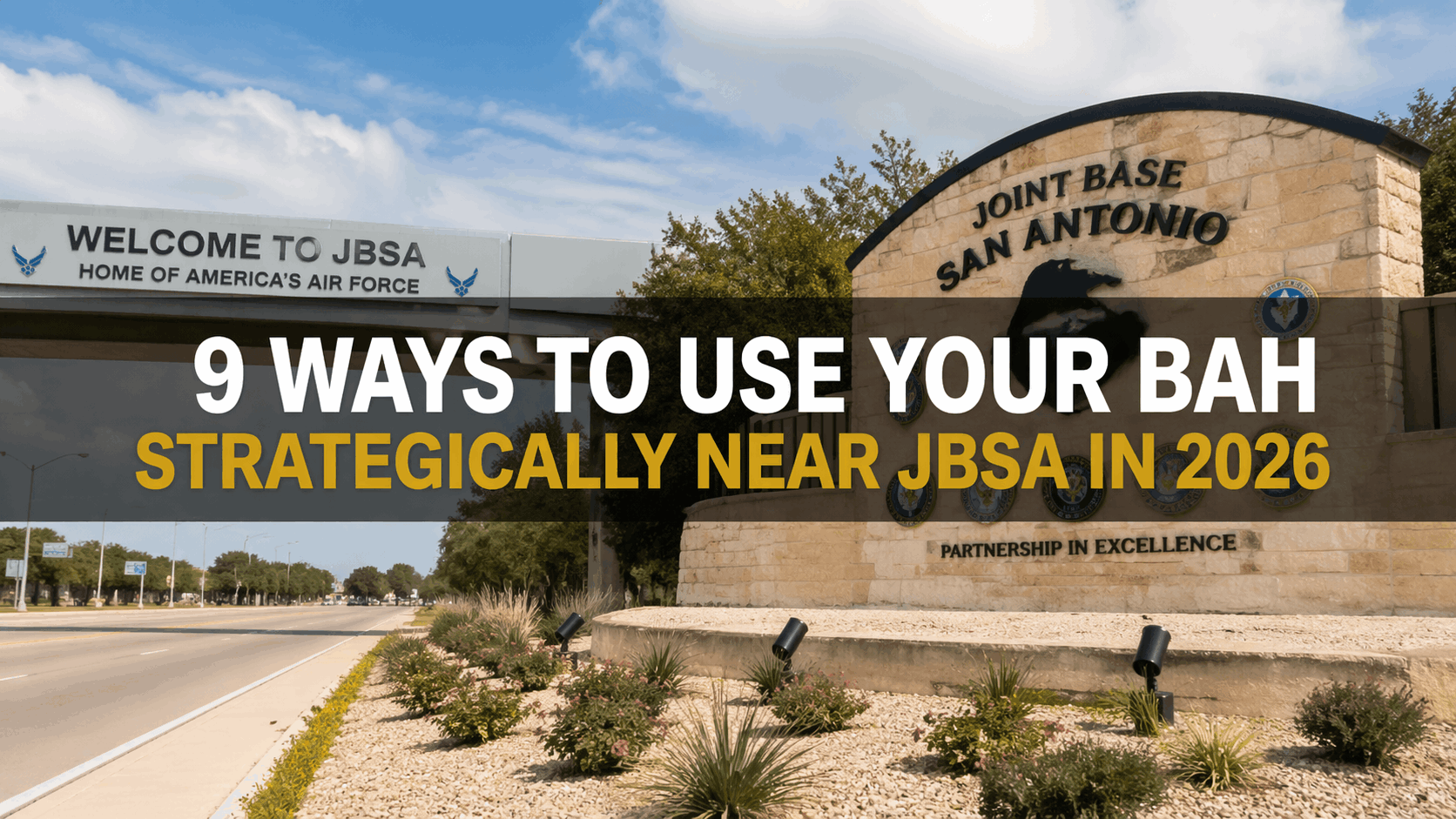
For military buyers relocating to Joint Base San Antonio, Basic Allowance for Housing is one of the most important financial tools in the homebuying process, and how strategically it is used has more impact on long-term financial outcomes than most buyers realize when they approach the purchase focused primarily on pre-approval amounts and purchase price. In 2026, with San Antonio's market offering more balanced inventory conditions, active builder incentive programs, and interest rate structures that reward deliberate financing strategy, the buyers who use BAH as a planning framework rather than simply as a budget ceiling consistently achieve better monthly affordability, stronger equity positions, and more successful transitions than those who treat it as a passive income figure. Tami Price, REALTOR®, a San Antonio real estate professional and Air Force veteran with nearly two decades of local market experience, notes that BAH-informed homebuying decisions near JBSA require integrating the allowance into every dimension of the purchase, from price range calibration through financing structure, closing cost management, and long-term exit strategy.
BAH rates for JBSA-area buyers are calculated based on rank, dependency status, and duty station location, and they are designed to reflect the cost of housing in the local market at a defined standard. Understanding how current BAH levels interact with total monthly housing cost, including principal, interest, property taxes, insurance, and HOA fees in the specific communities most relevant to each installation, is the financial foundation that makes every subsequent homebuying decision more grounded. For military families evaluating homes near Fort Sam Houston, Lackland Air Force Base, and Randolph Air Force Base, the nine strategies below represent the most effective ways to use BAH with intention in the current market environment.
Why Does BAH Strategy Matter More in San Antonio's 2026 Market Than in Prior Years?
The peak market years rewarded military buyers who acted quickly and accepted the monthly payment that came with compressed timelines and limited options, because the inventory scarcity made deliberate payment optimization difficult. The more balanced 2026 environment gives JBSA buyers more time to evaluate options, more negotiating leverage to structure financing terms that improve monthly affordability, and more builder incentive programs that directly reduce the effective monthly cost of new construction relative to what the purchase price alone would suggest. That combination of improved conditions and available tools means that buyers who develop a BAH-informed strategy before the search begins can achieve materially better monthly affordability outcomes than those who simply search within a lender-approved price range without the strategic framework that BAH planning provides.
The nine strategies below work together rather than independently, and buyers who apply multiple strategies simultaneously rather than selecting only the most immediately relevant one consistently achieve the best outcomes. A buyer who uses BAH to set their payment target, leverages builder incentives to reduce that payment below market rate, preserves savings through VA loan benefits, and incorporates exit strategy planning from the beginning has built a comprehensive financial framework that protects their position across the full ownership period, not just at the closing table.
1. Should I Set My Price Range Based on My BAH Payment Target Rather Than My Pre-Approval Ceiling?
Lender pre-approval establishes the maximum loan amount a buyer qualifies for based on income, debt, and credit profile, but the maximum qualification and the optimal purchase price are rarely the same number, and military buyers who anchor their search to the pre-approval ceiling rather than to a payment target that aligns with their BAH sometimes commit to a monthly obligation that strains the budget in ways that did not appear in the qualification calculation. BAH provides a natural and practical monthly payment benchmark that reflects the Department of Defense's assessment of appropriate housing cost for a specific rank and family configuration, and using it as the upper boundary of comfortable monthly cost produces a more sustainable homeownership experience than maximizing the loan the lender will approve.
The total monthly housing cost that a buyer should model against BAH includes principal and interest on the loan, monthly property tax escrow contribution, homeowners insurance escrow contribution, and HOA fees where applicable. In San Antonio, where property tax rates between 2 and 3 percent of assessed value add meaningfully to monthly cost beyond the mortgage payment, a buyer whose BAH fully covers the principal and interest but does not account for the tax and insurance escrow may discover post-closing that the total obligation exceeds what the allowance comfortably covers. The practical approach is to work backward from the BAH amount to identify the maximum loan payment that leaves room for taxes, insurance, and a maintenance reserve, and then use that payment target to identify the purchase price range rather than starting with the pre-approval ceiling and hoping the total cost fits within BAH.
Q: How do I calculate whether my BAH will cover the full monthly housing cost for a specific San Antonio home?
A: Request the actual property tax rate for the specific address from your agent, obtain a homeowners insurance quote for the property type and location, confirm any HOA fee from the community's governing documents, and add those figures to the principal and interest payment from your lender's amortization schedule for the proposed loan amount. The sum of those four figures represents the total monthly housing obligation that should be compared against the BAH rate for your rank, dependency status, and JBSA duty station. If the total exceeds BAH, the gap represents the out-of-pocket monthly contribution the home requires beyond the housing allowance.
2. How Can BAH Help Military Buyers Offset the Impact of 2026 Interest Rates?
Interest rates directly affect the monthly payment required to carry any specific purchase price, and in 2026's rate environment, the gap between a buyer's ideal monthly payment and what market rates produce at their target purchase price is one of the most common financial challenges JBSA buyers face. BAH strategy applied to rate management means using available financing tools to bring the effective rate, and therefore the monthly payment, into alignment with the BAH target rather than accepting the market rate as a fixed constraint. Several tools are available in the current San Antonio market that accomplish this objective with varying degrees of long-term financial impact.
Strategies that reduce effective monthly payments and keep them closer to BAH targets include:
- Seller-funded rate buydowns negotiated as part of the purchase offer, which reduce the interest rate for a defined period or permanently and directly lower the monthly payment
- Builder-funded rate buydown programs in new construction communities, which often produce rates meaningfully below current market levels through the builder's preferred lending partner
- Seller concessions applied to closing costs rather than price, which preserve more of the purchase price value while reducing the cash required at closing and allowing the buyer to preserve BAH for ongoing housing costs
- Adjustable-rate structures for buyers who are confident in a defined short holding period and can accept rate adjustment risk in exchange for a lower initial rate
For VA loan buyers evaluating rate buydown options, comparing the builder's incentivized rate through their preferred lender against an independent VA lender's standard terms, with the buydown cost factored into the comparison, is the only reliable way to determine which financing path produces the better long-term outcome for the specific purchase scenario.
3. How Should JBSA Buyers Evaluate Builder Incentives Relative to BAH?
Builder incentive programs near JBSA installations can meaningfully extend BAH's effective reach by reducing the monthly payment below what the purchase price alone would suggest, and for buyers whose BAH falls slightly short of covering the total monthly cost at desired price points, a well-structured builder incentive can bridge that gap without requiring the buyer to compromise on the home's size, location, or quality level. San Antonio builders in 2026 are actively offering closing cost assistance, rate buydown programs, and design center credits that directly reduce either the monthly payment or the cash required at closing, and these programs deserve explicit evaluation against BAH targets rather than being treated as incidental bonuses on top of the purchase decision.
The evaluation framework that produces the most accurate assessment of a builder incentive's value compares the total monthly cost of the incentivized new construction option against the total monthly cost of a comparable resale home at a similar purchase price without the incentive, using actual tax rates, insurance quotes, and HOA fees for each specific property rather than general estimates. A builder rate buydown that reduces the effective rate by one percentage point on a $400,000 loan produces a monthly payment reduction of approximately $250, which represents meaningful BAH alignment improvement that may not be achievable through resale purchase alone. The key qualifier is that some builder incentives require using the builder's preferred lending partner, and military buyers should confirm that the incentive is available for VA financing specifically before incorporating it into the BAH planning calculation. For a complete framework on evaluating new construction in San Antonio, that resource covers the full comparison approach that produces the most accurate total cost picture.
Q: Are builder rate buydown incentives near JBSA available to VA loan buyers or only to conventional financing buyers?
A: Most builder incentive programs are available to VA buyers, though the specific terms can vary by builder and community. Some rate buydown programs are structured specifically around the builder's preferred lender's conventional products, which may mean the advertised program does not apply in the same form to VA financing. Confirming incentive availability for VA buyers specifically, and comparing the builder's preferred VA terms against independent VA lender alternatives, ensures that the monthly payment calculation used for BAH comparison reflects what is actually achievable rather than what is advertised for a different financing type.
4. How Should BAH-Informed Buyers Evaluate the Commute vs. Cost Tradeoff Near JBSA?
Homes closer to JBSA installations often carry price premiums that reflect their proximity and convenience, and buyers whose BAH supports a comfortable monthly payment at that premium may reasonably prioritize proximity. However, buyers whose BAH alignment requires a lower purchase price frequently find that expanding the search area to less proximate communities produces homes with better size, features, or construction recency at monthly payments that fit within the allowance more comfortably. The commute versus cost tradeoff is not a simple calculation, because commute time has financial implications in fuel cost and vehicle wear as well as quality-of-life implications in daily operational stress and family time.
The most productive way to evaluate this tradeoff combines a realistic assessment of actual commute time during shift-change traffic from each community under consideration to the relevant installation gate, which Tami Price provides for remote buyers who cannot drive the routes in person, with a total monthly cost comparison that includes the payment difference between the proximate and more distant options. In some cases, the monthly payment savings from a community that is 15 minutes further from the installation justifies the commute addition clearly. In others, the payment difference is small enough that proximity's quality-of-life benefit produces a better overall outcome. Communities like Cibolo and Schertz near Randolph, and far west San Antonio communities near Lackland, each represent different points on the commute-cost spectrum that deserve specific evaluation against each buyer's BAH target and daily schedule rather than a general preference applied without the supporting data.
5. How Should Military Buyers Plan BAH Use Around PCS Timing and Housing Transitions?
PCS moves involve a transition window during which BAH continues but housing obligations from the prior station may overlap with the new station's housing costs, and military buyers who do not plan for this overlap explicitly sometimes find themselves managing unexpected out-of-pocket expenses during the transition period that a small amount of advance planning would have prevented. The overlap between a lease termination date and a new home's closing date, or between temporary lodging at the new station and the closing date of a purchased home, represents a period where BAH is being consumed by transition costs rather than applied toward the stable housing the purchase is intended to provide.
Specific transition cost categories that deserve explicit BAH planning include:
- Temporary lodging or short-term housing near JBSA during the period between arrival and closing on a purchased home
- Lease termination costs at the prior duty station if the lease end date does not align cleanly with the departure date
- Overlap costs when a home sale at the prior station closes after the buyer has already taken possession of the San Antonio property
- Moving and storage costs that represent cash outlays during the transition period before BAH is fully redirected to the new housing obligation
Buyers who model the complete transition timeline from final day at the prior station through the first full month in the new San Antonio home, with all overlapping housing costs identified and budgeted specifically, arrive at the closing process with a financial picture that does not produce surprises. For a comprehensive framework on PCS planning for JBSA relocation, that resource covers the full transition coordination approach that keeps BAH working efficiently throughout the move.
6. How Do VA Loan Benefits Amplify BAH's Effectiveness as a Homebuying Tool?
The VA loan and BAH work in combination to give JBSA buyers a financial advantage that most civilian homebuyers cannot access, and understanding how these two tools interact produces a more complete picture of what military homeownership actually costs on a monthly basis versus what renting costs at the same standard. The VA loan's no-down-payment feature preserves the savings that would otherwise be depleted by a down payment, which means the BAH covers the ongoing housing obligation without the buyer needing to liquidate savings that serve other financial goals. Combined with no private mortgage insurance and competitive interest rates, the VA loan structure means that a military buyer's effective monthly housing cost for a purchased home is often lower than a civilian buyer would pay for the same property under conventional financing.
The VA loan's assumable feature adds a long-term strategic dimension to the BAH planning framework that is particularly relevant for JBSA buyers who anticipate future PCS moves. A home purchased with a VA loan in 2026 at a specific interest rate carries that rate as an assumable obligation that a future buyer, whether veteran or civilian, may be able to take over rather than obtaining new financing at whatever rate prevails at the time of the future sale. If rates remain elevated or increase further by the next PCS, the assumable VA loan becomes a marketing asset that can accelerate the sale and support the home's resale value in ways that benefit the seller's equity position. For a detailed overview of how VA loan assumptions work for military sellers in San Antonio, that resource covers the full strategic picture that makes assumability a relevant consideration at the time of purchase rather than only at the time of sale.
Q: Should JBSA buyers use their full VA loan entitlement to maximize purchase price, or should they use BAH alignment as the limiting factor?
A: BAH alignment is the more financially sustainable framework for most military buyers. Maximizing the VA loan entitlement to reach the highest possible purchase price produces a monthly obligation that may exceed BAH, which means the buyer is using personal income rather than the housing allowance to fund the gap every month. That gap may be manageable when the assignment is stable, but it creates financial vulnerability if income changes, rates increase at refinance, or the assignment is shorter than expected and the home needs to be sold or rented before sufficient equity has accumulated. Using BAH as the payment ceiling and VA entitlement as the tool that enables the purchase within that ceiling produces a more durable financial outcome.
7. How Should Military Buyers Incorporate Home Maintenance and Operating Costs Into BAH Planning?
A common planning error among first-time military homebuyers is allocating the full BAH amount toward the mortgage, taxes, and insurance, leaving no room in the BAH framework for the ongoing maintenance and operating costs that homeownership requires. This planning gap does not create an immediate financial problem because maintenance costs are episodic rather than monthly, but it consistently produces the experience of feeling financially strained after the first significant repair or system replacement despite being technically within the original payment budget. The BAH planning framework that produces the most durable homeownership experience reserves a portion of the allowance for ongoing housing costs beyond the fixed monthly obligation.
A practical reserve planning structure for JBSA homeowners using BAH includes setting aside the equivalent of one percent of the purchase price annually for maintenance and repair, distributing that amount as a monthly contribution to a designated housing reserve account rather than treating it as available for other spending. On a $350,000 home, that represents $3,500 annually or approximately $290 per month that should be considered part of the total monthly housing cost when evaluating whether a specific purchase fits within BAH rather than treated as an optional contribution made only when a specific repair arises. Buyers who incorporate this reserve into the BAH comparison analysis before selecting a home consistently experience a more financially comfortable first year of ownership than those who discover the need for a maintenance reserve only when the first significant expense occurs.
8. How Can Military Buyers Near JBSA Use BAH to Support Long-Term Equity Goals?
Military homeownership near JBSA carries an equity-building potential that extends beyond the current assignment, and the most financially productive JBSA home purchases are those that are evaluated against long-term equity goals from the beginning rather than optimized only for the current assignment's requirements. A home purchased with BAH alignment in mind, in a neighborhood with strong rental demand and stable resale positioning, can transition from a primary residence to an income-producing rental at the next PCS and continue building equity through tenant payments rather than requiring the owner's cash flow to sustain it.
Specific equity planning questions that should inform the BAH-aligned purchase decision include whether the neighborhood's rental demand is strong enough to produce positive cash flow at projected rental rates after accounting for the full monthly carrying cost, property management fees, vacancy reserves, and maintenance reserves. They also include whether the home's location, floor plan, and school district position it to appreciate alongside or ahead of the San Antonio market over a typical PCS cycle of three to five years, and whether the VA loan's assumable feature could be leveraged at the time of the next sale to produce a faster, more competitive transaction. Military buyers who think through these questions before selecting a specific community and price range consistently make purchase decisions that serve their financial goals across multiple future PCS cycles rather than serving only the immediate assignment's housing needs.
9. How Should JBSA Buyers Align BAH Strategy With 2026 Market Conditions Specifically?
San Antonio's 2026 market conditions differ from the environment of prior years in ways that create specific strategic opportunities for BAH-informed buyers, and military families who adapt their approach to current conditions rather than applying strategies that were effective during the peak years consistently achieve better outcomes. The more balanced inventory environment means buyers have more time to evaluate options carefully, more negotiating leverage to structure favorable terms, and more ability to compare new construction and resale options side by side rather than being forced to act on whatever is available within a compressed timeline. These conditions favor the deliberate, BAH-aligned approach more than the urgency-driven approach that peak-year scarcity demanded.
Current 2026 market dynamics that JBSA buyers should incorporate into their BAH strategy include the increased prevalence of seller and builder concessions that can be structured to reduce monthly payment rather than simply lower purchase price, the longer days-on-market counts in many segments that provide more time for thorough financial analysis before committing, and the active builder incentive environment that rewards buyers who compare communities rather than committing to the first new construction community that meets basic criteria. Buyers who approach the 2026 market with the understanding that patience and comparison are now strategic assets rather than luxuries the market does not allow are positioned to use their BAH more effectively than those who carry the urgency posture of the peak years into a market that no longer requires it. Working with an experienced San Antonio military relocation agent who understands how BAH interacts with current market conditions produces the most actionable guidance for applying these strategies to each buyer's specific situation.
Expert Insight from Tami Price
BAH is one of the most powerful homebuying tools available to military families near JBSA, and it is also one of the most commonly underutilized when buyers approach it as a simple budget ceiling rather than as a strategic planning framework that should inform every dimension of the purchase decision. The buyers who build the most financial value from their JBSA assignments are those who treat BAH as the anchor for a comprehensive homebuying strategy, using it to calibrate payment targets, evaluate financing tools, assess the true cost of commute tradeoffs, plan transition overlap, and model long-term equity potential before any offer is made. Tami Price, REALTOR®, a USAF veteran and Military Relocation Professional with nearly two decades of San Antonio market experience, builds her military buyer consultations around exactly this BAH-informed framework, because she understands from personal experience that the housing allowance is not just a financial resource but a planning tool that, when used strategically, produces outcomes that extend well beyond the current assignment.
Her sustained work with JBSA-area buyers across Fort Sam Houston, Lackland Air Force Base, and Randolph Air Force Base gives her the installation-specific market knowledge that makes BAH strategy guidance genuinely applicable rather than generically useful. The goal of every military buyer consultation is to arrive at a purchase decision where the BAH framework, the VA loan benefits, and the current market conditions are all working together rather than being evaluated independently.
"BAH is not just the amount the military gives you for housing," says Tami Price, REALTOR®. "It is a planning framework, and the military families I see achieve the best long-term financial outcomes from their JBSA assignments are the ones who used it as exactly that. They built their payment target around it, they evaluated builder incentives through it, they planned their transition around it, and they selected their home with its long-term rental and resale potential in mind. That is what turns a PCS purchase into a genuine financial asset rather than just a place to live for the assignment."
Recognized as a RealTrends Verified top real estate agent in San Antonio, a 15-time Five Star Professional Award winner, and the recipient of more than 650 five-star reviews, Tami Price serves military buyers, VA buyers, and military families across San Antonio, Schertz, Cibolo, Helotes, Converse, and Boerne.
Three Key Takeaways
- Total monthly housing cost, not lender pre-approval ceiling, should be the framework that calibrates a JBSA buyer's price range, and BAH provides the natural benchmark for that calibration. Buyers who model the complete monthly obligation including property taxes, insurance, and HOA fees against BAH before beginning the search consistently achieve more sustainable monthly affordability than those who search at the pre-approval ceiling and discover the total cost only after committing to a specific home. This single planning shift produces better financial outcomes across the entire ownership period by preventing the monthly strain that misaligned payment targeting creates from the first month of occupancy.
- Builder incentive programs and seller-funded rate buydowns represent active tools for keeping monthly payments within BAH alignment at purchase price levels that would otherwise exceed the comfortable range, and military buyers who evaluate these tools explicitly against their BAH target before selecting a community consistently achieve better monthly affordability than those who treat incentives as incidental bonuses rather than strategic payment management instruments. The comparison that produces the most reliable answer models the total monthly cost of each incentivized and non-incentivized option specifically rather than comparing purchase prices or advertised rate headlines, and it should be completed before any community or property commitment is made.
- The long-term equity potential of a JBSA purchase, including rental viability at the next PCS and resale positioning within the San Antonio market, deserves as much attention as the immediate assignment's housing requirements when the BAH-informed purchase decision is being made. Military buyers who select homes with both current livability and future financial performance in mind consistently extract more long-term value from their JBSA assignments than those who optimize only for the current situation without evaluating the exit strategy. BAH-aligned homeownership that produces a positive-cash-flow rental at the next PCS turns a housing allowance into a compounding financial asset that builds value across the full arc of a military career.
Frequently Asked Questions
Q. How is BAH calculated for military buyers at JBSA, and where can I find the current rate for my rank?
A. BAH is calculated by the Department of Defense based on rank, dependency status, and duty station zip code, and it is designed to cover the median rental cost for housing appropriate to the service member's grade in the local market. Current BAH rates are published annually by the DoD and are available on the Defense Travel Management Office website. Your military finance office can confirm the specific rate applicable to your rank and dependency status at the JBSA duty station, which may differ from your current station's BAH if the two markets carry different housing costs.
Q. Can BAH be used as qualifying income for a VA loan?
A. Yes. BAH is treated as income for VA loan qualification purposes and contributes directly to the monthly income used to calculate debt-to-income ratios. Military buyers should confirm with their VA lender which BAH amount is used for qualification, specifically whether current station BAH or projected BAH at the new JBSA station is applied, because the two amounts may differ and the difference can affect the qualifying loan amount.
Q. What is the difference between BAH with dependents and BAH without dependents in San Antonio?
A. BAH with dependents is calculated at a higher rate than BAH without dependents for the same rank and duty station, reflecting the DoD's recognition that families with dependents require more housing space and typically face higher rental costs. The with-dependents rate applies to service members who have any dependent, including a spouse or qualifying child, and the without-dependents rate applies to single service members with no qualifying dependents. This distinction can affect the effective price range that BAH supports and should be confirmed before the search framework is established.
Q. How should a military buyer handle the situation where BAH does not fully cover the total monthly housing cost in San Antonio in 2026?
A. Several strategies can address this gap. Builder rate buydown programs and seller-funded concessions can reduce the monthly payment to within BAH range at higher purchase prices. Expanding the search area to communities with lower property tax rates or no HOA fees can reduce the non-mortgage components of monthly cost. Selecting a slightly lower purchase price within the target neighborhood reduces the loan payment. Or, in some cases, accepting a modest out-of-pocket monthly contribution to housing cost is a deliberate financial decision that the buyer makes with full awareness rather than discovering it as a surprise post-closing. The most important outcome is that the gap, if any, is known and planned for before closing rather than encountered unexpectedly.
Q. Should a JBSA military buyer use a VA loan even if they have enough savings for a conventional down payment?
A. In most cases, yes. The VA loan's combination of no private mortgage insurance, competitive rates, and the preserved savings that the no-down-payment feature provides produces a better financial outcome than using savings for a down payment on a conventional loan for most JBSA buyers. The saved funds can serve as a post-closing maintenance reserve, a bridge during transition periods, or the foundation for future investment rather than being committed permanently to a down payment. The exception may exist in specific situations where conventional financing produces materially better rate terms or where the specific property type is not eligible for VA financing, and those scenarios should be evaluated with a lender who has specific VA loan expertise.
Q. How does the VA funding fee affect the BAH strategy calculation?
A. The VA funding fee is typically financed into the loan rather than paid at closing, which means it increases the loan amount and the monthly payment rather than requiring an upfront cash outlay. Veterans with service-connected disability ratings of 10 percent or higher are exempt from the funding fee entirely, which represents meaningful savings both at the loan level and in the monthly payment comparison. Buyers should confirm their funding fee status with their VA lender early in the process and incorporate the accurate funding fee amount, or exemption, into the BAH-aligned monthly payment calculation to ensure the comparison reflects the actual loan terms.
Q. Can a JBSA buyer use their BAH to support both a home purchase and a rental property simultaneously?
A. BAH is intended to cover the service member's primary housing cost and is not designed to support simultaneous ownership of multiple properties. However, military homeowners who PCS out of a San Antonio property and convert it to a rental while using BAH at the new duty station to cover housing there are using the allowance appropriately for its intended purpose, which is housing at the current duty station. The rental income from the San Antonio property becomes a separate financial asset that supports the ongoing mortgage obligation while the owner receives BAH for housing at the new location.
Q. What should a JBSA buyer do if their BAH changes between the time they commit to a home purchase and their closing date?
A. Contact the lender immediately if a BAH change occurs between contract execution and closing, because BAH is part of the qualifying income calculation and a material change could affect loan qualification. In most cases, BAH changes that occur between offer acceptance and closing are upward adjustments tied to promotion or dependent status change that do not create qualification risk. Downward adjustments, which are less common mid-assignment, should be discussed with the lender promptly to understand any impact on the loan structure before the closing date.
The Bottom Line
BAH is more than a housing allowance for JBSA military buyers. It is a strategic planning framework that, when used intentionally across all nine dimensions in this guide, produces homeownership outcomes that extend well beyond the current assignment into long-term equity, rental income potential, and the financial compounding that deliberate military real estate strategy can produce across a full career. The buyers who achieve the best financial outcomes from their JBSA assignments are not those with the highest BAH rates but those who use the allowance they receive most strategically, aligning it with payment targets, financing tools, transition planning, maintenance reserves, and exit strategy from the first day of the homebuying process rather than discovering the full picture piece by piece after closing.
San Antonio's 2026 market conditions, with more balanced inventory, active builder incentive programs, and more negotiating leverage than the peak years provided, create a favorable environment for BAH-aligned military homebuying that rewards the deliberate, data-driven approach this guide describes. Military buyers who enter the search with a complete BAH-informed framework in place are positioned to make offers with confidence, structure financing that keeps monthly costs sustainable, and select homes that will serve both the current assignment and the financial goals that extend beyond it.
Military families planning a PCS move to Joint Base San Antonio in 2026 are encouraged to book a consultation before beginning the home search so that the BAH framework, VA loan strategy, and market conditions analysis are all in place before any community or property commitment is considered.

Contact Tami Price, REALTOR® | San Antonio, TX
Tami Price, REALTOR®, serves military buyers, VA buyers, and military families across San Antonio, Schertz, Cibolo, Helotes, Converse, and Boerne with nearly two decades of local market experience and specialized expertise in BAH-informed homebuying strategy, VA loans, PCS planning, and military relocation coordination.
📞 210-620-6681
🌐 TamiPrice.com
Tami Price's Specialties
- Buyer and Seller Representation
- Military Relocations and PCS Moves
- VA Loan Guidance
- New Construction
- First Time Home Buyers
- Move Up Buyers
- Downsizing and Rightsizing
- Strategic Pricing and Market Analysis
- San Antonio, Schertz, Cibolo, Helotes, Converse, and Boerne
Disclaimer
This blog is for informational purposes only and does not constitute legal, financial, or real estate advice. BAH rates, VA loan requirements, builder incentive programs, and market conditions are subject to change. Individual eligibility and circumstances vary. Readers should consult qualified professionals, including a VA-experienced lender and a licensed real estate agent, before making real estate or financial decisions. Tami Price, REALTOR®, is licensed in Texas and affiliated with Real Broker, LLC. Fair Housing principles apply to all content.
Categories
- All Blogs (643)
- Home Buying (21)
- Neighborhood Guides (41)
- 10 Incentive and Rate Buydown Questions (1)
- 10 Military Neighborhood (1)
- 10 Mistakes Sellers Make (1)
- 10 Strategies to Coordinate a Same Day Close (1)
- 12 Lifestyle Questions to Move In (1)
- 12 PCS What Ifs (1)
- 12 Photos and Marketing Assets (1)
- 13 PCS Hunting Trip Tips (1)
- 14 Design Center Decisions (1)
- 15 Red Flags Touring Home in San Antonio (1)
- 2026 Market (1)
- 30 days after closing your home (1)
- 7 Offer Terms Beyond Price (1)
- 7 VA Specific Questions (1)
- 78015 Ranked One (1)
- 8 Bridge (1)
- 8 Myths Buyers Believe about Down Payments (1)
- 8 Reasons VA Buyers Love New Construction (1)
- 9 Mistakes Move Up Buyers Make (1)
- 9 Questions to Decide If You Keep Your PCS Home (1)
- 9 Timeline Questions Every Buyer Need to Ask (1)
- 9 Warranty Questions to Ask (1)
- 9 Ways to Attract VA & Military Buyers (1)
- 90 days before your move (1)
- About Tami Price (6)
- Active Adult Homes (1)
- Affordable Communities (2)
- Affordable Homes (1)
- Affordable Housing & Community Development (3)
- Agent Qualifications and Credentials (1)
- Agent Qualifications and Experience (1)
- Agent Recognition (3)
- Agent Selection (1)
- AI and Real Estate Tools (1)
- Alamo Heights (4)
- Alamo Heights ISD (1)
- Alamo Ranch (2)
- Amenities in Helotes, Texas (3)
- Appraisals (1)
- Arts and Culture (1)
- Awards and Recognition (7)
- Balcones Creek (1)
- Best Neighborhoods to Live in Cibolo, TX (3)
- Best Neighborhoods to Live in San Antonio (15)
- Best Places to Live in Northeast Inner Loop: A Neighborhood Guide (1)
- Bexar County Property Tax (1)
- Bexar County Real Estate (3)
- Blue Tape Walkthrough (1)
- Boerne Home Sellers (1)
- Boerne Texas (4)
- Builder Contracts & Warranties (3)
- Builder Incentives (1)
- Builder Warranties (1)
- Buyer (64)
- Buyer Activity San Antonio (1)
- Buyer and Seller Guidance (3)
- Buyer Due Diligence (1)
- Buyer Education (45)
- Buyer Guide (9)
- Buyer Guides (7)
- Buyer Protection Strategies (1)
- Buyer Representation (1)
- Buyer Representation Expertise (1)
- Buyer Resources (91)
- Buyer Strategy (2)
- Buyers (13)
- Buyers Agent (1)
- Buying a Foreclosed Home in San Antonio (10)
- Buying a Home (4)
- Buying a Home in San Antonio (6)
- Buying Near JBSA (1)
- Buying Timeline (1)
- Buying vs Renting (1)
- Castroville, TX (8)
- Central Texas Growth (1)
- Choosing a Real Estate Agent (1)
- Choosing an Agent (1)
- Cibolo Communities (1)
- Cibolo Home Sellers (1)
- Cibolo TX (12)
- Client Reviews and Testimonials (1)
- Client Satisfaction (1)
- Client Stories (1)
- Client Testimonial (4)
- Clients review (4)
- Closing (1)
- Cobblestone (1)
- Comal County (1)
- Commercial & Retail Development (2)
- Commercial Development (1)
- Community (1)
- Community Development (2)
- Community Development and Real Estate (1)
- Community Guides (1)
- Community Investment Impact (1)
- Community Spotlights (1)
- Commuter Neighborhoods (1)
- Cons of Living in Helotes, TX (4)
- Conservation Communities (1)
- Contingency Questions (1)
- Converse Home Sellers (1)
- Converse Homes For Sale (3)
- Converse Real Estate (1)
- Converse TX (10)
- Cost of Living Guides (1)
- Cost of Living in San Antonio TX (23)
- Custom Homes (5)
- Davis Ranch (1)
- Days on Market (1)
- Down Payment Assistance (1)
- Downtown Revitalization (1)
- Downtown San Antonio (2)
- Dual Military (1)
- East Side Living (1)
- Economic Development (1)
- Education, Texas Hill Country (1)
- Emerald Pointe (1)
- Employment (1)
- Employment Corridors (1)
- Encino Forest (1)
- Equity and Pricing Strategy (2)
- Equity Q&A (1)
- Established Communities (3)
- Events in San Antonio (34)
- Expert Advice from Tami Price, Realtor® (7)
- Fair Oak Ranch (1)
- Family Homes (3)
- FAQ (1)
- Far Northwest San Antonio (1)
- Far West San Antonio (1)
- Farmer Markets in San Antonio (1)
- Fastest Growing Zip Codes in America (1)
- Featured Homes for Sale (2)
- Featured Properties (1)
- Final Walkthrough (1)
- Financial Planning (11)
- Financing Strategy (1)
- First Time Buyers (23)
- First Time Sellers (1)
- First-Time Buyers (6)
- First-Time Homebuyer Resources (4)
- First-Time Homebuyer Tips (2)
- First-Time Homebuyers (6)
- First-Time Investors (1)
- Fort Sam Houston (3)
- Fort Sam Houston Real Estate (1)
- Fort Sam Houston, TX (2)
- Fox Grove (1)
- FSBO vs Agent Representation (1)
- Future Rental (1)
- Gated Communities (5)
- Golf Communities (1)
- Great Northwest (1)
- Greater San Antonio Housing Trends (2)
- Greater San Antonio Real Estate (5)
- Growth and Development (11)
- HELOC (1)
- Helotes Home Sellers (1)
- Hill Country (1)
- Hill Country Communities (2)
- Hill Country Development (1)
- Hill Country Homes for Sale (1)
- Hill Country Real Estate (2)
- Hill Country Retreat (1)
- Historic Districts (5)
- Historic Neighborhoods (4)
- Holiday Guide (1)
- Home Buying (7)
- Home Buying Education (3)
- Home Buying Guide (7)
- Home Buying Process (8)
- Home Buying Strategy (2)
- Home Buying Tips (5)
- Home Energy Efficiency San Antonio (5)
- Home Financing (3)
- Home Improvement ROI (1)
- Home Inspections (3)
- Home Maintenance (1)
- Home Preparation (2)
- Home Pricing Strategy (14)
- Home Renovation for Resale (1)
- Home Selling (12)
- Home Selling Guide (12)
- Home Selling Strategies (3)
- Home Selling Strategy (3)
- Home Selling Tips (23)
- Home Staging and Updates (2)
- Home Values (2)
- Homebuyer Education (15)
- Homebuyer Resources (1)
- Homebuying Guide (1)
- Homebuying Tips (3)
- Homeowner (32)
- Homeowner Tax Benefits (1)
- Homeownership Costs (1)
- Homes for Sale (2)
- Homes for sale near Lackland AFB (2)
- Homestead amenities (1)
- Horizon Pointe (1)
- House Hunting Guide (1)
- Housing Development (1)
- Housing Market Updates (3)
- How to Buy a House in San Antonio TX (43)
- Hunters Ranch (1)
- Hybrid (1)
- In Person (1)
- Incorporated Cities (6)
- Industry News (2)
- Industry Recognition (1)
- Infrastructure & Growth Projects (2)
- Interest Rates (2)
- Invest in San Antonio (32)
- Investment Opportunities (1)
- Investment Property San Antonio (3)
- JBSA (8)
- JBSA Housing (11)
- JBSA Real Estate (2)
- JBSA Resources (7)
- Joint Base San Antonio (4)
- Joint Base San Antonio Housing (1)
- Judson ISD (2)
- Lackland AFB (5)
- Lackland AFB Housing (1)
- Land Use Planning (1)
- Lera MLS (15)
- Lifestyle & Community Growth (2)
- Lifestyle & Local Growth (1)
- Lifestyle Communities (1)
- Listing Preparation (1)
- Listing Strategy (1)
- Live Oak (1)
- Living in San Antonio, TX (44)
- Living Near Randolph AFB (5)
- Loan Programs (1)
- Local Development News (2)
- Local Market Insights (4)
- Local News Around San Antonio (1)
- Luxury Communities (3)
- Luxury Homes (4)
- Luxury Real Estate (2)
- MacArthur Park (1)
- Making Offers on Homes (1)
- Market Analysis (24)
- Market Conditions (47)
- Market Expertise (1)
- Market Insights (5)
- Market Strategy (2)
- Market Timing (2)
- Market Trends (6)
- Market Trends & Insights (2)
- Market Update (17)
- Market Update 2026 (1)
- Market Updates (16)
- Master Planned Communities (12)
- Medical Center Area Real Estate (1)
- Medina Valley ISD (2)
- Midtown Living (1)
- Military & Economic Impact (3)
- Military Buyers (3)
- Military Communities (1)
- Military Families (1)
- Military Family Resources (1)
- Military Homebuying (3)
- Military Homeownership (1)
- Military Housing (2)
- Military Housing Market in Texas (14)
- Military Life in San Antonio (2)
- Military Neighborhoods (1)
- Military PCS Relocations (3)
- Military Real Estate (2)
- Military Relocation (99)
- Military Relocation & VA Loans (10)
- Military Relocation San Antonio (4)
- Military Relocation Services (3)
- Military Relocation to San Antonio (46)
- Military Relocations (18)
- Military Relocations & VA Home Loans (5)
- MLS Accuracy & Data Transparency (1)
- Mortgage Programs (1)
- Mothers Day in San Antonio (1)
- Move to Boerne TX (15)
- Move to Castroville TX (9)
- Move to Converse TX (14)
- Move to New Braunfels (1)
- Move to North San Antonio (16)
- Move to San Antonio TX (64)
- Move to Selma TX (17)
- Move to Shertz TX (10)
- Move to Texas (45)
- Move Up Buyer Resources (1)
- Move Up Buyers (24)
- Move-In Ready Homes (3)
- Move-In Ready Homes San Antonio (2)
- Move-Up Buyers (2)
- Moving to Helotes, TX (14)
- Moving to San Antonio (61)
- MUD Taxes (1)
- Natalia Homes For Sale (1)
- Near East Side Living (1)
- Negotiation Strategy (2)
- Neighborhood Amenities (1)
- Neighborhood Guides (7)
- Neighborhood Spotlights (3)
- Neighborhoods near Randolph AFB (9)
- New Braunfels (4)
- New Braunfels Homes For Sale (1)
- New Braunfels News (2)
- New Braunfels Real Estate (2)
- New Construction (62)
- New Construction Communities (1)
- New Construction Homes (12)
- New Construction Homes San Antonio (5)
- New Construction vs Resale (2)
- New Construction Without Customization (1)
- New Construction Without the Wait (1)
- New Contruction Cost (1)
- New Listing (13)
- News (21)
- News & updates (23)
- No City Tax (1)
- No HOA Homes (1)
- North Central San Antonio (5)
- North East ISD (4)
- North San Antonio (7)
- North Side Neighborhoods (1)
- North Side San Antonio Development (1)
- Northeast Inner Loop (1)
- Northeast Inner Loop Neighborhoods (1)
- Northeast San Antonio (1)
- Northside ISD (5)
- Northwest San Antonio (6)
- Northwest San Antonio Real Estate (2)
- Northwood (1)
- Olympia Hills (1)
- One-Story Homes (1)
- Outdoor Living (1)
- PCS and JBSA (2)
- PCS checklist (1)
- PCS Guide (4)
- PCS Moves (12)
- PCS Moves to Joint Base San Antonio (4)
- PCS Planning (16)
- PCS Randolph AFB (15)
- PCS Relocation (1)
- PCS Resources (6)
- PCS San Antonio (42)
- PCS to San Antonio (38)
- PID Assessments (1)
- Pinon Creek (1)
- Pipe Creek (1)
- Places to Eat Near Randolph AFB (1)
- Pool Homes (1)
- Pre Approval (1)
- Pre-Listing Preparation (2)
- Pre-Listing Process (1)
- Prescott Oaks (1)
- Preserve at Medina (1)
- Pricing and Marketing Strategy (3)
- Professional Awards and Achievements (2)
- Professional Real Estate Representation (1)
- Property Tax Exemptions Texas (1)
- pros and cons living in Converse TX (3)
- Pros and Cons Living in Selma TX (6)
- Pros and Cons of Living in Castroville, TX (4)
- Pros and Cons of Living in San Antonio (30)
- PT500 List (1)
- Purchase Negotiation (1)
- Quick Close Real Estate (1)
- Randolph AFB Neighborhoods (2)
- Real Estate (1)
- Real Estate Advice (1)
- Real Estate Agent Recognition (6)
- Real Estate Agent Selection (2)
- Real Estate Agent Value (1)
- Real Estate Consultation (1)
- Real Estate Finance (1)
- Real Estate Financing (1)
- Real Estate Impact (1)
- Real Estate Investment San Antonio (1)
- Real Estate Market Trends (3)
- Real Estate Professional Designations (1)
- Real Estate Strategy (1)
- Real Estate Technology & Trends (1)
- Real Estate Tips (1)
- Real Estate Tips and Guides (2)
- Real Estate Trends (2)
- RealTrends Verified (1)
- Relocating to San Antonio (2)
- Relocation (4)
- Relocation Resources (2)
- Relocation to San Antonio (49)
- Remote Homebuying (1)
- Rental Housing (1)
- Rental Property (1)
- Rental Strategy (1)
- Resale Properties (1)
- Retail Development (1)
- Retire in Boerne TX (10)
- Retire in San Antonio (31)
- Retirement Communities (1)
- Reviews and Recognition (1)
- Rockwall Ranch (1)
- Rural Living (2)
- Ryland Homes (1)
- SABOR (27)
- San Antonio Buyer Resources (2)
- San Antonio Communities (3)
- San Antonio Community Events (1)
- San Antonio Growth (1)
- San Antonio Home Buying and Selling (2)
- San Antonio Home Buying Guide (5)
- San Antonio Home Improvement (1)
- San antonio home prices (3)
- San Antonio Home Sellers (3)
- San Antonio Homeowner Guide (1)
- San Antonio Homes for Sale (13)
- San Antonio Housing Market (2)
- San Antonio Housing Market & Mortgage Financing (1)
- San Antonio Housing Market Analysis (1)
- San Antonio Housing Trends & Market Analysis (3)
- San Antonio Lifestyle Amenities (1)
- San Antonio Listing (1)
- San Antonio Living (1)
- San Antonio Market (3)
- San Antonio Market Updates (7)
- San Antonio Military Relocation (3)
- San Antonio Neighborhoods (48)
- San Antonio New Construction & Master-Planned Communities (2)
- San Antonio New Home Communities (1)
- San Antonio News (22)
- San Antonio Property Taxes (2)
- San Antonio Real Estate (163)
- San Antonio Real Estate Agents (6)
- San Antonio Real Estate Excellence (1)
- San Antonio Real Estate Guide (6)
- San Antonio Real Estate Market (32)
- San Antonio Real Estate Market Analysis (2)
- San Antonio REALTOR Awards (1)
- San Antonio Seller Resources (2)
- San Antonio Sellers (1)
- San Antonio Spec Homes (1)
- San Antonio Spurs Community Programs (1)
- San Antonio Urban Living (1)
- Scenic Loop (1)
- Schertz Home Sellers (1)
- Schertz Real Estate (1)
- Schertz, TX (11)
- School Information (1)
- SCUCISD Schools (1)
- Secured Quick Offer (1)
- Sell Home In San Antonio TX (50)
- Seller (50)
- Seller Education (24)
- Seller Guide (4)
- Seller Guides (1)
- Seller Representation Expertise (1)
- Seller Resources (69)
- Seller Should Understand (1)
- Seller Strategy (3)
- Seller Tips (2)
- Sellers (10)
- Selling A Home in San Antonio (49)
- Selling Your San Antonio Home (3)
- Selma TX (9)
- Single-Story Homes (4)
- Smart Homes (1)
- Solar Homes (3)
- Southtown (1)
- Spec Homes and Inventory Homes (2)
- Stone Oak (2)
- Suburban Housing Growth (2)
- Suburban Living (2)
- Talise De Culebra (1)
- Terrell Hills (2)
- Texas Acreage Properties (4)
- Texas Homestead Exemption (1)
- Things to do in San Antonio TX (16)
- Things to do Near Randolph AFB (3)
- Time Planning (1)
- Time-Sensitive Home Buying (1)
- Timing Strategy (1)
- Tips for Buying New Construction (9)
- Top Real Estate Agent in San Antonio (3)
- Transaction Coordination (1)
- Transportation Infrastructure (1)
- Two-Story Homes (2)
- Universal City (1)
- Updated Homes (2)
- Upscale Communities (1)
- Urban Communities (2)
- Urban Living (1)
- Urban Neighborhoods (4)
- VA Buyers (1)
- VA Home Loan Benefits (3)
- VA Loan Assumptions (3)
- VA loan benefits (27)
- VA Loan Guidance (1)
- VA Loan Home Buying Assistance (2)
- VA Loans (71)
- VA Loans and Military Benefits (3)
- VA Loans and Military Home Buying (3)
- VA Loans San Antonio (41)
- VET Benefits Living in San Antonio (3)
- Veterans Resources (3)
- Village Northwest (1)
- Virtual Buyers (1)
- Von Ormy Homes For Sale (1)
- week in sales (40)
- Weekly Sales Report (41)
- West San Antonio (2)
- West San Antonio Real Estate (1)
- Westover Hills Employment Corridor (1)
- Westover Valley (1)
- Windcrest Homes for Sale (1)
Recent Posts